
Top prehistoric sites to visit in The Netherlands
Submitted by Andy B on Thursday, 25 October 2018 Page Views: 13858
Neolithic and Bronze AgeCountry: Netherlands Province: Drenthe Type: Passage GraveInternal Links:


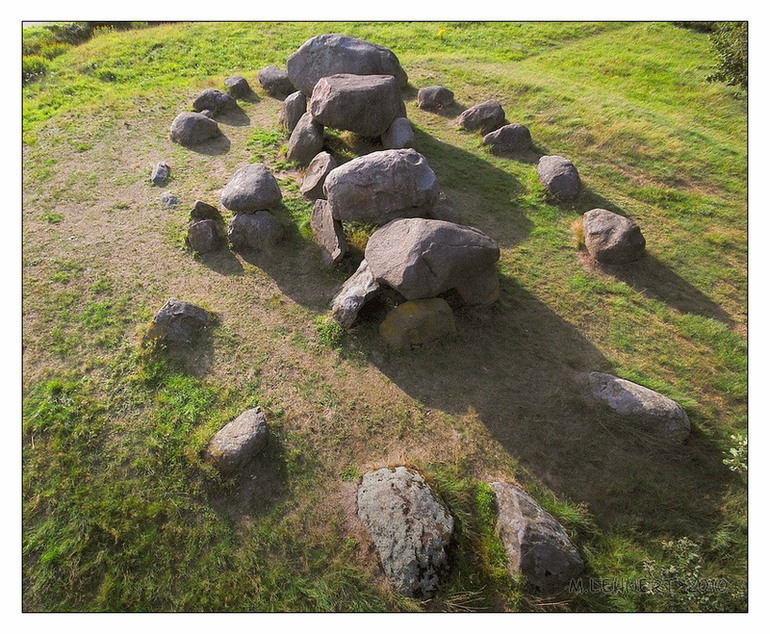
Otherwise known as passage graves, this type of megalithic site is relatively common in Holland, Denmark and Germany, but not seen at all in this form in Britain or Ireland.
So here is our run-down of the top hunebedden - worked out in the same way as the top lists in our Old Stones Book, so looking at a combination of popularity with our visitors, and ‘attractiveness’ if you will. Let’s have a closer look at our top five:
1. D15 Loon
Just out of the village of Loon, and only one field width away from the railway track this site has tons to see. This hunebed is complete with its outer circle and entrance. Originally, a mound covered the whole monument, which was removed in 1870, this is why the surrounding stones are intact. D15 is a lovely example to start a tour of the 50+ hunebedden in this part of the Netherlands. As at several other sites the westernmost capstone is the largest.
2. D50 Noordsleen
Well signposted from the village of Noordsleen near Emmen, this passage grave is again complete with its kerbstones (pictured right). Close by to the south-west is its neighbour, known as D51. This is rather wrecked but still impressive and worth a visit alongside this one.3. D14 Eexterhalte
This hunebed is a monster at 18 metres long. Easy to find, too. The chamber of this large passage grave originally had nine capstones, six of which are still in position. While the central and eastern parts are very well preserved the western end is more damaged. (pictured below left)4. D45 Emmen
This is a magnificent hunebed and quite close to the main railway station at Emmen, but still quite hard to find in the Emmerdennen woodland just to the east, right in the town. It’s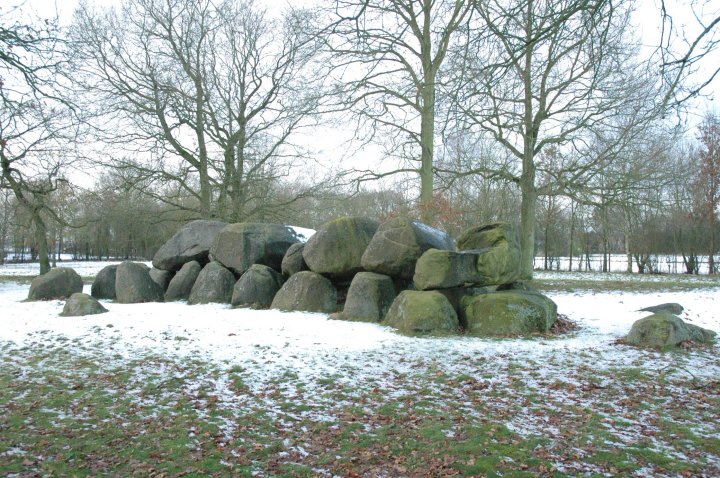 situated majestically on a small hilltop - which still has some remains of the eroded earthwork. The chamber measures approximately 18.5m long by a maximum of 4.5m wide. In 2011 one of the large capstones was vandalised, but has now been restored and placed back on its orthostats (the vertical stones which hold each side up)
5. D53 Havelterberg
Another of Holland’s classic hunebedden (pictured below right), but quite a long way west of most of the other sites. A grand site with its neighbour D54 a couple of hundred metres further up the lane to the east. They're worth a detour! The photo to the lower right is looking down the entrance passage - viewed from the south.How did these majestic dolmens get here? About 200,000 years ago, during the Ice Age, large parts of the Netherlands were covered with ice, including the area now known as Drenthe. These glaciers dragged huge boulders from Scandinavia across the land, taking thousands of years to make their way here.
 These stones were heaved and propped into the huge megalithic monuments we see today by the Funnelbeaker people (named because they made characteristic pottery in the shape of a funnel), starting around 5450 years ago. So earlier than the British dolmens and stone circles. Many of the archaeological papers about these sites are in Dutch, so a good translation service to translate Dutch to English accurately is recommended for more than just casual research.
So getting back to our list of the top sites to visit in the Netherlands, here’s the rest of the list:
6 D43 Emmen Schimmeres
7 D54 Havelterberg
8 D49 Schoonoord
9 D27 Borger (Holland’s largest passage grave)
10 D52 Diever
11 D16 Balloo
12 D12 Eext
13 D11 Anloo
14 D30 Exloo
15 D18 Rolde
There are around 50 hunebedden in total to visit, 52 in the province of Drenthe and 2 nearby in Groningen. Find them all on our full guide to ancient sites in the Netherlands here.
With many thanks to Sunflowerbird, Greywether, DutchTrans, and SolarMegalith for their assistance with this article.


 We would like to know more about this location. Please feel free to add a brief description and any relevant information in your own language.
 Wir möchten mehr über diese Stätte erfahren. Bitte zögern Sie nicht, eine kurze Beschreibung und relevante Informationen in Deutsch hinzuzufügen.
 Nous aimerions en savoir encore un peu sur les lieux. S'il vous plaît n'hesitez pas à ajouter une courte description et tous les renseignements pertinents dans votre propre langue.
 Quisieramos informarnos un poco más de las lugares. No dude en añadir una breve descripción y otros datos relevantes en su propio idioma.