
<< Feature Articles >> Some of the best ancient sites to see in Egypt
Submitted by Andy B on Tuesday, 16 October 2018 Page Views: 5529
Roman, Greek and ClassicalCountry: Egypt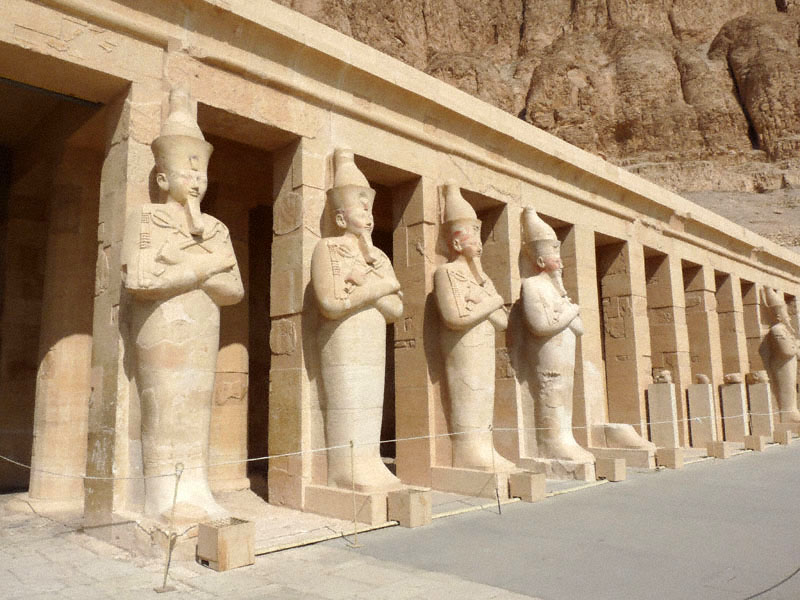
In this article, we’re going to look at a few of the best sites to visit, whether travelling by land or through one of the many Nile cruises offered in the area.
The Temple of Hatshepsut, also commonly referred to as the Deir el-Bahr temple, is located right opposite Luxor city. The temple was erected in the 15th century BC by pharaoh Maatkare Hatshepsut in honour of Amun, who was the chief deity of Thebes at the time.
The temple was influenced by the earlier Deir el-Barhi temple and borrows many of its architectural elements. The temple is built on three terraced levels with a massive 100-foot causeway that leads all the way to the top of the temple. You can also see pictures illustrating different important events of the late female pharaoh Hatshepsut on the walls surrounding the temple.
 The Karnak Temple complex, near Luxor, is the biggest temple complex on the bank of the Nile and one of the most popular to visit. It’s the second biggest temple complex of its kind in the entire world, stretching over 100 hectares, and was originally referred to as ‘Ipet-isut’ which means ‘most sacred places’ in ancient Egyptian.
Some of the best known temples were built in dedication to Mut, Khonsu, and Amun Ra, three important deities in the ancient Theban pantheon. Three massive statues dedicated to these deities were sailed all the way to the location through the Nile.
The complex was built using sandstone in the 14th century BC, and then reconstructed by the ancient Greeks after many years in disrepair. The complex has many open areas to visit and all were used as worship sites for different deities during the New Kingdom period. You can see great pylon towers depicting scenes of military triumphs by various pharaohs. The three remaining statues of prince Ramses (of an original six) at the entrance of the complex are an absolute must as well.
The precinct of Amun-Re, or Amun-Ra was built in dedication of the ancient god Amun, merged with the sun-god Ra. This temple contains colossal statues, tall columns and tapering monuments weighing over a ton each. A must see for any megalith lover.
 We can’t talk about the Valley of the Kings without including the Luxor Temple. The Luxor temple was not dedicated to a cult god or a deified version of the king in death, but instead dedicated to the rejuvenation of kingship; it may have been where many of the kings of ancient Egypt were crowned.
Set up on the straight avenue between Karnak and Luxor Temple were six shrines set up to the barques (sailing boats) of the gods. The 2.5km avenue was lined with human-headed sphinxes, although these may have replaced earlier sphinxes with different heads.
The main Luxor Museum , which has a separate entrance fee, is about a kilometre to the north-east.
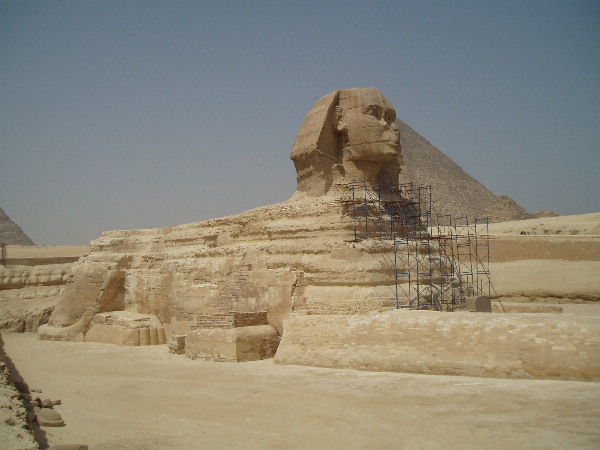 Commonly referred to as just ‘The Sphynx’, the Great Sphynx of Giza is often one of the first things people think of when they picture Egypt, and one of the eight wonders of the ancient world.
A giant limestone statue, the Sphynx depicts a mythical creature that has the head of a human and the body of a lion. It measures over 70 metres long and around 20 metres high, and is a very popular site, included in many tours.
Located at the Saqqara Necropolis, the Step Pyramid of Djoser was built during the 27th century BC. It is believed to be the first pyramid ever erected by the Egyptians and was built by Imhotep as a burial site for Pharaoh Djoser.

This ancient pyramid stands 60 metres high, although the burial chambers are actually located underground, through a maze of tunnels. It was built throughout the Djoser’s life, originally starting as a flat roofed mastaba, and ending up as a six-stepped pyramid.
Egypt is a country of many wonders, and these sites are just a few of the best. There are many hundreds of temples and pyramids to explore - have a look at the nearby sites listed on the pages linked from above, and also our detailed site listings for more
With many thanks to Alex Hunger, David Morgan, Memphis Tours, Swinside and the many others who have assisted with this article and sent in photos and information from Egypt.


 We would like to know more about this location. Please feel free to add a brief description and any relevant information in your own language.
 Wir möchten mehr über diese Stätte erfahren. Bitte zögern Sie nicht, eine kurze Beschreibung und relevante Informationen in Deutsch hinzuzufügen.
 Nous aimerions en savoir encore un peu sur les lieux. S'il vous plaît n'hesitez pas à ajouter une courte description et tous les renseignements pertinents dans votre propre langue.
 Quisieramos informarnos un poco más de las lugares. No dude en añadir una breve descripción y otros datos relevantes en su propio idioma.