Featured: Exploring Avebury: The Essential Guide - New Expanded Edition!

Exploring Avebury: The Essential Guide - New Expanded Edition!

Random Image

John Michell: From Atlantis to Avalon

John Michell: From Atlantis to Avalon

Login

Register here - as a registered user you get more features and fewer ads.

Who's Online

There are currently, 1218 guests and 1 members online.

Sponsors

<< Feature Articles >> The Great Stone Circles – How they Work Part 1

Submitted by JACKME on Monday, 30 November 2015  Page Views: 30083

Neolithic and Bronze AgeCountry: England County: Cumbria Type: Stone Circle

Internal Links:

Stonehenge, Jack Morris-Eyton
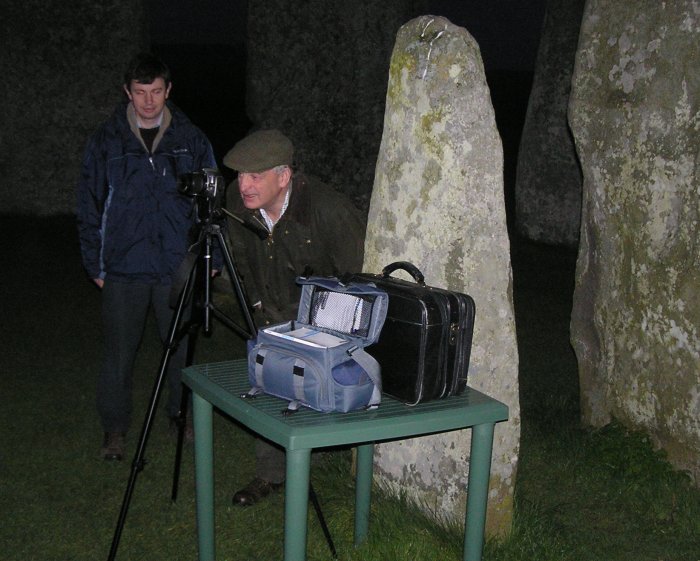
Stonehenge, Jack Morris-Eyton submitted by JACKME : Jack Morris-Eyton and son setting up his time-lapse photography equipment at a research session at Stonehenge, March 2005. Photo by Andy B. (Vote or comment on this photo)
Following 12 years of research visiting many of the circles in Britain and Ireland, Jack claims to have unravelled what no one else has done before - why, where and how the great stone circles worked. Jack does not profess to have the answers to all of the stone circle mysteries, indeed he admits himself there is still much to learn, but through the following series of articles he hopes to provide some possible answers to many intriguing questions.

Based on Research at Swinside by Jack Morris-Eyton

The contents page for the whole series is here.

I first began to take a serious interest in the Great Stone Circles after my wife and I watched the sunrise at Swinside on June 11th 1992. We had arrived at the circle far too early, but the wait was definitely worthwhile as we were eventually treated to a glorious sunrise that morning, an experience which was to lead to twelve years’ of research into how stone circles work.

As we watched the sun rising at Swinside that day, it soon became apparent that the centre of the circle was not the best place to see this event, as it did not line up with the entrance gateway. I therefore positioned myself in line with the entrance and moved around until I located the most suitable viewing point from where many of the stones lined up with features on the skyline, realising that the observations had to be made over two of the stones. Many people advocate making celestial observations from the unmarked centre of the circle, however this is clearly nonsense. A single aiming stone can be made to point to anything as the observer moves his head around.

This first visit inspired me to try and unravel the mystery of the stone circles, not by reading other people’s ideas about what they may have been used for, but by watching the sunrises and sunsets over the stones for myself. It was clear from the amount of effort invested in construction that these sites were not just built for fun, and so I hoped that as time went on I would come to discover how they worked. After a time I realised that there were many different types of circles and stone arrangements but I naturally concentrated on Swinside, being the nearest to my home.

Following initial investigations here, I began to look into the whereabouts of all the other stone circles in the county using John Waterhouse’s book ‘The Stone Circles of Cumbria’. This showed the sites at Bratts Hill and Elva Plain to be virtually True North of Swinside. Over the years I have also made use of Aubrey Burl’s book ´The Stone Circles of the British Isles’, to detect more interesting arrangements further afield. Unfortunately, I have only been able to inspect most of the distant circles on short day visits and it has not been possible to visit all of the sites, so there is a chance that some Great Stone Circle somewhere does not fit with the system.

Some people maintain that the alignments of the sun and moon at stone circles are all purely down to chance. However, during my research the same system has been found at many ancient sites all over the British Isles with similar shaped stones placed in the same key positions. What makes the system more complex is the fact that the stone circle builders appear not to have been too bothered whether a stone was used as a fore sight or a back sight and many of the stones act for both sun and the moon, making nothing simple. This research has produced spectacular results, unlocking the system used not only at Swinside and the other Great Stone Circles but also at other stone arrangements from Shetland to Brittany. Unfortunately I have yet to discover that at the famous stone rows of Carnac, although these do contain stones of the same shapes.

Research at Swinside

Swinside Stone Circle (SD172882) has been described by Aubrey Burl as ´one of the finest stone circles in Western Europe.’ I consider it to be the simplest and the most complete of the Great Stone Circles that I have visited. It holds the key to the understanding of all the others in this series of circles, namely circles normally comprising over forty stones built to indicate the sun and moon rises and sets over the full 18.6 years cycle of the moon.

Unfortunately many of the other circles are so incomplete or have suffered from such incorrect restoration that it would be impossible to figure out from scratch how these were supposed to work. Others have a quirk in the moon observations which it would be extremely difficult to understand without prior knowledge of Swinside. This does not mean that Swinside was built first, but that it is the only remaining circle in England, to my limited knowledge, with all of its elements more or less in place. Some of the stones were pushed over in the 19th century, ready for blasting by contractors building a new barn at Swinside Farm, however, when the estate owner was made aware of what was happening in a letter from his brother (dated 8th April 1808), he ordered the destruction to cease and the stones were pulled back into line over their sockets. All the surveys in my research have used only those stones which are still in the position they were when first erected.

The plan is to publish the results of 12 years’ research looking at all aspects of the Great Stone Circles and some other stone arrangements, which indicate sun or moon rises or sets, by posting a new article frequently on The Megalithic Portal. In order to show that what happens at Swinside is not purely down to chance or unique, comparisons will be made with other circles to demonstrate that the system I have discovered covers a large geographical area.

Throughout this series of articles an aerial photograph taken by Ed Cleasby from a microlite is used as the plan for Swinside - I have left a few cows in the picture to remind people that this is a photograph! The numbering applied is that which is commonly used, except that Stone number 25 does not exist (although it is shown on some plans) and there is no evidence of any stones having been removed since 1808. On some diagrams two stones are indicated (numbers 32 & 33), but from observation on site the socket looks as if only held one stone, although this can of course only be confirmed by excavation.

Read Part 2

The contents page for the whole series is here.

Jack Morris-Eyton sadly passed away in 2011 but his expanded research has been posthumously published in a book: Stone Circle Calendars: A New Understanding.

Note: To mark the anniversary of Jack Morris-Eyton's death, here is a reminder of Jack's series of nineteen articles, first published here in 2005.

<< A megalithic cycling tour of the Loire Valley

Top 5 things to do in Gran Canaria >>

Please add your thoughts on this site

Prehistoric Monuments of the Lake District

Prehistoric Monuments of the Lake District

Sponsors

More Feature Articles

See all Feature Articles →

Latest Visit Logs

  • Neonteikhos
    “This place actually used to be a major Aeolian city state in the region To get to the site, I par…”
    by longhintim · 13 Jul 2026
  • Assos Temple of Athena
    “The temple of Athena is at the acropolis. Apart from the temple of Athena, Assos is a quite large s…”
    by longhintim · 13 Jul 2026
  • Symi Castle
    “Requires a moderately steep climb to the castle. Not much ancient remains are visible, some medieva…”
    by longhintim · 13 Jul 2026
  • Mausoleum of Hecatomnus
    “The site and museum was open but access into the tomb was not when I visited”
    by longhintim · 13 Jul 2026
  • Incirliin Cave
    “Need to walk quite a bit of steps. More of a natural wonder with stalagmites and stalagtites than a…”
    by longhintim · 13 Jul 2026

"The Great Stone Circles – How they Work Part 1" | Login/Create an Account | 29 News and Comments
  
Go back to top of page    Comments are owned by the poster. We aren't responsible for their content.
Re: The Great Stone Circles – How they Work Part 1 by sem on Tuesday, 01 December 2015
(User Info | Send a Message)
Thanks for the reminder of this Andy.
I spoke to Jack the week before he died and he was very excited that photos I'd taken for him at Stonehenge earlier in the year confirmed something he'd long suspected. He said he'd get back to me on this, but alas he did not.
[ Reply to This ]
    Re: The Great Stone Circles – How they Work Part 1 by AngieLake on Tuesday, 01 December 2015
    (User Info | Send a Message)
    He was very grateful to you for that Sem. I'd told him you'd do a great job.
    [ Reply to This ]

Re: The Great Stone Circles – How they Work Part 1 by Bellchamber on Thursday, 12 September 2013
(User Info | Send a Message)
I'm so grateful that Mr. Morris-Eyton wrote and posted his research. I have just found it now! Sad he passed, but inspired to read!
[ Reply to This ]

Re: The Great Stone Circles – How they Work Part 1 by astronomer on Friday, 02 December 2011
(User Info | Send a Message)
Very sad news. I shared a very pleasant meal with Jack and Paul Morgan in a pub at Allgreave near Bullstones back in June 2005 when he was returning from Stonehenge. A nice man and extremely knowledgeable.
[ Reply to This ]

Re: The Great Stone Circles – How they Work Part 1 by Blingo_von_Trumpenstein on Friday, 02 December 2011
(User Info | Send a Message)
Sad news. His work has inspired many of us. My thoughts are with his family . . .
[ Reply to This ]

Re: The Great Stone Circles – How they Work - JackME's passing by AngieLake on Thursday, 01 December 2011
(User Info | Send a Message)
Sadly, on Tuesday 29th November 2011, Jack Morris Eyton passed peacefully away at his home in Cumbria.
A kind and jolly man, with ever-questing personality, he will be much missed, and we are thankful for his generosity in sharing so much of his painstaking research.
I shall think of him especially around Swinside and Stonehenge.
Maybe he will know all the answers now.....
[ Reply to This ]

Re: The Great Stone Circles – How they Work by Anonymous on Monday, 20 June 2005
Jack,
I spoke at length with Professor Aubrey Burl (the worlds leading expert on stone circles) yesterday and made him aware of your work. He seemed very interested and I suspect he will be in touch with you soon. Great things come to those who wait!! He was a lovely chap and had lots of time to talk megaliths after his opening of the portal stones and new path at the Rollright Stones. Overall a magical weekend and a super way to spread the word on your findings.

Have a truly magical solstice

Guybongo ([email protected])
[ Reply to This ]

Re: The Great Stone Circles – How they Work by JACKME on Monday, 23 May 2005
(User Info | Send a Message)
Thanks. Please follow the articles, and go and see for your self. JACKME
[ Reply to This ]

Re: The Great Stone Circles – How they Work by astronomer on Monday, 16 May 2005
(User Info | Send a Message)
Excellent article. Brave man, Jack. I wholly endorse your enthusiasm but please dont read too much into alignments across pairs of stones. There are just too many possibilities and that is why archaeoastronomy is mistrusted by the experts.

I hate solar alignments at prehistoric sites, but having found several I only accept the most obvious ones where the alignment is a simple line between a clearly defined backsight and an obvious horizon feature. Remember, too, that changing obliquity of the ecliptic has to be taken into account (not precession) so present-day solar and lunar alignments wouldn't have worked 3000 years ago.
[ Reply to This ]

Re: The Great Stone Circles – How they Work by LionsFan on Saturday, 14 May 2005
(User Info | Send a Message)
If you're right with your theory, sounds great. But there've been lots of "theories" before. Still, I wait to see the evidence. Good luck, but some acknowledgement of Thom might also be nice here.
[ Reply to This ]

Re: The Great Stone Circles – How they Work by sem on Saturday, 14 May 2005
(User Info | Send a Message)
I know the Portal caters for all types, many with vastly different ideas to my own, but was it really neccessary to allow this.
I would like to ask the authors just two questions ( but many more could be asked ).
1) As stonehenge as we know it was built over a period of approx 1000yrs, was this grid thing built by trial and error? I can just imagine Ug (a denizen of the old world) asking his neighbour " My ancestors have just spent 700yrs hauling stones here to stop this flat thing we live on floating up to the heavens, are you now telling me it won't work until I've hauled some more? I'm voting Neanderthal next year. Hunting and gathering for all was their promise."
2) As someone who has a hobby of scuba diving, why hadn't I noticed or been taught (he asks sarcastically) that extremely low and high tides ( called spring tides ) follow a full moon?
Come on chaps, surely the Portal is worth more than this?
[ Reply to This ]

Re: The Great Stone Circles – How they Work by Anonymous on Friday, 13 May 2005
Something(s) to consider:

http://www.templeofsakkara.com/menuframe.htm

RE: Knights Templar & Holy Grid, Holy Grail

An Open Letter (to be shared):

Holy Grid, Holy Grail
by Rev. Mary Hardy, Ph.D.

This is an open letter to all those who wish to understand the grid and how it can be reconstructed to save the planet during the Earth chages reported in Revelation and now predicted by El Nino due to the warming trend of the planet.

r.gif (124 bytes)ecently, my husband Dean and I, and two other travellers, Virginia Lonesky and Joanne Sibley, traveled for 17 days in the UK. We visited Stonehenge, Avebury, and many sacred sites in Scotland, and England. There is much I learned on my trip, and I am very grateful. For a long time, I have had a calling to put together the history of the Earth in relationship to the gridlines, called the Holy Grail. For whomever controls the grid, controls the consciousness of humanity. All of this unique engineering known as the grid,...

Read the rest of this post...
[ Reply to This ]
    Re: The Great Stone Circles – How they Work by hamish on Sunday, 15 May 2005
    (User Info | Send a Message)
    Now theres a thing, I didn't know it was David that brought down the walls of Jericho. Has "history" been rewritten?
    [ Reply to This ]

Re: The Great Stone Circles – How they Work by sem on Wednesday, 11 May 2005
(User Info | Send a Message)
Fantastic. It's good to hear of someone putting some serious legwork in. Personally I believe the astronomical alignments were very simple with many other factors contributing to the construction of circles. However I look forward to being proved wrong in future instalments.
Well done
Sem
[ Reply to This ]

Re: The Great Stone Circles – How they Work by JACKME on Tuesday, 10 May 2005
(User Info | Send a Message)
Thank you. You didn't waste much time. Dad.
[ Reply to This ]

Re: The Great Stone Circles – How they Work by Anonymous on Tuesday, 10 May 2005
Congratulations Dad! Look forward to reading the next installment.
Mel
[ Reply to This ]

Re: The Great Stone Circles – How they Work by AngieLake on Tuesday, 10 May 2005
(User Info | Send a Message)
Well done Jack - glad your dream has finally come to fruition. You deserve to be heard after all the hard work. Look forward to future postings.
[ Reply to This ]

Re: The Great Stone Circles – How they Work by Anonymous on Tuesday, 10 May 2005
Keep up the good work Jack.
It is always beautiful to hear of people as fascinated/obsessed as myself.
One day it will all become clear . . .

Guybongo
[ Reply to This ]
    Re: The Great Stone Circles – How they Work by JACKME on Tuesday, 10 May 2005
    (User Info | Send a Message)
    The way to progreess is for everybody to pool their observations. JACKME
    [ Reply to This ]
    Re: The Great Stone Circles – How they Work by Anonymous on Wednesday, 11 May 2005
    Yes I agree totally. The whole of life is more fun if shared.
    I am up at the Nine Ladies in Derbyshire this weekend armed with two telescopes, digital compasses, a laptop running STELLARIUM (fantastic free realtime star mapping PC software from http://stellarium.free.fr - download it and try it out) and lots of bits of paper. I am investigating several possible alignments that have come to mind over the 20 years I have been visiting (every week). Looking forward to the moon setting behind the King Stone and watching Saturn and Jupiter arc gracefully across the magical skyscape.
    I eagerly await more of your articles as we are on the same path . . . and you have inspired me greatly.
    I am also planning a visit to Arbor Low soon to take some measurements and get some bearings.
    I will let you know if I come up with any solid ideas.

    Thanks again for your inspiration - tis a calling . . .

    Guybongo
    [ Reply to This ]

Re: The Great Stone Circles – How they Work by Anonymous on Tuesday, 10 May 2005
Excellent article, I am really looking forward to hearing more! We visited Swinside three weeks ago, a beautifully sunny Sunday afternoon. The newborn lambs were tottering about around their mums' legs. It is so serene up there, so peaceful. I think it was one of the most relaxing experiences I have had. I lay down in the circle, and the only sounds I could hear, was the skylarks' musical song, the sheep cropping the grass and the stream gurgling close by. Magic
NicolaDidsbury
[ Reply to This ]
    Re: The Great Stone Circles – How they Work by JACKME on Tuesday, 10 May 2005
    (User Info | Send a Message)
    Thank you for your comments. Must meet you next time you come down here, or when I next visit Long Meg. JACKME.
    [ Reply to This ]

Re: The Great Stone Circles – How they Work by Thorgrim on Tuesday, 10 May 2005
(User Info | Send a Message)
I like this! Makes a great deal of sense and I look forward to the following articles.
Just a thought, but you indicate: " namely circles normally comprising over forty stones built to indicate the sun and moon rises and sets over the full 18.6 years cycle of the moon"

It has always intrigued me that the Greeks tell of the realm of the Hyperboreans governed by Apollo and located "beyond the north wind". Britain is well to the north-west of Greece and it has often been suggested that Britain was Hyperborea. This is strengthened when the ancient Greek, Hecateus, describes Apollo's temple (Stonehenge or other circle?) but also when he tells us that Apollo manifested himself there every 19 years! Compare that to the 18.6 years of the full lunar cycle - just coincidence?
[ Reply to This ]
    Re: The Great Stone Circles – How they Work by Anonymous on Tuesday, 10 May 2005
    The comment by Plato is ofter taken to refer to Callanish on Lewis.
    Callanish contains a number of alignments with the Sun at MidSummer/winter sunrise/set and for the equinoxes as per Ronald and Margaret Curtis.

    Nigel Burge
    [ Reply to This ]
    Re: The Great Stone Circles – How they Work by JACKME on Tuesday, 10 May 2005
    (User Info | Send a Message)
    Thank you for your comments. Somewhere I have heard that the Romans sailed around the North and found a temple where the sun never sets, well hardly at Brodgar.
    [ Reply to This ]

Your Name: Anonymous [ Register Now ]
Subject:


Add your comment or contribution to this page. Spam or offensive posts are deleted immediately, don't even bother

<<< What is five plus one as a number? (Please type the answer to this question in the little box on the left)
You can also embed videos and other things. For Youtube please copy and paste the 'embed code'.
For Google Street View please include Street View in the text.
Create a web link like this: <a href="https://www.megalithic.co.uk">This is a link</a>  

Allowed HTML is:
<p> <b> <i> <a> <img> <em> <br> <strong> <blockquote> <tt> <li> <ol> <ul> <object> <param> <embed> <iframe>

We would like to know more about this location. Please feel free to add a brief description and any relevant information in your own language.
Wir möchten mehr über diese Stätte erfahren. Bitte zögern Sie nicht, eine kurze Beschreibung und relevante Informationen in Deutsch hinzuzufügen.
Nous aimerions en savoir encore un peu sur les lieux. S'il vous plaît n'hesitez pas à ajouter une courte description et tous les renseignements pertinents dans votre propre langue.
Quisieramos informarnos un poco más de las lugares. No dude en añadir una breve descripción y otros datos relevantes en su propio idioma.