

The Nuragic Conspiracy: Alex’s intrepid adventure in Sardinia
Submitted by AlexHunger on Friday, 02 February 2007 Page Views: 16136
Multi-periodCountry: Italy Region: Sardinia (Sardegna)Internal Links:

I had heard rumours of megaliths in Sardinia and procured some large scale maps of the Island from the Sardinian Coedisar company that were available in a specialist German map shop and via mail order from the company’s web site. With some Googling, one could relatively easily locate more than a hundred megalithic sites whose position was easy to find and that looked like they were worth the trip.
Our endeavours were reinforced by the enthusiastic enquiries from representatives of the Sardinian Ministry of Culture who are trying to put themselves on the International map by bypassing Rome. The current governor just happens to be the founder of the Tiscali internet provider, named after the island’s most famous site. Being suitably well off, allows him the freedom to look after the Island and its culture. A new website recently went live with at least the coverage of the Nuraghe towers, which is were the name for the ancient local culture comes from.
Looking back to the beginning of the Neolithic, when people arrived on Sardinia, at first there were simple burial which then evolved into burials in niches eroded into the local stone. These evolved into more complex rock cut tombs, called Moseddu Domus de Janas and such as at Iloi, Branca and especially the monumental Sant Andria Priu tomb complex which all date to about 3000 BCE to about 2500 BCE.
Later on, there was a short period of time where Dolmens were in fashion, but only in the northern half of the Island as far as I can tell, such as the concentration around the village of Luras with the Cuiledda Dolmen as an example or Sa Coveccada, further South West. The latter is supposed to be the largest in the Mediterranean region according to local sources.
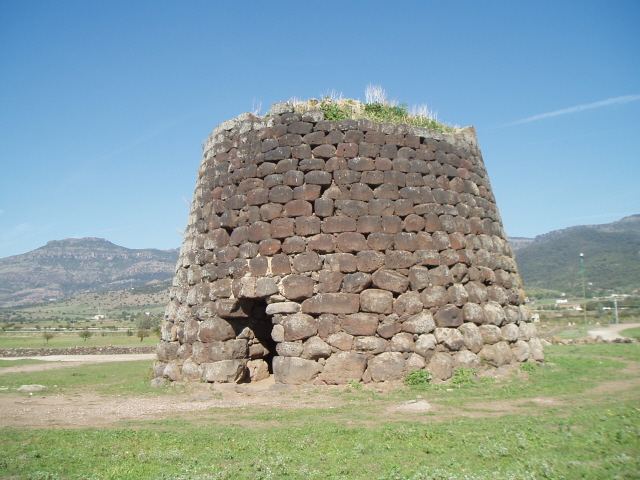
The Nuragic era started about 2000 BCE. Nuraghes are essentially stone towers, or "Brochs" as the Scotts would say or "Torres" as the nearby Corse would name them. The big difference is the number of Nuraghes. Local books speak of about 6000 of these well constructed fortified towers. This number is staggering as all of France has 6000 megalithic sites that we know of. It is doubtful that even one of the ubiquitous fast food chains has as many restaurants in a large European country. The level of organisation required to plan an execute such a building project, easily rivalling the ill fated Maginot line last century, for people in the Bronze age is momentous.
There are two basic types of Nuraghes; classic tholos tower type and the corridor type. The tholos type such as at Santa Sabina or Oes is an architects dream. It consists of a basaltic stone tholos.
Around this is built a circular stair case and then an outer cladding from large cyclopean blocks. Many had a further smaller tholos built over the first one and then had crenulations at the very apex. This has been conclusively proven by the discovery of ancient stone scale models. Eventually the Nuragic people got fancy by building them in threes or fours’, giving triangular shapes and so forth. The corridor Nuraghes where a more opportunistic creation using existing stone outcrops as foundations or walls. These are exemplified by the Albucciu Nurgahe near Arzachena or Maiori at Tempio Pausania.
No written records survive, so we don’t really know what the Nuraghes where used for. We have to assume the local potentate resided in them and that the population sought refuge in them in times of trouble. Many are within line of sight of each other, ca 500 Meters, so it’s possible they signalled to warn each other of trouble.
The funeral architecture also made its mark during the nuragic times. The Dolmens evolved into Tomba di Giganti, or Giants Tombs, which are essentially large allees couvertes, that usually have a large holed stele at the south east end with curved arms that served as a sort of funerary temple.
 Coddu Vecchiu Tomba and Thomes Tomba di Giganti are probably some of the most beautiful in existence. The early more megalithic looking tomba di giganti evolved into more masoned structures under Punic influence, such as at Madau or at the Mura Cuada Tomba di Giganti. There is no real comparable monument anywhere else as far as we can tell.

 The last unique type of monument in Sardinia are the sacred wells. The triangular masoned entrance to the Santa Christina Pozzo Sacro is positively futuristic. Behind it hides a tholos sunk into the ground where the water could be collected. The Su Tiempesu "Chalet" was buried under a mud landslide and therefore remained nearly intact except for the tip of the roof. There are a lot more to explore with different styles.
 There are many remains of Nuragic settlements in Sardinia, but due to time constraints, we were not able to go the momentous Tiscali site which was built inside a cave of sorts. With these sites, such at Serra Orios and sometime a little outside, such as at the Malchittu Tempietto A, the Nuragic people created interesting small temples. They all had benches around the inside of the walls.
 Menhirs in Sardinia are rarer than I expected, but the Tamuli Pedras Marmuradas Baethyles with their Anthropomorphic shapes are extremely spectacular.
History did eventually catch up with the Nuragic people. There are theories that they got together with the Mycenaean Greeks to raid the civilisations on the eastern Mediterranean, such as the Hittites, Phoenicians and Egyptians etc around 1180 BCE. The city of Ugarit in the current Syria, perhaps the Monte Carlo of its day, succumbed altogether due to the altercations from the naval raiders.
Within a couple of centuries, the Phoenicians, having sensed an opportunity and perhaps seeking revenge, set up trading posts on Sardinia. As stated previously, this allowed the development of building techniques, such as at Madau. However, when the Phoenicians where conquered by the Assyrians, the Carthaginians were freed of any constrictions by their middle eastern cousins and absorbed their brethren in Sardinia. It took them a couple of attempts, but the Carthaginians eventually conquered the rest of Sardinia in 575 BCE. Megalithic building activity essentially stopped and the absorption by Rome after the treaty following the Punic war around 260 BCE didn’t change the situation much. Sardinia wasn’t generating much revenue and logically did not figure as much of a priority for Rome either. This led to over two Millennia of neglect, which ironically probably allowed the large-scale preservation of the monuments as low level economic activity did not push them aside.
Today with the thriving agro touristic movement of small independent bed and breakfast farms, the efforts by the ministry of culture and our documented visit there, we hope to see a sustainable development in Sardinia that will work around and through the wonderful monuments. Yes, one week in Sardinia was toooooo short.
AlexHunger


 We would like to know more about this location. Please feel free to add a brief description and any relevant information in your own language.
 Wir möchten mehr über diese Stätte erfahren. Bitte zögern Sie nicht, eine kurze Beschreibung und relevante Informationen in Deutsch hinzuzufügen.
 Nous aimerions en savoir encore un peu sur les lieux. S'il vous plaît n'hesitez pas à ajouter une courte description et tous les renseignements pertinents dans votre propre langue.
 Quisieramos informarnos un poco más de las lugares. No dude en añadir una breve descripción y otros datos relevantes en su propio idioma.