

Area Guide - Lower Ohio Valley (Ohio, Indiana, Illinois, Kentucky,) U.S.
Submitted by bat400 on Wednesday, 26 April 2006 Page Views: 8595
Pre-ContactCountry: United States State: OhioInternal Links:

The watershed of the lower Ohio River was the cradle of the largest city in North America north of Mexico prior to 1800 AD. It was an independent birthplace of accurate plotting of the sun and moon's movement. And it is an exception to the anthropological "rule" that only farming allows the building of large public works by a society.
The following describes the people who populated the Lower Ohio by cultural artifacts they left behind - including large building projects. The people who built them may not have been displaced by others, but instead, likely changed their lifestyle over time.
More to life than food. Archaic Tradition.
From roughly 8000 BC to 1000 BC the Paleo-Indian cultures that lived throughout the Americas had given way in the Lower Ohio to the Archaic Tradition. The climate was roughly that found in the area today with most animals and plants of the region in evidence as they were documented by the first Europeans to arrive (~1650AD.)
Archaic people made full use of their environment, with varied tools for hunting, fishing, and food preparation. The population was still nomadic or semi-nomadic hunter gatherers, but toward the end of this period they left signs of living for longer periods in one location.
Late in the period they devoted time and resources to artistic and ritual activities. They had started to leave ritual burials (in purpose made cemetery sites,) make decorative items, and build large mounds of shell. Archaic sites are less obvious than the structures made by later peoples. There are few sites to visit that are purely associated with the Archaic period, though there are places with evidence of use through out most prehistoric periods (e.g. Flint Ridge quarries, Licking County, Ohio. )
Masters of Mounds. The Woodland Tradition.
The Woodland Tradition starts at ~1000BC throughout the Lower Ohio Valley, with the introduction of pottery, and "ends" at about 1200 AD. There are several different Woodland cultures over time. The characteristics of the Woodland Traditions that separate them from the Archaic period include:
* Extended occupation in single areas,
* Working a wide variety of decorative objects,
* Using trade materials from the Great Lakes, throughout the Ohio and Mississippi Valleys, and east and south to the Appalachian Mountains,
* Elaborate burial rituals,
* Building mounds, earthworks and hill "forts,"
* Plotting movements of the sun and moon.
The epicenter of Woodland Tradition was Ohio. Roughly from earliest to latest these cultures are the Hopewell (1000 BC - 500 AD,) Adena (800 BC - 100 AD,) Fort Ancient (~0 - 1200 AD.)
The Hopewell peoples left earthworks and mounds. Many of them sighted alignments of the sun or moon. One of the largest sites is the Newark Earthworks, Newark Ohio, with large earthen enclosures, connecting corridors, and many mounds. The complex originally covered 4 square miles. These ceremonial centers don't appear to have been settlements, although living sites are often found near these areas. The mounds are sometimes associated with burials of different types.
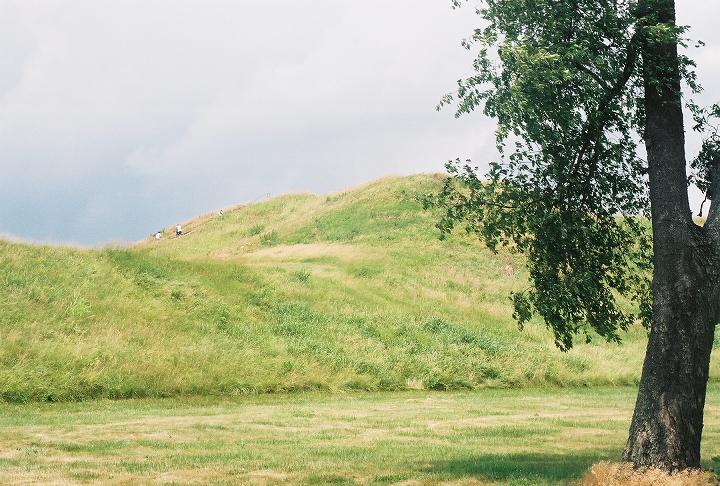
Although the Hopewell built huge earthwork complexes, some of the largest single conical mounds are associated with the Adena culture, including Miamisburg Mound, Miamisburg Ohio. This is the largest conical mound in eastern US, and is about 870 feet in circumference and was originally over 70 feet high.
Effigy mounds are generally low relief, no more than 3 to 8 feet high. Great Serpent Mound, near Peebles Ohio, is dated to the Fort Ancient culture and is probably the best known effigy mound in the US. The mound takes the form of a coiled snake, devouring an egg. Winding over a hilltop ridge it is over 1000 feet long.
Urban Living. The Mississippian Tradition.
The Mississippian Tradition (1000AD - 1400 AD) has overlap with the late Woodland period. The main characteristics of this period include agriculture based on corn, wide trading networks, central city / town locations with villages and farms in outlying areas, and building flat-topped earthen pyramids and mounds topped by temples or palaces. There are indications of an elite group separated from the majority of inhabitants and a rich civic / religious life.
The outstanding site associated with this culture was Cahokia, in southern Illinois. In this region both the Missouri and Ohio rivers meet the Mississippi forming an area known as the American Bottom. Cahokia appears to have been the center of a society that occupied the Mississippi watershed for three to four centuries.
The city of Cahokia consisted of a central pyramid, a complex of mounds, and a large central plaza, all enclosed by a wooden stockade. Around this city center were more mounds, many permanent dwellings, smaller plazas, cemeteries, and a wooden pole circle with astronomical alignments. Still farther out were villages and farmsteads. Smaller towns and cities existed along the Mississippi and Ohio Rivers. At the height of Cahokia's sway the city population is estimated to have been 10,000 to 20,000. This made it the largest city north of the Aztec Empire, half a continent away, and was only surpassed by a modern city in North America by Philadelphia in 1800.
No written language was used and there is little evidence of a written numbering system. As Cahokia was abandoned as a permanent settlement at around 1400 AD, prior to the arrival of French explorers in the area, there is no written record of any details of religion, governance, or personality of the society. French and Spanish explorers found the remnants of the Mississippians farther south, people who still built mounds on a smaller scale into the 1700's, but the tradition had already died out in the Ohio Valley.
History
European settlers found Ohio Valley Indian groups living in small permanent and seasonal villages by farming, hunting, and gathering. There were also large "empty" areas used as hunting grounds without settlement. There was evidence (unrecognized at the time) that local populations had been decreased by European diseases. But there was, and is, no evidence that the then unused mound builder's towns had been vacated by either sudden epidemic or invasion by conquering outsiders.
The local native people neither claimed the mounds as their own creations, nor had a common explanation for them. Many Europeans could not believe that these sites had been created by the ancestors of the locals. Instead, wild and popular speculations held sway that the mounds had been created by the Lost Tribe of Israel, Atlantis refugees, or Vikings. These myths began to be dispelled as early as the mid 1800's, but occasional outbursts about ancient Egyptians or space-faring mound builders still get an airing in the media today.
The early building cultures of the Lower Ohio had favored locations later desired by the Europeans, (for similar reasons) so that most sites are now entirely lost. There are over a thousand sites in the Lower Ohio River area that are known to archeologists but have not been excavated. Many of these are not noticeable to the casual observer and as the eastern US has no tradition of public footpaths or common land (outside of government owned lands) sites on private land are inaccessible to most, but can fall prey to looters.
Some helpful references and resources:
Today the sites that can be seen are those that were the most inaccessible to European use at the time ( Fort Hill, Ohio) or were just too big to be easily destroyed (Cahokia.) Most public sites are owned or maintained by State governments.
"An Introduction to Indiana Prehistory", by James Kellar, Indiana Historical Society, 1983. General enough to apply to the whole area.
Ancient Monuments of the Mississippi Valley, by EG Squire and EH Davis, Smithsonian Contributions to Knowledge, No. 1, 1848. The original scholarly work, the first publication of the Smithsonian Institute. Still in print, with detailed maps of the era.
Mound Builders of Ancient America, by Robert Silverberg, New York Geographic Society, 1968. Entertaining overall history and the history of the myth of exotic origins of the mounds.
General Resources on Net:
University of Maryland center for archeological astronomy.
National Historic Landmarks – a Division of the US National Parks Service
National Register of Historic Places – An official listing of places worthy of preservation. This listing can aid in receiving federal funds for preservation, and prevents the use of federal monies in damaging or destroying the site.
State by State Guide from Digs archeology magazine for kids.
Illinois
The American Bottom. Illinois State Historical Library, Springfield
Indiana
Indiana University Glenn Black Archeology center and museum.
Indiana University Archeology current digs.
Ohio
Ohio Historical Society website.
Ohio History Central Online Encyclopedia.
Kentucky
Kentucky Heritage Council. Kentucky Prehistory.


 We would like to know more about this location. Please feel free to add a brief description and any relevant information in your own language.
 Wir möchten mehr über diese Stätte erfahren. Bitte zögern Sie nicht, eine kurze Beschreibung und relevante Informationen in Deutsch hinzuzufügen.
 Nous aimerions en savoir encore un peu sur les lieux. S'il vous plaît n'hesitez pas à ajouter une courte description et tous les renseignements pertinents dans votre propre langue.
 Quisieramos informarnos un poco más de las lugares. No dude en añadir una breve descripción y otros datos relevantes en su propio idioma.