


★Standing Stones and Alternative archaeology in Japan: Stone Poles
Submitted by Aska on Tuesday, 18 January 2022 Page Views: 1030
Multi-periodCountry: Japan Type: Standing StonesInternal Links:

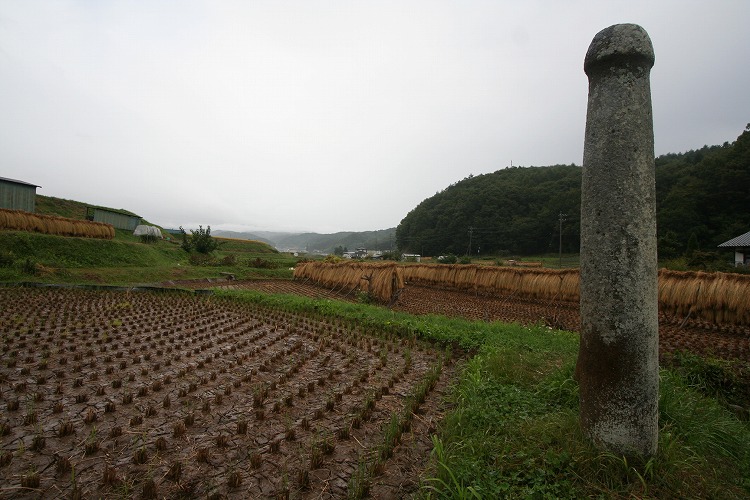
Outdoor standing stones, aka menhirs, in Japan are rare and tiny in contrast to the tradition in Korea which places pair of standing stone (선돌 (seondol), 입석 (ipseok)), along with pairs of cairns or totem poles, at the entrance of villages to prevent the trespass of evil spirits. Exceptionally, in following 3 areas, Ena city in Gifu prefecture, Ōzu city in Ehime prefecture, and Yoshino-gawa river basin area (southern bank) in Tokushima prefecture, standing stones densely distribute, along with famous Asuka district. Yoshino-gawa group is supposed to have something to do with Imbe (or Inbe 忌部) clan who conducted archaic rites and governed this area from 3rd to 9th centuries. Curiously most of Ena stones make a pair or more combinations. Some people insist that these stones were also elected in Jōmon era, but actually it should be impossible that these rather tiny stones, without any fundamental works, stand still for more than 1000 years. Okinawan people sometimes place stones called “ibi” (イビ), which are supposed to be the landing points of holy spirits, in their sacred spots called “utaki” (御嶽) or “ugan” (ウガン), some of them are placed even in the sea. On the Yaeyama islands of Ryūkyū (=Okinawan) archipelago there stand standing stones called “hoshi-mi-ishi” (星見石 = star observation stones) but the practical usage of them is unknown (some scholars suspect that these stones were originally pairs of longer and shorter stones and they were used like a sight of gun (or telescope). Stone rows, aka alignment, in Japan are much more rare and tiny. Besides Yoshino-gawa group, several outstanding alignments (or stone pile rows) lie in the mountains of Minami-Ise town in Mie prefecture. Although they have not been investigated scientifically, they are in common placed on mountain ridges from where the archipelago of Gokasho-wan (五ヶ所湾) bay can (or could) be overlooked. They might have something to do with the pirate navy of Kuki clan (九鬼水軍) who had exercised their power in thins area during 14 to 16C. The stone pile rows called “Shishi-gaki” (猪垣 = wild boar fence) can be seen in the mountains of western Japan which overlap the wild boar distribution area, the most well-known ones lie close to the Kumano Kodō ancient pilgrim path a UNESCO world heritage. Some people suppose it as fortress like the Great Wall of China and have something to do with the ancient Chinese explorer Xu Fu who has a legend of Japanese travel in quest for the elixir of life for the sake of the Emperor of Quin. Some people obsessionally believe the mountainous natural rock outcrop or a solitary gigantic rock called “iwakura” (磐座 = stone pedestal) as the heritage of lost ancient civilizations with super natural power and often call them “menhiru” (メンヒル = menhir). The municipal chronology of Beppu city in Ōita prefecture published in early previous century describes so many such “menhiru”s, along with other pseudo-megaliths, but nowadays most of them have fallen into oblivion. And some people also call the surface inscriptions (or cracks) on them “petorogurafu (ペトログラフ = petrograph?, not petroglyph)” which they regard seriously as the written proof of the immigration of Sumer people from Mesopotamia who brought civilization to Japan. Some other people insist that ancient Japanese people had their own characters before the import of Chinese characters and the evidences were inscribed on some stone tablets. Like “Dr.Torii’s style dolmens” (see also : Japanese Chronology for Dolmens), superficial knowledge based on the Western archaeology might have misguided Japanese scholars to the occult (see also : Buddhist Pyramids in Japan, Korea and beyond). The most attractive site in controversy, to be an archaeological site or not, might be Yonaguni Submarine Ruins. It was 1980’s that the Celtic culture in Europe and UK was introduced to Japan in full-scale, but so many books on Celts (ケルト) in published Japan, where almost nobody in Japan had exact knowledge on Neolithic culture in Europe, misguided Japanese people to believe that the megalithic monuments, e.g. Stonehenge and Carnac alignments, are built by the Celts, and even some of the early books misspelled it as “ケトル” (kettle). Main article : ★★Japanese Chronology With Featured Stone Monuments in Every Era


 We would like to know more about this location. Please feel free to add a brief description and any relevant information in your own language.
 Wir möchten mehr über diese Stätte erfahren. Bitte zögern Sie nicht, eine kurze Beschreibung und relevante Informationen in Deutsch hinzuzufügen.
 Nous aimerions en savoir encore un peu sur les lieux. S'il vous plaît n'hesitez pas à ajouter une courte description et tous les renseignements pertinents dans votre propre langue.
 Quisieramos informarnos un poco más de las lugares. No dude en añadir una breve descripción y otros datos relevantes en su propio idioma.