


★Japanese Chronology for Kofun burial mounds (Kofun era. 3rd-7th C)
Submitted by Aska on Saturday, 21 August 2021 Page Views: 1704
Iron Age and Later PrehistoryCountry: Japan Type: Long BarrowInternal Links:

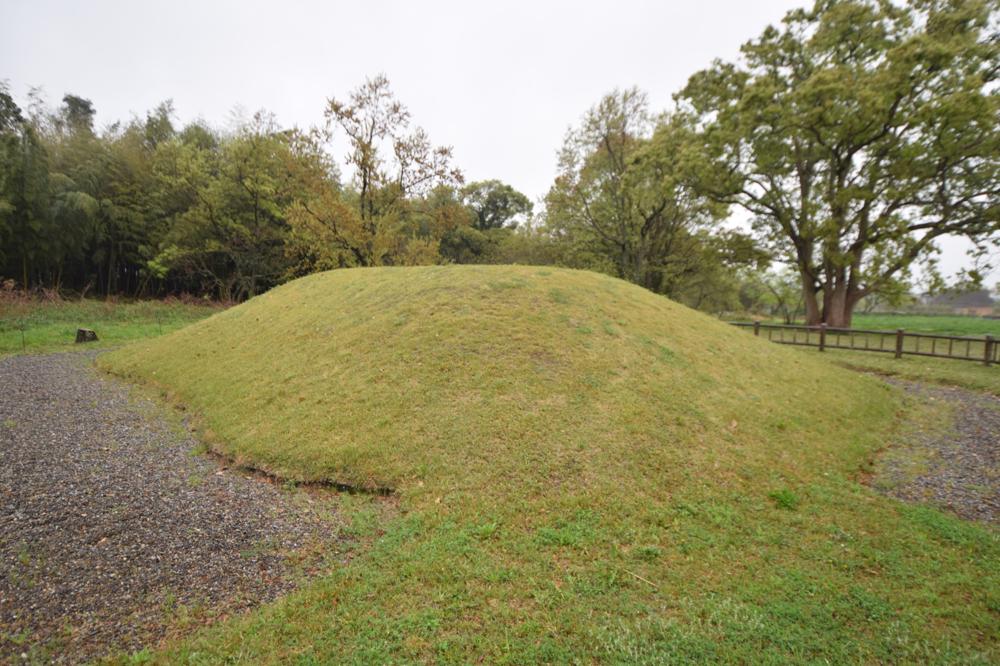
In the late Yayoi era (2nd -3rd C) the mounds increased their size up to 40m long and got long extensions which look like climbing paths towards the mound top : round mound with 2 extensions looks like spinning top ; rectangular mound with extensions at every 4 corner looks like a crushed table. The latter mainly distribute in coastline area of Sea of Japan : Shimane, Tottori, Fukui and Toyama prefectures. In mid 3rd century, Keyhole-shaped (= combination of round and triangle mounds) Kofun around 100m long appeared. The triangle mound part is supposed to be the developed form of the extensions of late Yayoi burial mounds. A samurai archaeologist, Kumpei GAMŌ (蒲生君平) created the term for the Kofun in this shape, “zenpō-kōen-fun” (前方後円墳 = front-square rear-round burial mound), which is still used in Japan generally. The concept of ‘front’ and ‘rear’ is derived from the shape of the funeral cart in his own imagination, based on no scientific nor reasonable evidence. The edges of the triangle part of the Keyhole-shaped Kofun of this dawn period spread like the edge of bell, it is supposed to be a peculiar feature of the early keyhole-shaped kofun and the edges are supposed to have been still used as climbing paths. From the end of 3rd century, representational (man, animal etc.) and cylinder “haniwa” terracotta began to decorate Kofun surface and surroundings.
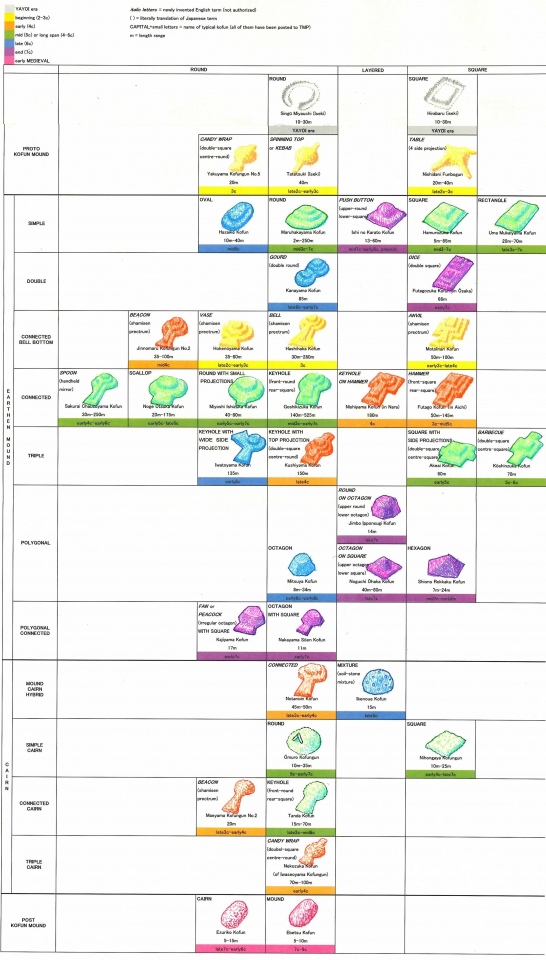 DIAGRAM RIGHT: Kofun Morphology - Click for larger version
Towards the 5th century, the whole shape of keyhole-shaped Kofun got sophisticated, or complicated with additional projections on the other hand, and the size grown up to 500m long maximum. Long days had passed since their construction, people got to forget the significance of the mounds as a burial monuments, some people (especially in Shikoku island, see Ghibli anime “Pom Poko”) began to suspect that the mounds with chamber were the entrance of underground world dominated by “tanuki” raccoon dogs, badgers and foxes which were supposed to have supernatural power and wisdom, and some of the medieval landlords modified them into their own fortresses.
But for the most of Japanese people, the Kofun mounds are a sacred and untouchable existence, so if you find a small wood with naturally grown trees in a landscape, it should be a Kofun or a Shinto shrine. During Edo era (17th-19th C), great tumuli were attributed as imperial mausoleam by Japanese philologists without any scientific knowledge of archaeology, in spite of some of the successive emperors themselves were substanceless imaginary heroes like King Arthur. Recently such non-scientific noble site names are being shifted to the ones based on the place name, e.g. the greatest burial mound Emperor Nintoku (仁徳天皇 257-399 !) Mausoleum is now being called Daisen Kofun and so on. Still nowadays, Japanese mass media tends to publish sensational headline after the excavation of a Kofun "The seal of Emperor XXX's mausoleum has just broken ?!" Such great construction could not be accomplished within a lifespan of each emperor. In fact, several stone coffins and burial chembers were excavated from one single Kofun mound. Each emperor described in the oldest historic book Nihon Shoki might be the assembly of several generations of the emperors.
In the 5th century, the burial system gradually shifted from vertical pit to a horizontal chamber with entrance passage, and “horizontal rock-cut-tombs” and “underground tunnel tombs” also appeared in almost same period. In Kyūshū island some Kofun adopted “sekijin” (石人 = stone man) and “sekiba” (石馬 = stone horse) instead of haniwa terracotta for decoration, and then such aesthetic tendency switched to mural Kofun. The mural Kofun and mural rock-cut-tombs, coloured or engraved, also distribute in other areas such as Tottori prefecture, the Pacific coastline area of Tōhoku region from Ibaraki to Miyagi prefectures and so on but their relation and propagation are still unclear. From the late 5th century to early 6th century, several keyhole-like-shaped burial mounds (Kr : 장고분 = janggu(=long drum)-shaped tumulus) were also constructed in the south-western corner of Korean peninsula. In 6th century, the size of keyhole-shaped Kofun decreased and in 7th century construction of keyhole-shaped Kofun discontinued at last and tiny Kofun in various shape, such as polygonal pyramid and round mound on square pedestal (push button shape?), appeared as alternatives. Burial system also reduced to hollowed-rock capsule chamber. Realistic style mural paintings, influenced by Goguryeo (고구려 one of the three ancient Korean kingdoms) culture, were painted in the chambers of Takamatsuzuka Kofun and Kitora Kofun in Asuka district, Nara prefecture. In 646 CE, promulgation of “funeral economize law” terminated the construction of Kofun, and rock-cut-tomb became popular subsequently. During 7th to 10th centuries, the natives in Hokkaidō island and northern Tōhoku region imitated Kofun-like burial mound on their territory where no Kofun had been constructed before.
DIAGRAM RIGHT: Kofun Morphology - Click for larger version
Towards the 5th century, the whole shape of keyhole-shaped Kofun got sophisticated, or complicated with additional projections on the other hand, and the size grown up to 500m long maximum. Long days had passed since their construction, people got to forget the significance of the mounds as a burial monuments, some people (especially in Shikoku island, see Ghibli anime “Pom Poko”) began to suspect that the mounds with chamber were the entrance of underground world dominated by “tanuki” raccoon dogs, badgers and foxes which were supposed to have supernatural power and wisdom, and some of the medieval landlords modified them into their own fortresses.
But for the most of Japanese people, the Kofun mounds are a sacred and untouchable existence, so if you find a small wood with naturally grown trees in a landscape, it should be a Kofun or a Shinto shrine. During Edo era (17th-19th C), great tumuli were attributed as imperial mausoleam by Japanese philologists without any scientific knowledge of archaeology, in spite of some of the successive emperors themselves were substanceless imaginary heroes like King Arthur. Recently such non-scientific noble site names are being shifted to the ones based on the place name, e.g. the greatest burial mound Emperor Nintoku (仁徳天皇 257-399 !) Mausoleum is now being called Daisen Kofun and so on. Still nowadays, Japanese mass media tends to publish sensational headline after the excavation of a Kofun "The seal of Emperor XXX's mausoleum has just broken ?!" Such great construction could not be accomplished within a lifespan of each emperor. In fact, several stone coffins and burial chembers were excavated from one single Kofun mound. Each emperor described in the oldest historic book Nihon Shoki might be the assembly of several generations of the emperors.
In the 5th century, the burial system gradually shifted from vertical pit to a horizontal chamber with entrance passage, and “horizontal rock-cut-tombs” and “underground tunnel tombs” also appeared in almost same period. In Kyūshū island some Kofun adopted “sekijin” (石人 = stone man) and “sekiba” (石馬 = stone horse) instead of haniwa terracotta for decoration, and then such aesthetic tendency switched to mural Kofun. The mural Kofun and mural rock-cut-tombs, coloured or engraved, also distribute in other areas such as Tottori prefecture, the Pacific coastline area of Tōhoku region from Ibaraki to Miyagi prefectures and so on but their relation and propagation are still unclear. From the late 5th century to early 6th century, several keyhole-like-shaped burial mounds (Kr : 장고분 = janggu(=long drum)-shaped tumulus) were also constructed in the south-western corner of Korean peninsula. In 6th century, the size of keyhole-shaped Kofun decreased and in 7th century construction of keyhole-shaped Kofun discontinued at last and tiny Kofun in various shape, such as polygonal pyramid and round mound on square pedestal (push button shape?), appeared as alternatives. Burial system also reduced to hollowed-rock capsule chamber. Realistic style mural paintings, influenced by Goguryeo (고구려 one of the three ancient Korean kingdoms) culture, were painted in the chambers of Takamatsuzuka Kofun and Kitora Kofun in Asuka district, Nara prefecture. In 646 CE, promulgation of “funeral economize law” terminated the construction of Kofun, and rock-cut-tomb became popular subsequently. During 7th to 10th centuries, the natives in Hokkaidō island and northern Tōhoku region imitated Kofun-like burial mound on their territory where no Kofun had been constructed before. Basic Resources :Main article : ★★Japanese Chronology With Featured Stone Monuments In Every Era
- Thomas Knopp et al (2018) Burial Mounds in Europe and Japan. Summertown (Oxford, UK) : Archaeopress ISBN:987-1-78969-007-1
- 白石太一郎 1985 古墳の知識 1墳丘と内部構造 東京 : 東京美術 ISBN:4-8087-0245-2 (lit: Knowledge on Kofun 1 : mound and inner structure)
- 村井嵒雄ほか 1988 古墳の知識 2出土品 東京 : 東京美術 ISBN:4-8087-0318-1 (lit: Knowledge on Kofun 2 : excavated artefacts)
- 中河原喬 1999 磐井の乱と九州王朝:石人・石馬の語る世界 東京:同成社 ISBN:4-88621-182-8 (lit: Riot of Iwai clan and their kingdom in Kyūshū : as told by stone men and stone horses)
- 装飾古墳の世界 : 国立歴史民俗博物館開館10周年記念企画展示 東京:朝日新聞社, 1993 (lit: World of mural Kofun : 10th anniversary exhibition of National Museum of Japanese History)


 We would like to know more about this location. Please feel free to add a brief description and any relevant information in your own language.
 Wir möchten mehr über diese Stätte erfahren. Bitte zögern Sie nicht, eine kurze Beschreibung und relevante Informationen in Deutsch hinzuzufügen.
 Nous aimerions en savoir encore un peu sur les lieux. S'il vous plaît n'hesitez pas à ajouter une courte description et tous les renseignements pertinents dans votre propre langue.
 Quisieramos informarnos un poco más de las lugares. No dude en añadir una breve descripción y otros datos relevantes en su propio idioma.