

★Buddhist Pyramids in Japan, Korea and beyond (Nara era, 8th C)
Submitted by Aska on Sunday, 19 December 2021 Page Views: 1420
Early MedievalCountry: Japan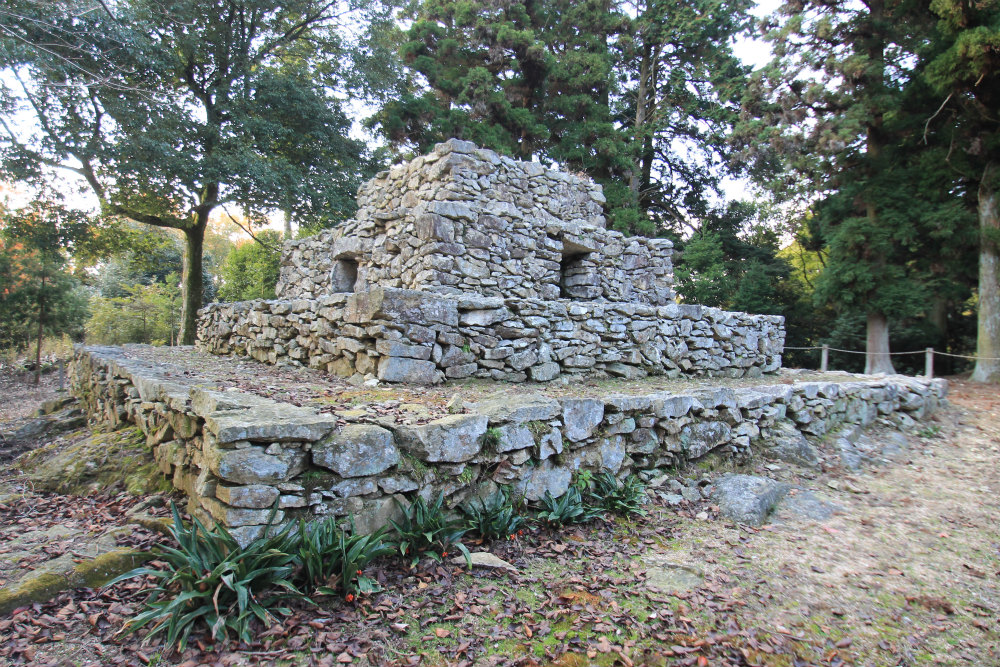
There are also this kind of pyramids in South Korea. The one in Uiseong (의성) county contains Buddhist statues like Zutō. They all should be the prototype or variation of Buddhist pagoda in which the fragment of bone of Buddha was installed originally (Kumayama scripture might be the substitute). Most of archaeologists nor researcher on Buddhist art do not show interests in them but a few scholars investigate the relation of them including the grand Buddhist temple of Borobudur in Indonesia. There lie more Buddhist pyramids in Japan : Hyōgo and Tottori prefectures, also on the slope of Mt.Kumayama there lie 33 small pyramids (almost collapsed) and the 8 boundary mounds protecting Katsuō-ji temple in the northern mountain of Ōsaka also take the shape of stepped pyramid. A pyramid-shaped cairn on Tsushima island which lies between Korean peninsula and Japan is supposed to be the sacred temple of local solar worship which might derived from Korean myth : the sunbeam penetrated the genital organ then it made the woman pregnant, and the founder of the kingdom was born consequently. The pyramid in Andong (안동) county, South Korea, has a strange stone (linga?) on its top, some of the pyramids and cairns on Tsushima and Hegura-jima islands in Sea of Japan also have such linga-yoni (phallus-vagina) stones on their top. (On Mishima island in the Sea of Japan, there are several stone monuments called Kasaishi (or Nabaishi) which resemble to phallus or mashroom.) Some scholars suspect that these pyramids are kind of burial chambered cairns because the giant chambered cairns of Goguryeo kingdom take the shape of stepped pyramid. Some people in Japan fanatically believe that some of the symmetric-shaped hills in Japan are artificial “piramiddo” (ピラミッド = pyramid), like Silbury Hill, although the nominee are much higher than the Great Pyramid of Giza. Since the same 8th century (Nara era), TOWER-shaped stone pagodas were also built. The proportion of eaves and column varied but then it became fixed in the 12th century (later Heian era). Since the 13th century (Kamakura era), small stone pagodas became popular as independent tombstones or memorial tablets. At first the Buddhism denied idol worship like the Islam, and worshiped indirect icons : Buddha footprint ; Bodhi tree ; Śarīra (= fragment of bone of Buddha). Then the arrival of Hellenism (= Greek sculpture-making culture ; Anabasis of King Alexander) to India caused the manufacturing of Buddha statues. The shortage of Buddha bones caused the shift of worship target : indirect icons to representational images. Then significance of pagodas was also shifted : the principal building of the temple to an optional symbol. And the main hall which contains the Buddha statues has become the new principle building of the temples. But the flexible structure (= without iron nails) of wooden pagoda which stood against the 1923 Great Kantō Earthquake proved the ability of skyscrapers on the quake-prone country.
Basic Resources :Main article : ★★Japanese Chronology With Featured Stone Monuments in Every Era
- 坂井隆 2008 ’古代における仏塔の伝播’ 日本考古学(25) pp.23-45 東京:日本考古学協会 ISSN:1340-8488 (‘The diffusion of Buddhist stupas in ancient times’ Japanese journal of archaeology No.25) http://enlight.lib.ntu.edu.tw/FULLTEXT/JR-MISC/misc168127.pdf
- 林永珍(임영진) 2013 ’公州宋山里D地區積石遺構의性格’ 百済文化(백제문화)1(48) pp.109-128 공주 : 공주대학교백제문화연구소 ISSN: 1598-2963 (lit: ‘The features of the stone pile monument at D zone in Sonsang-ri site, Gongju.’ Baekje culture. Vol.1,no.48) http://kiss.kstudy.com/thesis/thesis-view.asp?key=3134609


 We would like to know more about this location. Please feel free to add a brief description and any relevant information in your own language.
 Wir möchten mehr über diese Stätte erfahren. Bitte zögern Sie nicht, eine kurze Beschreibung und relevante Informationen in Deutsch hinzuzufügen.
 Nous aimerions en savoir encore un peu sur les lieux. S'il vous plaît n'hesitez pas à ajouter une courte description et tous les renseignements pertinents dans votre propre langue.
 Quisieramos informarnos un poco más de las lugares. No dude en añadir una breve descripción y otros datos relevantes en su propio idioma.