

<< County Introductions >> Alex's Intrepid adventure in Syria
Submitted by AlexHunger on Wednesday, 25 April 2007 Page Views: 9034
Other ArchaeologyCountry: Syria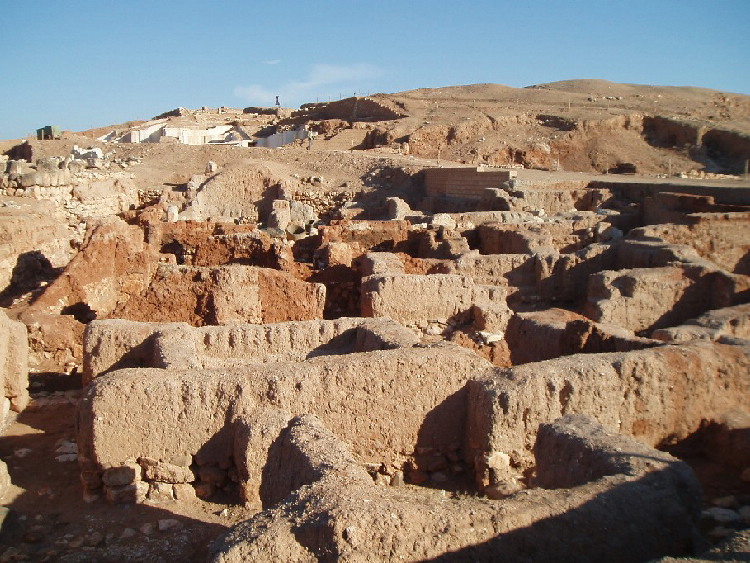
In contrast, the rest of Syria has more than enough ancient to modern history to go around. In an ideal world, Syria would concurrently shake its somewhat undeserved geopolitical reputation, spend a little more on the upkeep and research of the monuments and improve the tourist infrastructure a little more in order to gain a greater audience for its high class sites. While Syria figures prominently in the 20th century Middle East wars and certainly has a conservative law and order tendency, the Al Assad Dynasty has successfully maintained internal stability and a degree of prosperity in a troubled region and is currently gently liberalising the economy. At no time did I feel remotely threatened or insecure, which is a nice change from central London! If anything, there were less "uniforms" visible in Syria than at the average western airport.
Our bus group didn’t even have Secret Service agents following us around, as we had been warned happened in previous years. While posters and statues of the late Syrian leader Hafez Al-Assad and the current president, his son, Bashir Al-Assad pervade Syria, no-one talked much about politics or tried to convince our bus load of Germans of what a bad man George W. Bush is. So much for the cloak and Dagger stuff. If anything, the Syrians are most aware that they stand at the crossroads of history and need to be flexible.
There is a certain fatalism that tribes and warlords had always passed through Syria on the way to somewhere else or to settle down until the next bunch arrive. This would include the Sumerians, Akkadians, Amorites, Hittites, Hurians, Mittanis, Canaanites, Arameans, Assyrians, Persians, Greeks and Romans if one were brief.
International Archaeologists such as Baron Max von Oppenheim and his predecessors have only been researching Syria and Iraqi sites since the middle of the 19th Century, and there are still hundreds of Tells (large man made earth mounds hiding ancient settlements) to dig up. Clever researchers would simply have followed up the Euphrates and its tributaries to find a major Tell, on average every 50 Km.
Oppenheim got lucky and found Tell Halaf and its megalithic Basalt statues which in turn led to the discovery of much earlier Neolithic cultures at lower levels. The Mari site in Tell al Hariri, a stones throw from the Iraqi border, wasn't found until the 1920s and was largely excavated by Louvre archaeologist Andre Parrot. This confirmed a Sumerian presence and extensive trading activity in the fertile crescent all the way up to Turkey. Mari had good quality sculptures, but consisted almost entirely of mud bricks, which doesn’t keep well, hence the metal roof.
Up north in Aleppo itself, there is a Turkish citadel on a hill, and Archaeologists are currently digging out an Assyrian temple in between the battlements. Some basalt blocks have been exhibited. Before the arrival of the Hittites, the local Amorite Kingdom of Yamkhad thrived in the Aleppo region. Deeper digging will confirm that the history of Aleppo must certainly go back to the 8th millennium BCE and even the biblical Patriarch Abraham was said to have lived here, according to legend.
A little further to the South East, archaeologist in the late 1958 found the ancient city of Ebla which peaked once in the middle of the 3rd Millennium and again in the 2nd Millennium BCE. The people of Ebla used considerably more basalt and limestone block for their fortifications and foundations of their palaces and temples, but everything else still consisted of mud bricks.
The key issue was however the discovery of 19,000 clay tablets. Most held boring accounting information and trade contracts, but others offered a lexicon on ancient knowledge and translation manuals for the writing of regional cultures.
 Ugarit, on the Mediterranean coast is even more relevant to us Europeans as Ugarit actively traded with the likes of Egypt, Crete and Cyprus as well as the Asiatic hinterland. The Ugaritians also processed Murex shells into purple dye, that no self respecting potentate could be without.
Ugarit did finally go out with a bang when the Sea People, raiders from Greece and Sardinia, torched the place around 1180 BCE, around the same time as the Trojan War. The palace must have been spectacular and the underground Graves in the merchants houses point not only to a high standard of living but also of Dying. Ugarit's fame is however secure as a small clay tablet showed the worlds first known Alphabet, which greatly simplified cuneiform but also enabled the more famous Phoenician, Greek and Roman alphabets a little later.
 Though the Museum in Aleppo is currently being renovated at a Glacial pace, it contains fascinating stone artefacts from most of the sites mentioned. The stone columns holding up the façade are copies of items found at Tell Halaf, which were later taken to Germany, but were extremely badly damaged during WWII.
Although the bus tour did not permit me to see Ain Dara found in 1954 near the Turkish border, the Temple looks particularly interesting on account of the volume of Basalt blocks and reliefs built into it's walls. The Louvre also has a fantastic human faced menhir found at Tell Brak.
The city of Palmyra served as an important Oasis trading town in the middle of the desert halfway between Homs and the Euphrates. While it was inhabited from a very early time on the basis of Neolithic finds, it thrived just as the Romans got there.
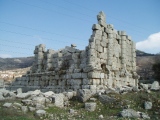 Part of the diversity of Syria are the many "multiple use" sites that were used by successive cultures. Among them, you can count the temple of Yabrud and the Baitokaike Temple of Zeus which both started out as Canaanites or Phenician temples of Baal and were progressively renovated into temples of Zeus. Yebrud then also had a career as a church, although it lost its columns in the process. While now abandoned, Baitokaike, however has the largest stones I have ever seen used in a man made structure, with some measuring about 10 meters in length.
As I said earlier, there are 100s of Tells remaining which may lead to further discoveries, but Syria can't possibly afford to dig them up at present, and there are probably not enough trained archaeologists around to do the work. If anything, some capacity needs to be kept in reserved for the Greek and Roman sites, but that is an other story. In conclusion, Syria needs to be on the tourist map of archaeology while the stories of the "Axis of Evil" stories need to relegated to history
Alex Hunger
<< The Nuragic Conspiracy: Alex’s intrepid adventure in Sardinia
Five unusual types of Megalithic Monument to be found in Kerala, India >>


 We would like to know more about this location. Please feel free to add a brief description and any relevant information in your own language.
 Wir möchten mehr über diese Stätte erfahren. Bitte zögern Sie nicht, eine kurze Beschreibung und relevante Informationen in Deutsch hinzuzufügen.
 Nous aimerions en savoir encore un peu sur les lieux. S'il vous plaît n'hesitez pas à ajouter une courte description et tous les renseignements pertinents dans votre propre langue.
 Quisieramos informarnos un poco más de las lugares. No dude en añadir una breve descripción y otros datos relevantes en su propio idioma.