Featured: Hare and Tabor T Shirts for discerning antiquarians

Hare and Tabor T Shirts for discerning antiquarians

The Stone Circles of Britain, Ireland and Brittany, Aubrey Burl

The Stone Circles of Britain, Ireland and Brittany, Aubrey Burl

Login

Register here - as a registered user you get more features and fewer ads.

Who's Online

There are currently, 1526 guests and 1 members online.

Sponsors

Five unusual types of Megalithic Monument to be found in Kerala, India India

Submitted by Andy B on Monday, 07 August 2017  Page Views: 9405

Discoveries

<< County Introductions >>

Country: India
Cherumangadu Kudakkalparambu
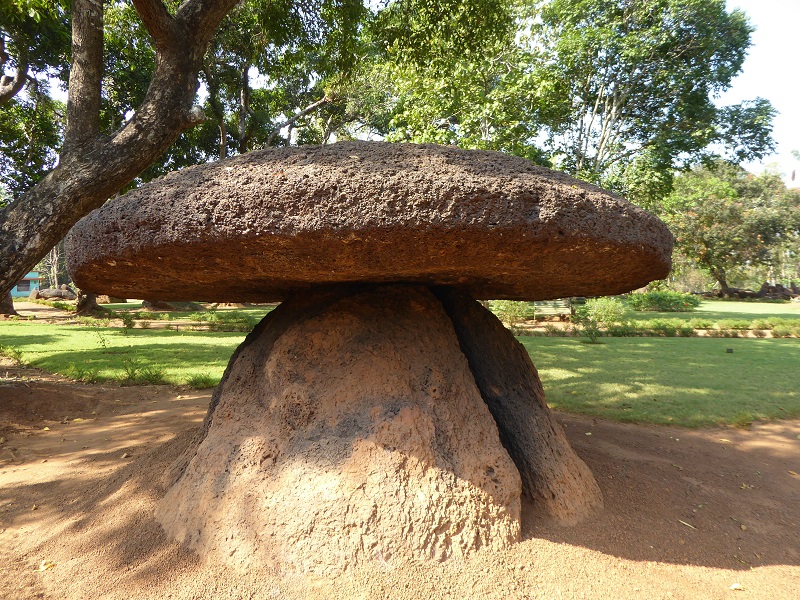
Cherumangadu Kudakkalparambu submitted by baz : One of the umbrella stones at Kudakkallu Parambu, Cheramangad (Vote or comment on this photo)
Located in Southwestern India, Kerala is a state that has many megalithic monuments that are not very well known outside India. Megalithic sites in this area are thought to date to the Iron Age, and many other items, such as clay plates, iron weapons, fishing hooks, pots, utensils of Iron Age date have been found.

Megalithic monuments in Kerala mark burial sites, and types of site include Muniyara, Muthumakkathazi, Nadukkallu, Pandavakuzhi, Kudakkallu (hood stones), Thoppikkallu (hat stones), Kalmesha, and Kalvrithangal.

Muniyara Monument (dolmenoids)
Muniyara is a coastal region of Kerala best known among anthropologists and archaeologists for the remnants of ancient burial chambers. Also the region has multiple caves that, according to historians, date from 2 or 3 BC. These caves served initially as housing for Jain and Buddhist monks and later, in 68-69 AD they were used by Judaist missionary groups. Roman coins and clay pots dated to these periods have been found.

Muthumakkathazi (nannangadi)
Another megalithic monument in Kerala, Muthumakkathazi is a burial site used to bury the dead in large urns. Some ancient documents date the burial urns back to the King of the Chola's dynasty. The burial urns have different names in different regions of Kerala. For example, in the North, they are called Nannangadi but they are the same thing. The only difference is that, in some places, the bodies were buried with weapons, while in others this practice was not common. Some historians claim that the pots were used only to bury village chiefs and other prominent figures from the village.

Nadukkallu

Nadukkalu is a monument type which describes rocks used to cover burial sites. Some of these rocks were inscribed with the names of the warriors that were buried underneath them. These burial sites are linked to some Hindu rituals and other ancient traditions like “offering” alcohol, bathing and offering bali to the Nadukkallu site.

Pandavakkuzhi
Another type of burial chamber, from the Stone Age is Pandavakkuzhi, also known as Panchapandavar Padukai or Pandukkuzhi. The structure of these burial chambers was usually built with three linear stone slabs with another slab on top. Most of the structures are 3 meters in length and 1.5 meter in width. Underneath Pandavakkuzhi sites, archeologists have found burial urns with bones and weapons. During an excavation in 1946, clay utensils, pieces of plats and iron tools were discovered at Cheramanparambu, a site located close to the Thiruvanchikkulam temple. A couple of decades later, at the same burial site were discovered the ruins of white rock walls, copper coins and lamps that date from the dynasties of Rajendra Cholan and Rajaraja Cholan.

Kudakkallu (umbrella stones)
The umbrella stones are another type of megalithic monument from Kerala that were used as burial sites centuries ago. Kudakkalus are curvilinear shaped blocks installed on the ground with a block shaped like an umbrella on top. This type of burial site was discovered in various regions of Kerala including Kandanassery, Chowannur, Porkulam, Kattakampal, Eyyal and Ariyannur.
Besides Kudakkallus, another type of site in this region is Thoppikallu, which is another type of burial site, similar to Kudakkallus. The only difference between these types of burial sites is that in the case of thoppikallu the umbrella-shaped ground is not placed on top but on the ground.

I hope this has been a useful introduction to the many varied types of megalithic site to be found in Kerala. There is much more to discover in this fascinating area and to research these sites more could be an amazing travel destination for archaeologists and anthropologists.

The author Boris Dzhingarov loves to travel. He writes for several websites and is the Founder of Travel Tipsor.

Please add your thoughts on this site

The Henge Monuments: Ceremony and Society in Prehistoric Britain

The Henge Monuments: Ceremony and Society in Prehistoric Britain

Sponsors

More County Introductions

See all County Introductions →

"Five unusual types of Megalithic Monument to be found in Kerala, India" | Login/Create an Account | 4 News and Comments
  
Go back to top of page    Comments are owned by the poster. We aren't responsible for their content.
Pre: Five unusual types of Megalithic Monument to be found in Kerala, India by Anonymous on Saturday, 17 October 2026
Prof. Prem raj Pushpakaran worldarchitecture.org/profiles/gfhvm/prof-prem-raj-pushpakaran-profile-page.html comments - This commentary evaluates the provided overview of Kerala’s megalithic burial typology, acknowledging its utility as an introductory survey while critically addressing significant chronological conflations, terminological misalignments, and cultural-historical discrepancies. While the text successfully categorizes primary monument types—such as Kudakkallu, Thoppikkallu, and Nannangadi—it inadvertently collapses centuries of distinct historical eras (from the Iron Age to the High Medieval period) into singular narratives. This review seeks to untangle these chronological overlaps and ground the architectural typologies within established South Asian archaeological frameworks. The text provides a valuable ethno-archaeological catalog of Kerala’s unique mortuary architecture. The region’s sub-surface Laterite geology uniquely facilitated the creation of highly specialized monuments.
• The Kudakkallu (Umbrella Stone) and Thoppikkallu (Hat/Hood Stone): The distinction made between these two is structurally vital. However, the description requires technical precision. A Kudakkallu consists of clinostats (inclined support stones) converging to support a large, dressed hemispherical capstone. Conversely, a Thoppikkallu features a low-profile dome resting directly over a subterranean pit or urn burial without prominent structural uprights.
• The Nannangadi / Muthumakkathazi: Correctly identified as regional variants of pyriform (pear-shaped) burial urns, these represent the most ubiquitous mortuary practice of the South Indian Iron Age. The text’s observation regarding the uneven distribution of grave goods (weapons vs. aceramic deposits) aligns with contemporary theories on social stratification and emergent complex societies during the Megalithic-Sangam transition. The primary limitation of the text lies in its temporal fluidities, where distinct archaeological horizons are compressed: • The Chola Anachronism: The text associates Muthumakkathazi and Pandavakkuzhi sites directly with the Imperial Chola monarchs (Rajaraja I and Rajendra I, c. 10th–11th centuries AD). Megalithic dolmens and urn burials predominantly span from 1000 BCE to 100 CE. Finding medieval Chola coins or artifacts at these sites typically denotes secondary usage, structural disturbance, or much later historical occupations near ancient sacred landscapes, rather than the original phase of megalithic construction.
• The "Muniyara" Multi-Era Conflation: The commentary regarding Marayoor/Muniyara dolmenoids mixes prehistoric megaliths with early historic monasticism. True Muniyaras (dolmens) are Iron Age mortuary features. The rock-cut caves of Kerala did house Jain and Buddhist ascetics, but this represents a shift into the Early Historic period (c. 3rd century BCE – 3rd century CE). Attributing these sites to "Judaist missionary groups in 68-69 AD" lacks robust, peer-reviewed archaeological consensus and appears to confuse legendary narratives of early St. Thomas Christians or Muziris Jewish migrations with verifiable material culture. Hero Stones (Nadukkallu): While Nadukkallu (Hero Stones) evolved out of the Megalithic tradition of erecting menhirs, inscribed Nadukkallu commemorating fallen warriors belong overwhelmingly to the Sangam and Early Medieval periods.
The text properly highlights the discovery of iron implements (fishing hooks, weapons), which underscores an economy transitioning from pastoralism to settled agriculture and coastal exploitation. However, characterizing Pandavakkuzhi as a "Stone Age" chamber introduces a terminology error; these are explicitly Iron Age / Early Historic constructions, as true Stone Age (Neolithic/Mesolithic) communities in Kerala did not construct heavy granite or laterite slab monuments. As a descriptive primer, the text effectively communicates the rich, overlooked variety of Kerala's mortuary architecture to a broader audience. However, for rigorous academic consumption, it must clearly segregate the primary monument building phase (Iron Age) from subsequent historical taphonomies (Roman trade, Jain asceticism, and Medieval Chola interventions). Rectifying these chronological boundaries will elevate the text from an intriguing travelogue introduction into a precise scientific framework.
[ Reply to This ]

Re: Five unusual types of Megalithic Monument to be found in Kerala, India by Anonymous on Tuesday, 28 May 2019
Kerala is in the Southern part of India. Not in the north
[ Reply to This ]
    Re: Five unusual types of Megalithic Monument to be found in Kerala, India by Anonymous on Wednesday, 29 May 2019
    Indeed it is, now corrected, thankyou
    [ Reply to This ]

Re: Five unusual types of Megalithic Monument to be found in Kerala, India by Anonymous on Sunday, 08 July 2018
[ Reply to This ]

Your Name: Anonymous [ Register Now ]
Subject:


Add your comment or contribution to this page. Spam or offensive posts are deleted immediately, don't even bother

<<< What is five plus one as a number? (Please type the answer to this question in the little box on the left)
You can also embed videos and other things. For Youtube please copy and paste the 'embed code'.
For Google Street View please include Street View in the text.
Create a web link like this: <a href="https://www.megalithic.co.uk">This is a link</a>  

Allowed HTML is:
<p> <b> <i> <a> <img> <em> <br> <strong> <blockquote> <tt> <li> <ol> <ul> <object> <param> <embed> <iframe>

We would like to know more about this location. Please feel free to add a brief description and any relevant information in your own language.
Wir möchten mehr über diese Stätte erfahren. Bitte zögern Sie nicht, eine kurze Beschreibung und relevante Informationen in Deutsch hinzuzufügen.
Nous aimerions en savoir encore un peu sur les lieux. S'il vous plaît n'hesitez pas à ajouter une courte description et tous les renseignements pertinents dans votre propre langue.
Quisieramos informarnos un poco más de las lugares. No dude en añadir una breve descripción y otros datos relevantes en su propio idioma.