


Jade axeheads, standing stones and the world of the spirits
Submitted by neolithique02 on Thursday, 27 September 2012 Page Views: 22630
DiscoveriesCountry: France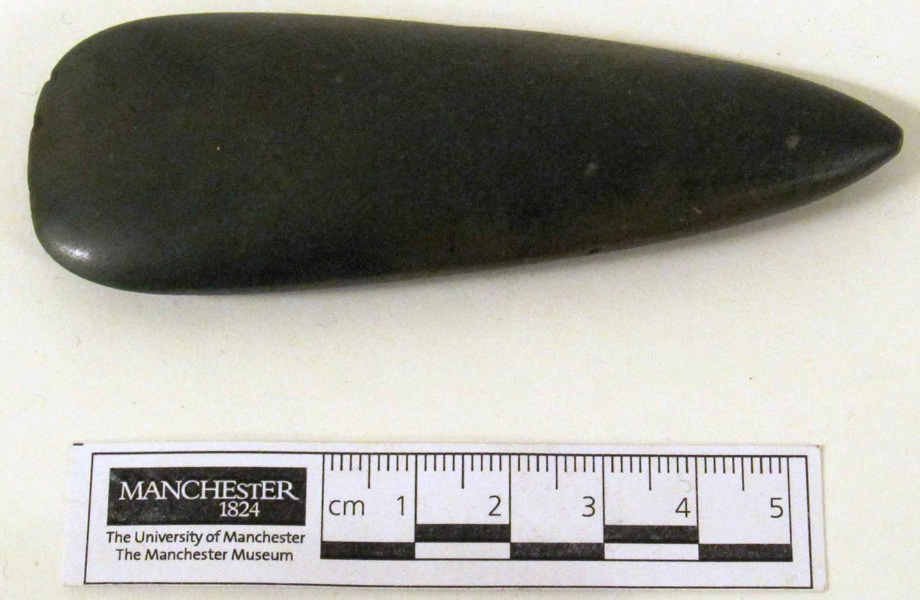
It was a great discovery because most geologists and archaeologists believed Alpine jades had been gathered only from secondary sources in river valleys. In 2003, they were proved right when they found high-altitude quarries – 1800–2450m od – at the south-east foot of Monte Viso, 60km south-west of Turin. In November that year, they struck green gold again, in the vicinity of Monte Beigua, part of the Voltri massif, immediately to the north-west of Genoa.
From these 2 quarries, Jade axe-heads circulated for considerable distances — that is 3,300 km from the West to the East, Ireland to Bulgaria, and more than 2,000 km from the North to the South, Denmark to Sicily — through Western Europe during the fifth and forth millenniums B.C.
To understand the process, they decided to focus on the large axes (> 13.5 cm. length) and they found almost 1800 axeheads in Europe. For Britain and Ireland, the first attempt at a British and Irish corpus was made by Lily Chitty in the 1930s. By 1949, the total had risen to 50 and by 1977 the list had more than doubled, to 112. Today, it stands at nearly 130... and rising.
The earliest exploitation focused on the dark green Monte Viso eclogites, and the products were workaday axeheads for local use in north Italy (up to 400 km around Monte Viso). But from the beginning of the fifth millennium BC, these were being exported as prestigious exotic novelties up to 700km away, into eastern France and the Paris Basin, and were being copied in local materials.
By around 4500 BC or slightly before, blocks of the exceptionally rare, pale green jadeites from Monte Viso and Monte Beigua were being transferred over 200km to the northwest fringe of the Alps, to be made into fine long axeheads. These then found their way – via the Paris Basin – to Brittany, where they were reground and repolished into a thinner, regionally-distinctive shape for burial in the famous massive Carnac tumuli, alongside copies made from local fibrolite and imported Spanish beads of variscite (callais).
These are the axeheads shown on the Breton menhirs and on the famous passage tomb at Gavrinis. The Alpine sources continued to be exploited into the first half of the third millennium, but the main period of production for very long-distance movement seems to have ended by 4000BC.
Beside the 1800 blades axes > 13, 5 cm, we know at least 14,000 blades smaller sizes. These smaller blades were used for "technical" reason but the further away, the more small blades are rare. If we take as an example the French Jura, we will find 2 major axes smaller blades for 50 where in Ireland we have two large blades for a little one !
To get these large axes, people were organising summer expeditions in altitude, with long residence times to craft the axeheads. From there, two types of products were back down in the valley: sketches already partly hammered (which advocates for long stays in altitude) and rough blocks or summarily regularized.
These axeheads were exported for example in the Paris basin to be polished during hundred of hours. To achieve a nice 20 cm. length “carnacéenne" axe, it will need:
• 30 to 70 hours to select and prepare the draft axe
• 100 hours for the first polishing in Alpine valleys (1 to 3 grams per hour)
• 100 hours to transform the axe (going from one type "Durrington" to type "Altenstadt").
• 2 to 10 hours for the “glass polish” or perforations (for example the type “Tumiac”)
Finally, some of these axes, after all these changes can be re-exported, including Spain (Vilaperde / 1900 km in total), in Germany (Schweichen / 2000 km in all) and even in southern Italy (Laterza / 2800 km in total).
Within the 1800 axeheads, we can distinguish 14 different major axes:
• Between -5300 and -5000 BC, these are only small blades for technical use.
• From -4900 and -4500 BC, the most common type is "Bégudes", a long and narrow blade with oval sections. Up to now, 272 "Bégudes" were found, concentrated in Italy (159 blades)and France (80 blades) but outside Brittany.
• Towards -4600 BC, we have the greatest range of axes including "Bernon" (45 axes), “Chelles” (188 axes) and the flat triangular axes such as the 240 "Durrington", the 67 “Altenstadt” and 61 "Tumiac" perforated or not. All these blades irrigate the Northern Europe are in opposition to the development of copper blades that grow in Southern Europe.
• After -4200 BC, the main type is "Puy" as an imitation of copper axe until -3700 BC.
1800 known axes produced in 1000 years is not enough to maintain the know-how of the local population. Pierre Pétrequin thinks that about 10 axes were produced every year between -4800 and -3800 BC. But only a few regions were concentrating these large axes (Morbihan, Paris Basin, Loire Valley).
Most of the large axes are not found in the villages but in megalithic graves are in some specific area. Some of them can be found by 2 or more. Of course, when you are visiting Carnac or Vannes museums, a large number of large axes comes from tumulus. But if you step back, it is really a specificity of the Morbihan and in total, only 138 axes have been found in graves.
In many cases, the axes are found outside tombs and often in the form of deposits (65 deposits listed in Europe for 286 axes). Lot of these axes are “out of context" but that does not mean that all these axes have been lost !
In fact, if we look at the environment of these blades "out of context", we see that :
• 79% of the blades are in close proximity to water (marsh, bog, lake, spring, waterfall ...),
• 13 % are in shelters under rocks or hidden in cracks,
• 8% can be found near standing stones.
It is clear that these are voluntary deposits. These include for example the marshes of Glastonbury (UK), Grevenbroich (Germany), Casarotto, (Italy) and rivers like Vendeuil (France). They think that valued object becomes a sacred object that allows elites to get in touch with supernatural powers. This is a very common pattern across centuries and continents: From Emperors of China to the civilizations of Central America through the peoples of New Guinea.
All these great axes, both very rare and highly valued were diverted from their meaning and dedicated to the world of spirits and supernatural powers. This is further reinforced by the numerous representations of monumental standing stons of Morbihan (Gavrinis).
To conclude and whatever the value of these major axes (statutory purpose and / or sacred object), it is clear that these axes are very symbolic and reflect great social differences in the Neolithic
- They are operated at high mountain expeditions (1700 to 2400 meters)
- Only clearest jade are selected for large axeheads
- They are prepared by master craftsmen
- They are hammered and polished for hundreds of hours
- They are transferred over long distances
- They are exchanged between elites
- They can be repolished or reshaped as to load a different story
- They have no trace of technical uses
- They are rare
- They are found in very specific places
- They are included in the engravings standing stones
- Finally, they will be copied with other rocks (flint Paris Basin for example).
The book is a great job following 10 years of research. They found almost 1800 jadeite axeheads in Europe (including 130 in Great Britain) and the Alpine quarries. I have spent all my weekends for the last 3 months reading the 1500 pages and I have learned many things. By the way the iconography is also amazing. The Jadeite axes were part of the Neolithic mythology, such as the standing stones (many axes were engraved on the megaliths.
To follow on, the “JADE 2 project” is on its way. It will focus on the "Objects-Signs and social interpretations of Alpine jades in Neolithic Europe."
PS, sorry for my English, I am a French native - Emmanuel.
See below for more info and links.




 We would like to know more about this location. Please feel free to add a brief description and any relevant information in your own language.
 Wir möchten mehr über diese Stätte erfahren. Bitte zögern Sie nicht, eine kurze Beschreibung und relevante Informationen in Deutsch hinzuzufügen.
 Nous aimerions en savoir encore un peu sur les lieux. S'il vous plaît n'hesitez pas à ajouter une courte description et tous les renseignements pertinents dans votre propre langue.
 Quisieramos informarnos un poco más de las lugares. No dude en añadir una breve descripción y otros datos relevantes en su propio idioma.