

Book Review: Guidestones to the Great Langdale Axe Factories
Submitted by Thorgrim on Saturday, 31 October 2015 Page Views: 30380
Multi-periodCountry: England County: Cumbria Type: Ancient TrackwayInternal Links:


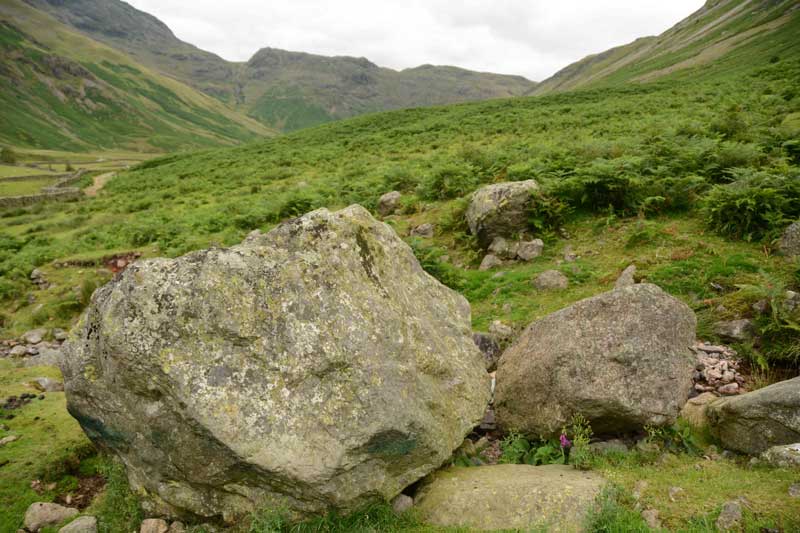
This book has nothing to with leylines, but everything to do with how Neolithic people may have moved around, marked their routes and posted guides. It will also appeal to those readers intrigued by British rock art.
We can be certain that axe heads of the finest quality were made from the very special stone of Great Langdale in the Lake District (see here). We can also be certain that these axes were transported all over Britain by traders and by gift exchange. We are certain, because these axes have been found from Aberdeen to Cornwall and from Galloway to Kent with a particular concentration in Yorkshire and Lincolnshire. Such a manufacturing and export industry must have had a considerable infrastructure. How were the axes transported from the bleak and hostile high fells of Langdale?
The author addresses these issues with detailed maps and very many photographs. He identifies stones that not only appear to mark the routes, but also to point the way. These stones are mainly triangular, lozenge or pentagonal in shape. The presence of hundreds of carved cup, ring and spiral shapes on rocks in northern Britain has never been explained. Is there a link with route marking? Could some of those odd shaped rocks on the northern moors be guidestones too? It might be argued that in an area like Langdale, there are so many random boulders that any researcher could select those that he wishes to make fit a route and exclude others. The author tackles that issue, honestly and openly.
Part 1 describes the Great Langdale Way past the rock art site and on to Raven Crag and then Mickleden. Part 2 covers the Waterfall Way to the axe working sites, Harrison Stickle and Pike o’ Stickle. Written by a man who has lived in Cumbria for thirty years, this is a dependable guide for anyone who wants to search out the guide stones and make up their own minds. By a fortunate coincidence – the Megalithic Portal is adopting a new category of Marker Stones. This category is to be used for natural stones and erratics that appear to have been moved from where nature left them to be used as waymarks. Originally intended to plot the East Anglian Puddingstone Trail (see here
), this category can now be used to plot the guide stones to the Langdale Axe Factory or any other Neolithic trade route.
Readers will make up their own minds. Are these stones just random boulders that seem to mark a trail? Or can we follow the paths of heavily burdened men bringing high quality stone out of the fells? Anyone who has become lost in the sudden mists of Langdale will appreciate how essential are the little walkers’ cairns that lead to safety. Are these strange shaped stones guides to and from the axe factories high up in Langdale? If so – then this study is of major importance to our understanding of Neolithic and Early Bronze Age communications and trade routes. Using the Portal’s sophisticated mapping system; we can perhaps begin to plot Neolithic route maps that will link communities and sacred sites. Very highly recommended!
 Guidestones to the Great Langdale Axe Factories
Ancient ways to stone axe working sites in the English Lake District.
Gabriel M Blamires
ISBN 0-9550270-0-4
2005 Paperback 135pp.
£5.99 (Special Offer price)
Order now from our Online Shop
See more photos from Great Langdale on our page here, then scroll down for the nearby sites list.
Note: Worth a re-run as this excellent book is now on special offer in our shop.


 We would like to know more about this location. Please feel free to add a brief description and any relevant information in your own language.
 Wir möchten mehr über diese Stätte erfahren. Bitte zögern Sie nicht, eine kurze Beschreibung und relevante Informationen in Deutsch hinzuzufügen.
 Nous aimerions en savoir encore un peu sur les lieux. S'il vous plaît n'hesitez pas à ajouter une courte description et tous les renseignements pertinents dans votre propre langue.
 Quisieramos informarnos un poco más de las lugares. No dude en añadir una breve descripción y otros datos relevantes en su propio idioma.