
Featured: See Your Book Here

See Your Book Here

Random Image

Stone Worlds: Narrative and Reflexivity in Landscape Archaeology

Stone Worlds: Narrative and Reflexivity in Landscape Archaeology

Login

Register here - as a registered user you get more features and fewer ads.

Who's Online

There are currently, 1275 guests and 0 members online.

Sponsors

<< Our Photo Pages >> Shovel Down - Multiple Stone Rows / Avenue in England in Devon

Submitted by thecaptain on Friday, 05 July 2024  Page Views: 12719

Neolithic and Bronze AgeSite Name: Shovel Down
Country: England County: Devon Type: Multiple Stone Rows / Avenue
Nearest Town: Chagford  Nearest Village: Teigncombe
Map Ref: SX65958599
Latitude: 50.658115N  Longitude: 3.897843W
Condition:
5Perfect
4Almost Perfect
3Reasonable but with some damage
2Ruined but still recognisable as an ancient site
1Pretty much destroyed, possibly visible as crop marks
0No data.
-1Completely destroyed
4 Ambience:
5Superb
4Good
3Ordinary
2Not Good
1Awful
0No data.
4 Access:
5Can be driven to, probably with disabled access
4Short walk on a footpath
3Requiring a bit more of a walk
2A long walk
1In the middle of nowhere, a nightmare to find
0No data.
4 Accuracy:
5co-ordinates taken by GPS or official recorded co-ordinates
4co-ordinates scaled from a detailed map
3co-ordinates scaled from a bad map
2co-ordinates of the nearest village
1co-ordinates of the nearest town
0no data
5

Internal Links:
External Links:

I have visited· I would like to visit

whese001 would like to visit

Catrinm visited on 27th Jun 2025 - their rating: Cond: 3 Amb: 4 Access: 4

jeffrep visited on 21st May 2011 - their rating: Cond: 3 Amb: 4 Access: 4

Andy B: would like to visit Area of hut circles and reaves visited by Neil Oliver in Episode Four of A History of Ancient Britain

AngieLake TheCaptain have visited here

Average ratings for this site from all visit loggers: Condition: 3 Ambience: 4 Access: 4

Shovel Down
Shovel Down submitted by thecaptain : Overall view of the Shovel Down site, taken looking west from Kestor on Sunday 10th October 2004. I have tried to indicate the position of most of the various parts of this large ceremonial centre. (Vote or comment on this photo)
Near the northeastern corner of Dartmoor, to the west of the old stannary town of Chagford at Shovel Down, are a multitude of remains which together make up the Shovel Down complex of ceremonial sites. The site includes an open stone circle, a fourfold cairn circle, a long single stone row, 6 double stone rows or avenues, a giant longstone, several other standing stones, several cairns, and the remains of an ancient settlement.

Access to these sites is fairly easy for Dartmoor, by driving west from Chagford to Batworthy Corner, right up on the moor, where a few parking spaces are available. From here it is only a short walk along a fairly well defined trackway until the first of the sites is encountered. There are many other trackways here, which will take the visitor around most of the rest of the sites. In fact, there is a trackway which runs right along the north south axis of the site, which is part of an ancient trackway from Scorhill in the north to Fernworthy in the south, which no doubt is here because of the ancient avenues and rows which it follows.

The visitor here is walking in the footsteps of 4000 years of our ancestors.

Update December 2019: This complex is also featured on the Prehistoric Dartmoor Walks (PDW) website - see their entries for the Shovel Down Ceremonial Complex and the Shovel Down Complex. PDW also includes separate entries for the individual stone rows, standing stones and cairns (see the individual pages on the 'nearby sites below' for more information).

More information can also be found on Pastscape Monument No. 443524 and as part of the scheduling information for Historic England List ID 1017874 (The North Teign coaxial field system (western part) and associated later remains at Shovel Down, Stonetor Hill and Long Ridge).
You may be viewing yesterday's version of this page. To see the most up to date information please register for a free account.
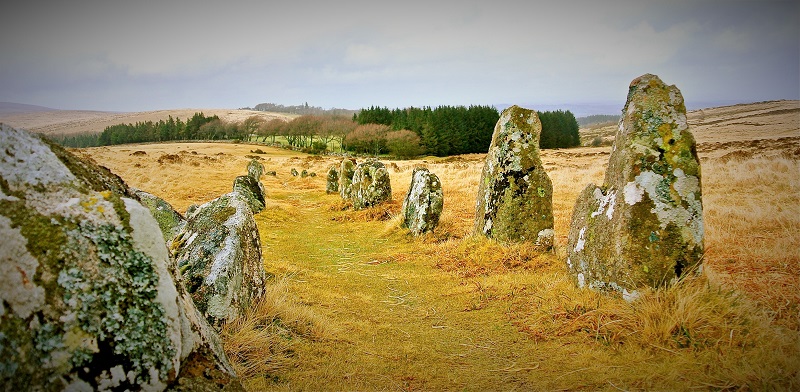

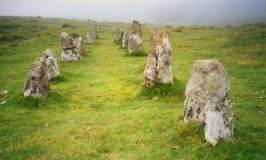
Shovel Down row 2
Shovel Down row 2 submitted by StoneLee : Great Site. (Vote or comment on this photo)

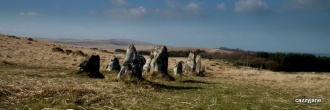
The Longstone (Shovel Down)
The Longstone (Shovel Down) submitted by cazzyjane : The longstone at Shovel Down with Kestor Rock behind. (Vote or comment on this photo)

The Longstone (Shovel Down)
The Longstone (Shovel Down) submitted by GlavindStrachan : Visited in April 2021 and (as per usual when coming here) we weren't disappointed 😍 It was a cold start to the day, and Dartmoor's wonderfully unpredictable weather meant sunshine, sleet and finally some snow ... made for very dramatic photographs! (Vote or comment on this photo)

Shovel Down Fourfold Circle
Shovel Down Fourfold Circle submitted by crannog : fourfold circle, double stone row. (snuggledown). SX 659 860. (6 comments - Vote or comment on this photo)

Shovel Down Fourfold Circle
Shovel Down Fourfold Circle submitted by crannog : double stone row, fourfold circle (snuggledown) . SX 659 860. (1 comment - Vote or comment on this photo)

The Longstone (Shovel Down)
The Longstone (Shovel Down) submitted by HelenElizabeth : Site in Devon England, Longstone at Shoveldown with Kes Tor in background (artistic representation, oil painting as part of my 'Walking with the stones' project).

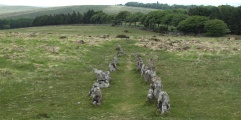
Shovel Down row 2
Shovel Down row 2 submitted by AngieLake : Looking across Row 2 (Worth's A-B), at an angle towards approx NW, as it rises towards the fourfold circle. Cosdon dominates the horizon. (2 comments)

The Longstone (Shovel Down)
The Longstone (Shovel Down) submitted by cazzyjane : The Longstone in it's stunning surroundings. March 2012. (2 comments)

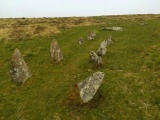
Shovel Down row 2
Shovel Down row 2 submitted by cazzyjane : Shovel Down Row 2. March 2012

The Longstone (Shovel Down)
The Longstone (Shovel Down) submitted by Bladup : The Longstone (Shovel Down) with Kestor Rock in the background

Shovel Down row 2
Shovel Down row 2 submitted by davep : Shoveldown B stone row, from the Prehistoric Dartmoor Walks website, site 134.

Shovel Down row 2
Shovel Down row 2 submitted by Bladup : Shovel Down row 2.

Shovel Down row 2
Shovel Down row 2 submitted by cazzyjane : Shovel Down Row 2 on a beautiful March day.

The Longstone (Shovel Down)
The Longstone (Shovel Down) submitted by crannog : nice walk from many the stone rows at four fold following what seems a partial stone row that leads to this langstane.... with breath-taking views over the moor and kiss tor

Shovel Down row 2
Shovel Down row 2 submitted by jeffrep : Shovel Down Stone Row 2, Dartmoor National Park, Devon, England.

The Longstone (Shovel Down)
The Longstone (Shovel Down) submitted by simonsworn : The Longstone first thing in the morning, facing southeast (1 comment)

Shovel Down Fourfold circle
Shovel Down Fourfold circle submitted by simcon : SX659861 Shovel Down Stone Circle, Dartmoor Devon. I see this Web site lists two circles here, SE and NW. I only saw this circle which matches the description of Shovel Down SE Stone Circle. The view is looking south where the row continues to a large standing stone. Notice the two large standing stones fallen at the bottom of this picture. One has CP carved into it and the large stone over the hi... (1 comment)

The Longstone (Shovel Down)
The Longstone (Shovel Down) submitted by phlebas : Menhir Love!

Shovel Down row 2
Shovel Down row 2 submitted by Bladup : Shovel Down row 2 with the Fourfold Circle

The Longstone (Shovel Down)
The Longstone (Shovel Down) submitted by Anne T : The last but one stop (via the absent row 6) of our epic three day guided tour of to Dartmoor. The group around the Longstone. Left to right: Janet Daynes, Angie Lake, Andy Burnham, Sandy G, Dave P, Gordon Fisher, Andrew Tate (Anne T thankfully behind the camera!). Photograph taken 16th May 2019.

The Longstone (Shovel Down)
The Longstone (Shovel Down) submitted by davep : Shovel Down Long Stone Standing Stone. Prehistoric Dartmoor Walks, site 18. (1 comment)

The group on Shovel Down
The group on Shovel Down submitted by AngieLake : This is the best of two I took of the group at the Shovel Down Longstone on Dartmoor. At least Andy B's hair looks tidy! (he's just to the left of the stone) Kestor Rock over Janet's right shoulder. 'GP' stands for Gidleigh Parish. 16th May 2019

The group on Shovel Down
The group on Shovel Down submitted by AngieLake : Have done a swap with AnneT [see previous photo] who took this shot on my camera. Showing how windy it is again, with the old girl on the left looking almost bald! ;-)

The group on Shovel Down
The group on Shovel Down submitted by AngieLake : Left to right: Angie, Gordon (Janet's partner), Dave Parks of Prehistoric Dartmoor Walks, Andrew Tate, Andy Burnham, Sandy Gerrard, and Janet Daynes (director of the dig at Moistown by ACE Archaeology Club). Anne T took the photo, 16th May 2019. (3 comments)

These are just the first 25 photos of Shovel Down. If you log in with a free user account you will be able to see our entire collection.

Do not use the above information on other web sites or publications without permission of the contributor.
Click here to see more info for this site

Nearby sites

Click here to view sites on an interactive OS map

Key: Red: member's photo, Blue: 3rd party photo, Yellow: other image, Green: no photo - please go there and take one, Grey: site destroyed

Download sites to:
KML (Google Earth)
GPX (GPS waypoints)
CSV (Garmin/Navman)
CSV (Excel)

To unlock full downloads you need to sign up as a Contributory Member. Otherwise downloads are limited to 50 sites.


Turn off the page maps and other distractions

Nearby sites listing. In the following links * = Image available
 40m N 358° Shovel Down Fourfold Circle* Stone Circle (SX65958603)
 50m SE 142° Shovel Down row 4* Multiple Stone Rows / Avenue (SX65988595)
 112m SSE 152° Shovel Down Cairn Row 4* Cairn (SX66008589)
 175m WSW 237° Shovel Down Settlement* Ancient Village or Settlement (SX658859)
 180m NNW 339° Shovel Down row 3* Multiple Stone Rows / Avenue (SX65898616)
 193m SSE 157° Shovel Down row 5* Multiple Stone Rows / Avenue (SX66028581)
 210m N 359° Shovel Down row 2* Multiple Stone Rows / Avenue (SX65958620)
 216m NNE 12° Shovel Down row 1* Stone Row / Alignment (SX660862)
 247m NNW 327° Shovel Down stone circle* Stone Circle (SX65828620)
 320m SSE 164° The Longstone (Shovel Down)* Standing Stone (Menhir) (SX66038568)
 393m S 171° Shovel Down row 6* Multiple Stone Rows / Avenue (SX660856)
 516m S 170° Three Boys* Standing Stone (Menhir) (SX66038548)
 553m SSE 162° Thornworthy Corner North Cist (SX66118546)
 592m S 174° Shovel Down row 7* Multiple Stone Rows / Avenue (SX660854)
 647m ENE 62° Kes Tor Cairn* Cairn (SX6653286277)
 665m ENE 63° Kes Tor Rock Basin* Natural Stone / Erratic / Other Natural Feature (SX66558628)
 671m ENE 58° Kestor Settlement* Ancient Village or Settlement (SX66538633)
 759m WSW 240° Stonetor Brookhead East Cist (SX65288563)
 870m SW 232° Stonetor Hill Cairn Circle* Cairn (SX6525085470)
 949m NE 55° Modern Stone Circle near Kestor Rock* Modern Stone Circle etc (SX66748652)
 965m NNE 26° The Round Pound* Ancient Village or Settlement (SX66398685)
 992m SW 228° Stonetor Hill Stone Ring Cairn Circle Ring Cairn (SX65198535)
 1.2km NNW 336° The Tolmen Stone (Dartmoor)* Natural Stone / Erratic / Other Natural Feature (SX65508708)
 1.2km SE 141° Thornworthy Down Stone Row / Alignment (SX66688505)
 1.3km NNW 338° Scorhill Cairn and Rows* Multiple Stone Rows / Avenue (SX65488721)
View more nearby sites and additional images

<< Binidalinet

Pithenge (Szeged) >>

Please add your thoughts on this site

Prehistoric Settlements

Prehistoric Settlements

Sponsors

Latest Visit Logs

  • The Bargain Stone
    “Sadly when I was there it was covered by a large box. At least the workers renovating the church ha…”
    by cactus_chris · 15 Jun 2026
  • Sigtuna U 389
    “Right next to the museum entrance, this runestone is hard to miss.”
    by CharcoalBurner89 · 15 Jun 2026
  • The Awen Stone
    “Situated in the grounds of West End Campsite, easily visible and accessible as of June 2026.”
    by TimPrevett · 15 Jun 2026
  • Dolmen de la Roc de l'Arca
    “GPS co-ordinates are accurate. Use the same parking as for Dolmen de la Cauna del Moro and walk 200…”
    by Jhalst1 · 14 Jun 2026
  • Dolmen de la Cauna del Moro
    “The GPS co-ordinates are accurate, and you can drive to withing 10m of the dolmen. There is parking …”
    by Jhalst1 · 14 Jun 2026

"Shovel Down" | Login/Create an Account | 2 News and Comments
  
Go back to top of page    Comments are owned by the poster. We aren't responsible for their content.
Re: Shovel Down (Shuggledown) Stone Rows described by R. Hansford Worth in 1932 by AngieLake on Friday, 17 August 2012
(User Info | Send a Message)
Excerpts from R. Hansford Worth’s Survey of The Prehistoric Monuments of Scorhill, Buttern Hill and Shuggledown (Shoveldown) as read at Paignton on 21st June 1932.
[Reprinted from the Transactions of the Devonshire Association for the Advancement of Science, Literature, and Art. 1932. – Vol. lxiv, pp. 279-287.]
NB: There was no copyright note on either* of the Transactions of the Devonshire Assoc. booklets that I bought recently in a hospice charity shop in Exeter. * [The second is The Stone Rows of Dartmoor, Part 1].
Btw: Letters after his name = R. Hansford Worth, M. Inst. C. E., F.G.S. (Presumably a Civil Engineer and fellow of Geological Soc.?, who should have been capable of producing a very accurate survey and account.)

STONE ROWS ON SHUGGLEDOWN

Before starting at the beginning of his lecture on Shuggledown (Shoveldown), it might be helpful to look at R. Hansford Worth’s plan of his 1931 survey on Meg P’s site page for ‘Shovel Down’, and read a summing-up paragraph that explains the ‘lay [or lie] of the land’:
“As regarding the whole group, a plan alone is capable of some misinterpretation, the levels have a great influence in any attempt at realizing the conditions. In this case the line of the rows crosses a ridge. The rows north of F lie on ground descending to the north, and those south of H lie on ground descending to the south. The two sets, north of F and south of H, are each wholly invisible from any part of the other. Even in each group there are parts obscured from points in the same group. Thus from the north end of the row lying north of the Longstone, that menhir can not be seen.”

At the beginning of his lecture Hansford Worth made this interesting comment:
“It has been alleged by more than one writer that the rows on Shuggledown form part of a series which once extended from the Fernworthy Circle to the Scorhill Circle.” However, he found no evidence for this during his detailed surveys.

According to Worth, the best approach to Shuggledown Rows is from Batworthy Corner, starting at the north end of the group. “Standing at Batworthy Corner and looking a little west of south, you will see at a distance of about 285 feet the first stone of a row; except where it has been robbed the row is double. It is obvious that the north end has been much more severely despoiled than the south part, probably as being much nearer the walls and fences of Batworthy, which have very possibly swallowed a considerable length of the row.”
“This row, marked A-B on the plan, is in length 595’-7” to the centre of a barrow with a fourfold circle which forms its southern terminus. I noted 34 stones still standing, and four fallen. Between the pairs of stones constituting the double row the average distance is 3ft. 6ins. The two last stones, before the circle is reached, are both fallen, both are larger far than the other members, the one further from the circle being 7ft. 4ins. in length, and the nearer being 11ft. 6ins. In length; this latter is inscribed with the letters “G.P.” being a boundary mark of Gidleigh Parish, an adopted use.”

He mentions Croker [1852] as giving the most accurate description of the fourfold circle: “a set of circles of upright stones placed as follows: the outermost circle consists of 17 stones, the second of 6 stones, the third of 8 stones, and within this are 3 stones irregularly placed, the whole being 15 feet in circumference.” Here, Hansford Worth points out Croker’s error – “circumference” should read “radius”.
H. Worth observes: “Today”.. [1931]..”the outermost circle contains nine stones standing and one fallen (Ormerod, 1858, say ten stones in all), and has evident gaps; it may well be that seven stones have been removed since 1852, indeed, the least number required to fill the gaps would be five. The second circle still presents six stones, all standing, and probably once had four more. The third circle still has eight stones, all standing, and probably once had two more. (There is an obvious error in Ormerod’s statement that the diameter of this circle is 3 feet; the measure is 16 feet.) The fourth and inmost circle has four standing stones, two fallen, and room for two more. This fourfold circle has its parallel in the much larger example on Yellowmead Down which is over twice the diameter.”

“The direction of length of the row A-B is S. 1⁰- 40’ E. About 83 feet north-west of the centre of the fourfold circle is the end of another double row” .. [D-E].. “which extends 476 feet in a direction N. 21⁰-15’ W.” [NB: Later Worth gives Row E-D’s orientation as “S. 21⁰-15’ E.] “The average distance between the lines of stones is a little over four feet, but it varies considerably. For the more part the stones of one or the other line are missing and there are but nine pairs standing as such. I counted forty stones in all. No special feature now marks either end of the row, neither barrow, menhir, nor blocking stone.”

“On a bearing a little to the north of west from the north end of row D-E, and at a distance of 207 feet is the centre of the geometric circle which would pass through three stones still standing.” [‘CIRCLE ?’ on plan]. “Whether these stones are in fact the remains of a circle cannot be determined; they are three standing stones, and the greatest breadth of each is set tangentially to the circle which can be described as passing through them, and would have a diameter of 56 feet 6 inches.” [NB: In the early days – 1997? – of my membership of our local dowsing group we did extensive archaeological dowsing surveys on Shovel Down, and found a circle in this area. It dowsed as ceremonial, rather than just a hut circle, btw.]

“Returning to the point B, almost due west from this, and at a distance of 65 feet 6 inches, is the commencement of yet another double row, C-F, the direction of which is S. 28-30’ E.,” [see table of orientations of rows]* “the length of which to the centre of the barrow which forms the southern end is 386 feet. The two lines of this row are 5 feet apart, twelve pairs of stones still stand, thirty-one stones stand the companions of which have been removed, and there are six fallen stones. At a point 94 feet along the row, measured south from C, and at a distance 29 feet to the east is a barrow of 13 feet diameter.” [Marked ‘CAIRN’, below ‘B’]
“The Barrow at F, which forms the southern terminus of the row C-F, has a diameter of about thirteen feet. It may have contained a kistvaen; indeed, Ormerod describes this row as ending in a kistvaen.” [1858?]

“About 225 feet to the S.S.E. from the centre of the barrow at F are the first remaining stones of a double row which runs S. 3⁰ E. for a distance of 485 feet, to the Longstone, with which it terminates. Of this row ten pairs still stand, and thirty stones which have lost their companions, while five have fallen. The average distance between the rows would appear to have been about 3 feet three inches.”
[This row seen starting below ‘G’ on the plan.]

“The Longstone is a fine menhir, measuring at the base, N. 35 ½ inches, E. 24 inches, S. 33 inches and W. 21 inches; its height is 10 feet 5 inches (Croker and Page both give the height as 12 feet).” [The latter pair writing in 1851? and 1889?]

“Due South of the Longstone, at a distance of about 555 feet, is an isolated menhir, the last of three associated stones, known as the Three Boys, which Ormerod suggests were once the supporters of a cromlech. (More probably these were merely selected large stones at the end of the row, as at the fourfold circle.) The two missing stones have doubtless gone as gateposts to the Thornworthy enclosures; and the same enclosures have absorbed in their fences the stones of a double row which formerly connected the Longstone and the Three Boys. Ormerod states that, in 1858, the pits left by the removal of the stones of this avenue were still to be seen in the turf.”
“The remaining “Boy” is now much out of the perpendicular, and the length out of ground is about 4 feet 6 inches.”
[A point of interest: when I first met the dowsers whose group I subsequently joined, they were surveying and dowsing the Longstone, and had dowsed a circle of stones surrounding it.]

Hansford Worth continues: “We may now return to the row running north from the Longstone. This has a companion lying at an average distance of forty feet to the east, being sixty feet away on the south and converging toward the Longstone Row to the north. Excepting Baring-Gould”.. [1900?].. “no previous writer has mentioned this row, and his plan shows it as, in part at least, double. It is now single, and appears always to have been so. From H to K it pursues a straight course, S. 11⁰ E., 95 feet in length, and contains thirty small stones still set, the largest of which is 25 inches in height. But from H northward there is a curious apparent extension, consisting of nine small stones and a terminal of larger size which has fallen, its length is 4 feet 6 inches and its greatest width 2 feet 9 inches. This extension curves to the west, toward the point F. It may really be an independent row.”

“The interest of this group as a whole is increased by the fact that it supplies instances of rows which fail to conform with the rule that the direction should lie somewhere between South and West, and exceptions to that rule are exceedingly rare. Here we have the following directions: -
1. Row A-B. S. 1⁰-40’ E.
2. Row E-D. S. 21⁰-15’ E.
3. Row C-F S. 28⁰-30’ E.*
4. Row H-K S. 11⁰-0’ E.
5. Longstone Row. S. 3⁰-0’ E.
6. Longstone to Three Boys, due S.
*[NB: Worth did not put a ⁰ sign after ‘28’ on his earlier statement regarding row C-F, but this orientation in the table above seems more accurate when compared to his plan.]
“The deviations from the rule may be ignored in the case of 1, 5 and 6, but 2, 3 and 4 are a different matter. No explanation can be offered; we know too little.”

“It remains to mention a kistvaen which lies 177 feet distant from Thornworthy Corner, on a bearing N. 14⁰ W., one side stone measures 5 feet 6 inches, and the direction of length is S. 1⁰ E., conforming to the kistvaen rule as to the direction lying within the south-east quadrant. This kistvaen has not previously been reported.”

I hope Meg P readers will find this useful. I've been there many times but never with such detailed information at hand. Even if this is now superseded by Butler's more modern surveys it might be useful to compare the number of stones left today, and how they once leaned over, or matched in pairs along a row, and even follow the missing row? Maybe someone has excavated the 'circle?'...?
[As well as dowsing that one, our group - while I was working full-time - dowsed a huge circle on the summit of Shovel Down. A 'cromlech' at its centre aligned with sunrise rising over Kestor Rock on Summer Solstice. Members Tony and Jackie observed and filmed this event. As with all the group's dowsing surveys, careful plans were drawn up, so there's a written and drawn record of the circle, which they christened 'The Arena Circle'.]
[ Reply to This ]

Re: Shovel Down by TheCaptain on Sunday, 17 October 2004
(User Info | Send a Message)
I have to admit to being fairly disappointed by all the Shovel Down sites except for the Longstone when I visited on a wet and windy October 10th 2004.

Most of the sites have been well demolished, probably by wall builders in the 18/19th century. Just look at the walls around Batworthy Corner, and you will see that an awful lot of stone, both large and small, was used to build them, and it would all have to have been sourced from somewhere. Where better than a nicely laid out row of ready made building material just a few yards away on the moor.

And of the remaining stones, many are very small indeed, and have become overgrown very easily by the grass, and indeed buried in the turf.

But still, it was a nice afternoon out exploring, much better for me than sitting here at the pooter ! And its always nice to get out for a walk on the moor, even in the wet. In three and a half hours of walking, I only saw another 3 people all afternoon (and one dog).
[ Reply to This ]

Your Name: Anonymous [ Register Now ]
Subject:


Add your comment or contribution to this page. Spam or offensive posts are deleted immediately, don't even bother

<<< What is five plus one as a number? (Please type the answer to this question in the little box on the left)
You can also embed videos and other things. For Youtube please copy and paste the 'embed code'.
For Google Street View please include Street View in the text.
Create a web link like this: <a href="https://www.megalithic.co.uk">This is a link</a>  

Allowed HTML is:
<p> <b> <i> <a> <img> <em> <br> <strong> <blockquote> <tt> <li> <ol> <ul> <object> <param> <embed> <iframe>

We would like to know more about this location. Please feel free to add a brief description and any relevant information in your own language.
Wir möchten mehr über diese Stätte erfahren. Bitte zögern Sie nicht, eine kurze Beschreibung und relevante Informationen in Deutsch hinzuzufügen.
Nous aimerions en savoir encore un peu sur les lieux. S'il vous plaît n'hesitez pas à ajouter une courte description et tous les renseignements pertinents dans votre propre langue.
Quisieramos informarnos un poco más de las lugares. No dude en añadir una breve descripción y otros datos relevantes en su propio idioma.