



Bone dice and gaming boards from Iron Age and Roman Britain
Submitted by Andy_B on Wednesday, 28 October 2026 Page Views: 37
Resources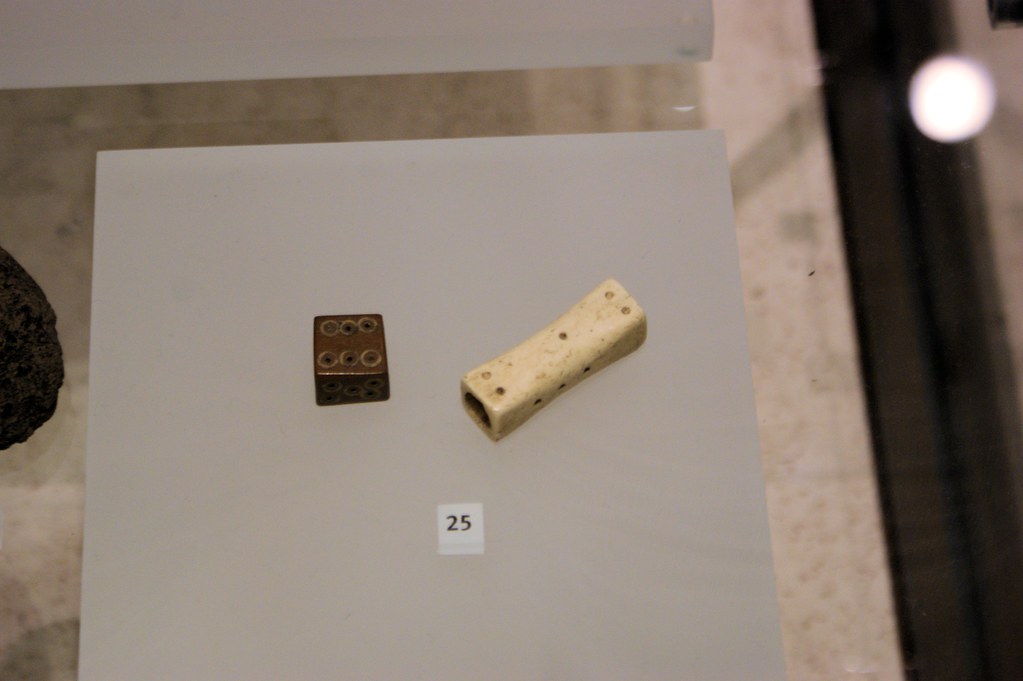
Rolling the bones: games of chance in prehistoric and Roman Britain
Among the finds from Skara Brae, the Neolithic village in Orkney, is a small block of bone, about 20mm square and 10mm thick, that resembles a die. National Museums Scotland, which holds it, dates it to the late Neolithic, around 3200 to 2400 BC, and adds a careful note: it "may also be interpreted as an unfinished bead".
That caution suits the subject: the surer evidence is later, and much of it Roman or touched by Rome. In a 2011 paper in Antiquity, Mark Hall and Katherine Forsyth argued that board games "arrived in Britain and Ireland through contact with the Roman world".
Long dice and a grave set
Some Iron Age dice were long rather than cubic. A bone die from Stacwick Bay on Sanday, also in Orkney, is an oblong with dots on four sides, dated by National Museums Scotland to between the 2nd century BC and the 4th century AD. Such dice, D. V. Clarke wrote in 1970, "form a small but important group in the bonework of the Scottish Iron Age".
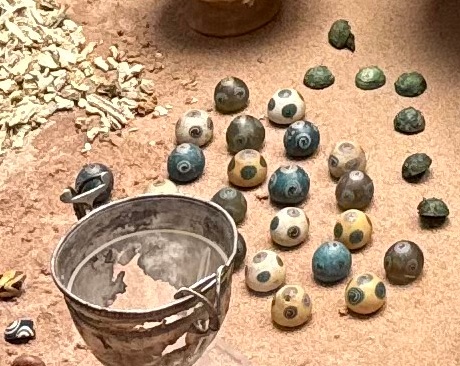
At Welwyn Garden City in Hertfordshire, a trench for a gas pipe cut into a rich cremation burial of the late first century BC, which Ian Stead excavated in 1965. Among the grave goods were 24 glass gaming pieces, six each in white, yellow, red and green, found so close together that the British Museum suggests they were buried in a bag. Four matching sets suggest four players, which would make the game unique, as other ancient board games seem to have been for two. The set is on display in Room 50.
Boards and dice on the frontier
English Heritage calls Corbridge in Northumberland the most northerly town in the Roman Empire. Parts of at least five stone gaming boards and hundreds of counters have been found there, and the collection on site includes a board with counters, dice and a shaker from the 2nd to 3rd centuries AD. Its dice, usually of bone, "mirror modern examples in their design", while the orange counters were made from broken samian, an imported Roman pottery.
Further north, at the fort of Newstead near Melrose, James Curle's 1911 report records "a bone die, indicating a game of chance rather than of skill" from a pit he called the Well at the Baths. Of the fort's improvised discs he wrote that they "were probably used to beguile the tedium of garrison life in Caledonia". A Roman bone die from Newstead, dated AD 80 to 180, is now in the National Museum of Scotland.
What the law allowed
Roman law frowned on all this. Justinian's Digest quotes the praetor's edict refusing to hear a host at whose house dice had been played if he was then beaten, robbed or had his property damaged. It also records a Senate decree banning play for money except in contests of strength and courage, such as throwing the javelin, running, jumping, wrestling and boxing.
December was different. "Games of chance were, however, tolerated in the month of December at the Saturnalia," as Smith's Dictionary of Greek and Roman Antiquities put it in 1875. The poet Martial pictures a slave at the festival who, "as he rattles the dice-box, has no fear of the Aedile". Suetonius notes that Augustus played "not only in the month of December, but on other holidays as well, and on working days too".
Four knucklebones
Knucklebones, or tali, were thrown in fours, each bone scoring 1, 3, 4 or 6. The top throw, Venus, showed four different faces; the lowest was the dog. In a letter quoted by Suetonius, Augustus sets out the rule at his table: "whoever turned up the 'dog' or the six, put a denarius in the pool for each one of the dice, and the whole was taken by anyone who threw the 'Venus.'"
In Kent, Folkestone Museum holds flint, bone and stone gaming counters from Folkestone Roman Villa, dated about AD 100 to 175, and eight Roman knucklebones whose findspot its online record does not give.
Then and now
Nearly two thousand years on, much of the rattle has moved online. Gambling Commission figures for April 2025 to March 2026 put the remote casino, betting and bingo sector at £8.3 billion of Great Britain's £13.2 billion gross gambling yield, lotteries excluded. That yield is what operators keep after prizes are paid; it measures money, not how many people play. At Fortune Games, an online casino for over-18s, there is no bone to rattle: roulette, blackjack and scratchcards are played on a computer, a phone or the site's own app.
The older pieces are easier to see than to play: at the British Museum, the National Museum of Scotland in Edinburgh and Corbridge itself.
You must be 18 or over to play. If gambling stops being fun, the National Gambling Helpline (0808 8020 133) is free and open 24/7, and GAMSTOP lets you block every UK-licensed gambling site at once.
