


Tiny hazelnut reveals secrets of Peeblesshire’s earliest people
Submitted by vicky on Friday, 17 October 2003 Page Views: 1107
DiscoveriesA recently processed radiocarbon date shows that a prehistoric hunting camp excavated at Manor Bridge, just outside Peebles, is one of the oldest yet known in Scotland. The result shows that the hazelnut must date to between 8300 and 7960 BC in the Mesolithic period.Only two of the sites of this period known from Scotland are older: Cramond, on the shores of the Forth outside Edinburgh dates to 8600 - 8100 BC, and Daer Reservoir, Lanarkshire, excavated under the direction of Tam Ward, dates to 8550 - 7950 BC. Manor Bridge, along with Daer, shows that groups of hunter-gatherers were present in the interior of Scotland soon after our first evidence of their arrival in the country.
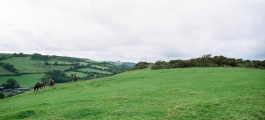
The site at Manor Bridge lies on a small rocky outcrop on the north bank of the Tweed, immediately downstream of its junction with the Manor Water.
Well-known local archaeological enthusiast Bob Knox first identified the site in the early 1980s.
Bob’s sharp eyes spotted tiny stone tools made of chert and flint, eroding out of the popular footpath along the river.
In July 1998, Graeme (then of the Department of Archaeology, Edinburgh University) and Bob excavated a small number of test pits on the rocky outcrop above the river junction and in the field above this.
The excavations showed evidence of structural remains including a stone setting and a pit or scoop from which the carbonised hazelnuts were recovered.
Much of the evidence from the site is in the form of stone tools, of which nearly a thousand have been found. Small amounts of flint and larger amounts of local deposits of chert were used to manufacture blades and tiny tools known as microliths.
Together, all the evidence points to a small campsite set above the Tweed.
The Manor Bridge date places this activity around 1300-1600 years after the end of the last Ice Age, and the landscape surrounding the site would then have been dominated by light woodland — with birch and hazel particularly important.
Plant remains from Manor Bridge include hazel, birch, willow, oak and rowan/crab apple family.
The location of the site, above a popular fishing location, seems to imply that salmon may have been an important resource.
As animal remains do not survive, it is difficult to be certain about the overall diet - but it certainly seems that hazelnuts played a part — as they did on many other Mesolithic sites in northern Europe. Collected in the autumn, they would have provided a useful source of nourishment especially if roasted and stored for the winter use.
Graeme’s fascinating report finished by stressing that further work is needed at this and other sites in the region, so that archaeologists can get a better picture of when and how people first settled the Borders landscape.
In the meantime, however, the Manor Bridge site shows that the Peebles area has long been a focus of human settlement in Scotland!
At the moment only one fragment of hazelnut has been dated — and further radiocarbon dates will be needed. Little did those early folk by the Tweed know that that their food remains would one day be used to throw light on their lives!
Source: Peeblesshire News 16/10/2003


 We would like to know more about this location. Please feel free to add a brief description and any relevant information in your own language.
 Wir möchten mehr über diese Stätte erfahren. Bitte zögern Sie nicht, eine kurze Beschreibung und relevante Informationen in Deutsch hinzuzufügen.
 Nous aimerions en savoir encore un peu sur les lieux. S'il vous plaît n'hesitez pas à ajouter une courte description et tous les renseignements pertinents dans votre propre langue.
 Quisieramos informarnos un poco más de las lugares. No dude en añadir una breve descripción y otros datos relevantes en su propio idioma.