Featured: New Book: Astrometrology: The Science of Ancient Metrology by Christopher Willett

New Book: Astrometrology: The Science of Ancient Metrology by Christopher Willett

Current Archaeology Book of the Year 2019!

Current Archaeology Book of the Year 2019!

Login

Register here - as a registered user you get more features and fewer ads.

Who's Online

There are currently, 991 guests and 14 members online.

Sponsors

<< News >> New Mineral analysis indicates Stonehenge’s Altar Stone originated from Scotland

Submitted by Andy B on Wednesday, 14 August 2024  Page Views: 6516

Discoveries
Stonehenge.
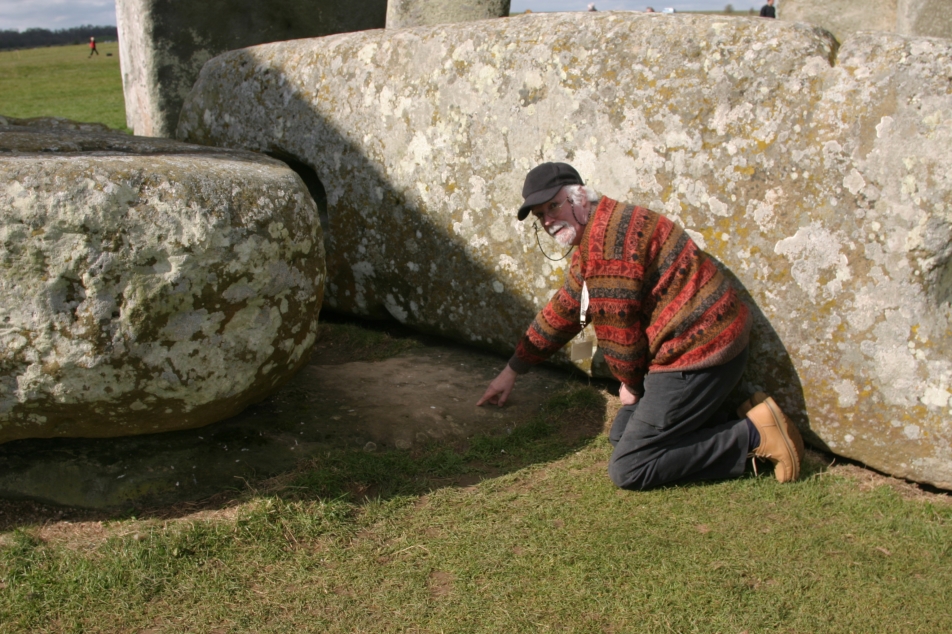
Stonehenge. submitted by Andy B : Geologist Dr Rob Ixer, co-author of much scientific research on the provenance of stones at Stonehenge points out the Altar Stone, deeply buried under two other sarsens. (Vote or comment on this photo)
By Dr Rob Ixer and Prof. Peter Turner, two key Altar Stone researchers. A new analysis of Stonehenge’s central six-tonne Altar Stone indicates that it is likely to have come from north east Scotland, at least 750 kilometres away from its current site in Wessex, and perhaps more than 1000 kilometres if it travelled following the present-day coastline. Plate tectonics and precise radiometric age dating are the keys to this discovery.

Almost exactly 60 years ago a series of papers convinced the geological world that the disputed idea of continental drift was correct, with the concept of plate tectonics (a continual process of crust being created and destroyed) being the mechanism for this movement. In the succeeding years the movements of landmasses since the Proterozoic (2.5 billion years ago) have been and are being reconstructed (mainly based on palaeomagnetic data) to show cycles of break-up, coalescence and recombining of super-continents.

Zircon, rutile and apatite are small rare minerals found in igneous rocks. They are found more in acidic/granitic rocks than basic/basaltic ones. Zircon, rutile and apatite are chemically inert and quite resistant to weathering, so

a) they are ideal for obtaining radiometric ages to date their creation within their parent body of igneous rock;

b) they can be a significant component in the make-up of clastic sediments such as sandstone - bearing in mind that their radiometric age is usually earlier than that of the enclosing sediment, and retains the date of their origins from those original landmasses.

This study, published in Nature, analyses the chemical and isotopic composition of detrital zircon, rutile and apatite grains within the Altar Stone – an assumed Palaeozoic Old Red Sandstone - to determine their isotopic ages and so help to pinpoint the sediment’s origin.

Two samples of the Altar stone were used - one excavated in the 1920s by Lieutenant-Colonel William Hawley and a sample known as Wits 277 - a thin section of a piece directly knocked off the Altar Stone in the 1840s and labelled as such. Both are from the Salisbury Museum collection. You can read more about these here in Current Archaeology magazine.
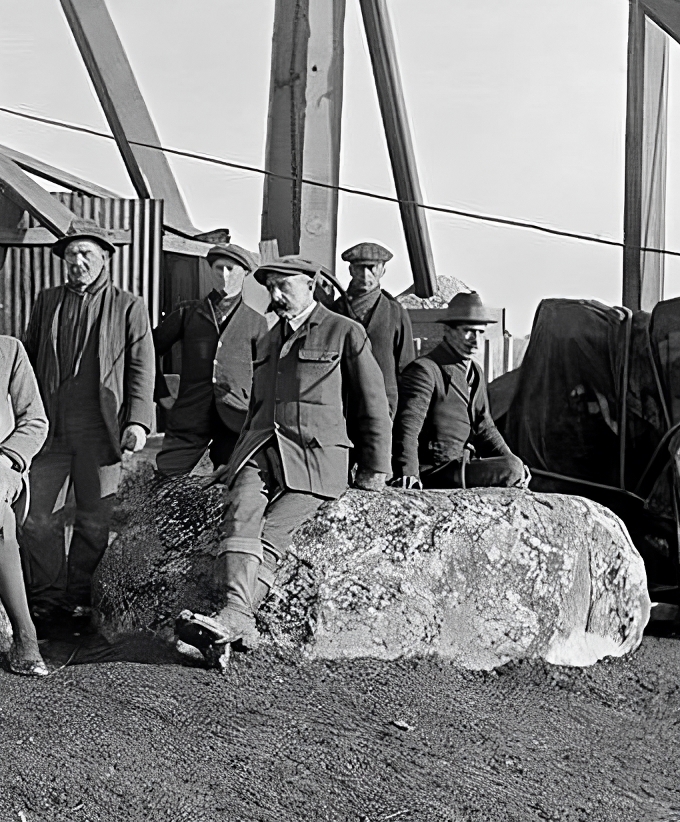
Photo of William Hawley (seated) and some of his team at Stonehenge in 1919/20, Credit: Historic England Archive, Source English Heritage.

An earlier study in 2023, by a team of eight researchers led by Richard Bevins and published in the Journal of Archaeological Science demonstrated that the Altar Stone was not Welsh but probably from northern England and perhaps Scotland: the authors had noted (in 2020) the presence of a few extremely old and so intriguing zircons.

Quite by chance researchers in Australia contacted the British Stonehenge research group and were invited to confirm the presence of these old zircons and to provide additional data. This they have done - with breath-taking results based on uranium-lead and lutetium-hafnium age radiometric dating, derived from these zircon, apatite, and rutile mineral grains.

It is ironic that every time new researchers are asked to join and contribute to the Altar Stone studies, from the original duo of ourselves (Rob Ixer and Peter Turner) in 2006 to over 12 contributors by 2024, the Altar Stone appears to move further away from its originally proposed origin on the banks of Milford Haven in South Wales.

The Australian team was able to determine that within the Altar Stone these detrital grains have a range of ages suggesting their formation by a number of different igneous events. Some give Ordovician ages of between about 470 to 444 million years ago, slightly older than the formation age of the sandstone. However, also mixed in are grains that are far, far older - greater than 1000 million years which must have been eroded from much more ancient Archaean rocks.

Their ages suggest that these eroded grains originated from the ancient landmass/terrane of Laurentia - which now forms most of North America and Greenland - rather than from Ganderia, Meguma or East Avalonia terranes, which from north to south, now form the underlying basement to most of England and Wales and the Eastern coastal strip of North America.

The very old dates from the zircon in the Altar Stone matche igneous events in Laurentia; events that did not occur in the Gondwanan, Ganderia, Meguma, or East Avalonia terranes which were then thousands of miles away.

This means that no Old Red Sandstone sandstones in England and Wales can carry mineral grains from Laurentia, as English/Welsh Old Red Sandstone lithologies are essentially sourced from rocks with non-Laurentian basements.

Tectonic processes slowly (taking almost 100 million years) brought these land masses together to their current locations. Their join is now marked by what is known as the Iapetus Suture. This is a geological feature that runs roughly along the border between England and Scotland. It is associated with the mountain building event called the Caledonian Orogeny and marks the collision site between Laurentia and Ganderia (with Meguma and East Avalonia) due to the closure of the Iapetus Ocean.
See the map below:

Importantly for this study, this event caused the incredibly slow, and continuing collision of the rocks of Scotland with England. Crucially, only British Palaeozoic rocks north of the Iapetus Suture can show an abundance of Laurentian characteristics, these results indicate that the Altar Stone has to have originated from Scotland.

Although more sampling is needed to identify the source more exactly, these extraordinary results - using all of the age dates - suggest that the Altar Stone most closely matches Old Red Sandstones from the Orcadian Basin, which includes both the Orkney and Shetland Islands plus much of north east Scotland.

These rocks are quite unlike the Old Red Sandstone of the Anglo-Welsh basin and comprise a thick (2km wide) sequence of cyclical sandstones, limestones and shales deposited in a large (lacustrine) lake system. The basin is flanked on all sides by the Laurentian basement, and the sediment was locally sourced, quite consistent with the radiometric dating of the zircons and other minerals.
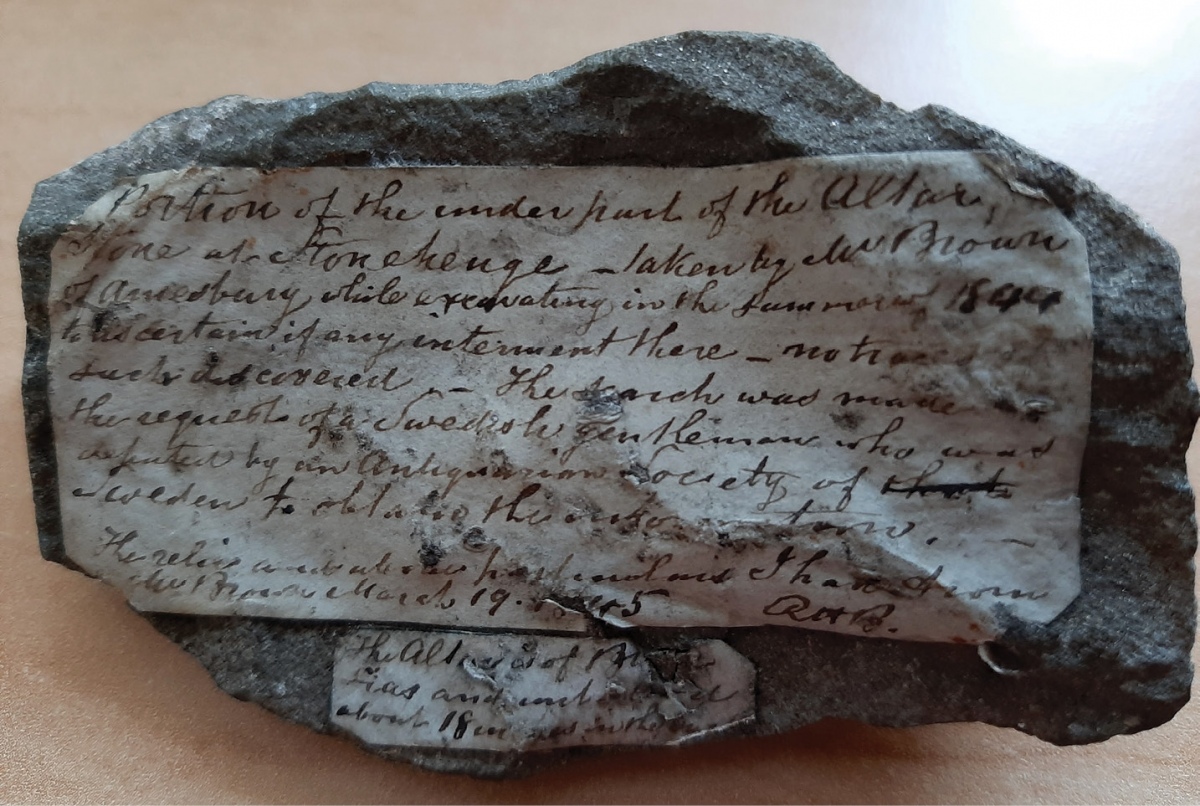
A fragment of the Stonehenge Altar Stone from Salisbury Museum

Putting aside Merlin’s magic or space alien tractor beams, there are only two alternative methods of transport for the Altar Stone from Scotland to Stonehenge - the dumping by an ancient glacier on Salisbury Plain, or physical manhandling by Neolithic people, either overland or by boat.

Despite vociferous, special and cyclical pleading from a lone proponent of the glacial hypothesis, there is no evidence for any glacial erratics on Salisbury Plain - the nearest accepted glacial deposits travelled from the west, and occur close to the Somerset coastline, but no further than that. And to the north of Stonehenge evidence of glacial action is more than 100km distant and carries no Scottish rocks. It must have been anthropogenically moved.

This breathtaking result now raises many archaeological puzzles - notably how the Altar Stone was transported from Scotland, and more significantly why. This should be thoroughly formulated before thinking of supplying answers and choosing one option, and are not questions for we geologists to answer, for that would be hubris! It is over to the archaeologists to solve.

Not Milford Haven but perhaps Scapa Flow.

Here it might be useful to be reminded of past and present assertions about the movement of the other Stonehenge bluestones from their outcrop origins to the Wessex circle.

In 2006 Ixer and Turner with absolute confidence wrote: “A lithologically unremarkable, grey-green, micaceous sandstone is perhaps the most famous Welsh lithic export in the world for it is stone 80 (numbering after Atkinson, 1979) namely the recumbent (or possibly fallen) ‘Altar Stone’ from Stonehenge”.

The prevailing almost century old belief was that the Altar Stone and a companion sandstone now known as the Lower Palaeozoic Sandstone were collected from the shores of Milford Haven (the exact outcrop for the Lower Palaeozoic Sandstone on the shore-line was identified by Sir Kingsley Dunham the leading geologist of the day). They were said to have been shipped or rafted from there along the Severn Estuary to Somerset and then punted down rivers to Salisbury Plain, together with the Preseli bluestones. Claimed proofs of this route included dropped/lost bluestones found on Steep Holm and rumoured orthostats resting on the bottom of Milford Harbour.

In the two decades since, piece by piece, detailed petrographical and geochemical work has shown all this to be unlikely. The Steep Holm rocks are nothing like any rock associated with Stonehenge or even Salisbury Plain, they may even be ship’s ballast.

Portable XRF analysis of the Stonehenge Altar Stone

The Altar Stone and Lower Palaeozoic Sandstone origins are separate, and neither is from the Milford Haven area - the Lower Palaeozoic Sandstone is not Devonian in age but older (Ordovician perhaps Silurian) and comes from north or northeast of the Preseli Hills; and it is now clear that the igneous Preseli bluestones come from the northern slopes of the Preseli Hills not from its southern slopes accessible from Milford Haven.

The current proposal is that the Bluestones were transported overland along a proto- A40, and it has even been suggested the transportation was accompanied by a succession of communal celebrations - something more difficult to do on the high seas.

How ironic it would be, were the same process needed to be repeated when dealing with the transhipment of a Scottish Altar Stone.

In 2024 a wiser Ixer and Turner suggest with some confidence that “A lithologically unremarkable, grey-green, micaceous sandstone is perhaps the secondmost famous Scottish lithic export in the world, after the Stone of Destiny/Scone. This is stone 80, using Atkinson's numbering from 1979, namely the recumbent and much travelled ‘Altar Stone’ from Stonehenge”.

The incremental search for the Altar Stone's origin


We have detailed a a retrospective of 21st century Altar Stone research that you can follow here - it highlights the incremental ‘journey’ taken by both researchers and the stone as they moved conceptually away from Wales.

This is a genuinely shocking result, but if plate tectonics and atomic physics are correct - and there is no indication they are not - then the Altar Stone is Scottish. What we don't know is how or why it travelled the length of Britain to its current location as a significant part of the Stonehenge monument.

This beautiful bit of 21st century science is truly breathtaking and will send seismic shocks through the bedrock of current interpretations of the British Neolithic.

Now that the geologists have done the heavy lifting (if you will) - it is over to the archaeologists...

Dr Rob Ixer is a specialised mineralogist by training, having worked on metal ores. He graduated from Manchester University with a BSc (Hons) in geology with subsid. in Northwest European Prehistory. He stayed at Manchester for his PhD on "controls on mineralisation in Derbyshire".

Rob taught mineralogy/petrography for decades at Aston University, then at Birmingham and Leicester universities, but retired in 2000. He is now an honorary senior research fellow in the Institute of Archaeology at UCL and a Fellow of the Society of Antiquaries of London.

Prof. Peter Turner is a geoscientist with interests in sedimentary mineralogy, palaeoclimatology, and palaeomagnetism. His Ph.D was from Leicester and he went on to lecture at the Universities of Aston and Birmingham. He was a pioneer in palaeomagnetics - awarded a DSc by the University of Wales for research on the magnetisation of sedimentary rocks. His current interests (apart from the provenance of the Altar Stone) include remagnetisation processes in sedimentary rocks.

Read More: The incremental search for the Origin of Stonehenge's Altar Stone

The full paper is now online here: A new analysis of Stonehenge’s central six-tonne Altar Stone indicates that it is likely to have come from north east Scotland, at least 750 kilometres away from its current site in Wessex Plate tectonics and precise radiometric age dating are the keys to this discovery.
Clarke, A.J.I., Kirkland, C.L., Bevins, R.E. et al. A Scottish provenance for the Altar Stone of Stonehenge. Nature 632, 570–575 (2024).
http://www.nature.com/articles/s41586-024-07652-1
doi.org/10.1038/s41586-024-07652-1


Note: Some updates on this, Rob Ixer addresses criticisms of the provenance of the samples, and thoughts from Alison Sheridan that the Altar Stone could have been a diplomatic gift from the north to boost sacredness

<< Welcome to the New Improved Megalithic Portal Web Server

Help Right to Roam campaign open up access to Ancient Sites in England and Wales >>

Please add your thoughts on this site

Caithness Archaeology: Aspects of Prehistory

Caithness Archaeology: Aspects of Prehistory

Sponsors

More News

See all News →

Latest Visit Logs

  • Cyzicus
    “Temple of Hadrian is within the town and can be directly driven to. While the theatre requires a bi…”
    by longhintim · 1 Aug 2026
  • Ortona Prehistoric Village
    “An extremely brief stop—I spent very little time perusing through the earthworks.”
    by IanMu4966 · 30 Jul 2026
  • Shapinuwa
    “There are pedestrian footpaths constructed but they are not well maintained and very overgrown. The…”
    by longhintim · 30 Jul 2026
  • Kerkenes
    “It's a huge site with scattered identifiable remains”
    by longhintim · 30 Jul 2026
  • Göbekli Tepe
    “While the megalithics itself were quite impressive, I was left quite disappointed with the informati…”
    by longhintim · 30 Jul 2026

"New Mineral analysis indicates Stonehenge’s Altar Stone originated from Scotland" | Login/Create an Account | 24 News and Comments
  
Go back to top of page    Comments are owned by the poster. We aren't responsible for their content.
Re: New Mineral analysis indicates Stonehenge’s Altar Stone originated from Scotlan by Andy B on Wednesday, 25 February 2026
(User Info | Send a Message)
Another new paper: Altar to Attic to Analysis: Geochemical Authentication of a Rediscovered Victorian Thin Section of Stonehenge's Altar Stone
Anthony J.I. Clarke, Christopher L. Kirkland, Arthur de Oliveira Vicentini, Lisa Brown

Highlights
• A rediscovered Victorian thin section is attributed to Stonehenge’s Altar Stone.
• Zircon-Apatite U–Pb dating authenticates heritage material.
• Pb contamination from antique resin complicates age analysis.
• Time-resolved treatment of ablation signals yields intercept ages.
• Our framework facilitates geochronology on Pb-contaminated samples.

Abstract
Authenticating purported fragments of the Altar Stone, the central six-tonne megalith at Stonehenge, underpins ongoing archaeological investigations and helps preserve valuable material by limiting the need for further destructive sampling. Here, using automated mineralogy and U–Pb zircon–apatite isotopes we examine Victorian thin-section S45 rediscovered in 2021, to evaluate its provenance. Pb-contamination from antique coverslip balsam resin complicates obtaining primary zircon U–Pb ratios. To address this issue, we subset time-resolved zircon isotopic ratio integrations from laser ablation signals and calculate internal grain-level regressions, maximising data recovery. This approach yields twelve zircon dates spanning 389–1850 Ma, while apatite yields components at ca. 1043 and 449 Ma. These ages are consistent with a provenance from northeast Scotland’s Upper Old Red Sandstone Orcadian Basin. Our findings support S45 as an Altar Stone fragment and demonstrate a framework for extracting reliable U–Pb ages from historic thin sections.

www.researchgate.net/publication/401009479_Altar_to_Attic_to_Analysis_Geochemical_Authentication_of_a_Rediscovered_Victorian_Thin_Section_of_Stonehenge%27s_Altar_Stone

doi.org/10.1016/j.jasrep.2026.105619
[ Reply to This ]

New paper by Bevins, Ixer et al. Was the Stonehenge Altar Stone from Orkney? (No) by Andy B on Friday, 30 August 2024
(User Info | Send a Message)
Stonehenge Altar Stone Latest: Portable XRF analysis of Stenness and Brodgar stones indicates Altar Stone NOT sourced from Mainland Orkney. Previous results about 'Scottish' (Laurentian) source still apply so the search must continue... New paper by Bevins, Ixer et al. Was the Stonehenge Altar Stone from Orkney? Investigating the mineralogy and geochemistry of Orcadian Old Red sandstones and Neolithic circle monuments:
www.sciencedirect.com/science/article/pii/S2352409X24003663
[ Reply to This ]

How Scottish stone at Stonehenge may have been 'diplomatic gift' to 'boost sacredness by Andy B on Tuesday, 27 August 2024
(User Info | Send a Message)
An article by Alison Campsie featuring "Lively and nuanced analysis, as you would expect , from the one and only Dr Alison Sheridan on why - and how - the altar stone at Stonehenge might have come from Scotland… diplomatic gifts, ancient boats, sacredness and the Orkney Vole."
www.scotsman.com/heritage-and-retro/heritage/scottish-stone-at-stonehenge-may-have-been-diplomatic-gift-to-boost-sacredness-4749523
[ Reply to This ]

Re: New Mineral analysis indicates Stonehenge’s Altar Stone originated from Scotlan by mountainman on Sunday, 25 August 2024
(User Info | Send a Message)
I'll ignore the cheap insult about "vociferous, special and cyclical pleading from a lone proponent of the glacial hypothesis" and will just remind these guys that a very large number of geologists and geomorphologists over the years have also supported the glacial transport hypothesis. The fundamental flaw in this paper is that none of the 4 "key samples" on which the research is based has been shown to have come from the locations claimed. The "Altar Stone" samples are just assumed to have come from the Altar Stone, and the Orkney and Caithness samples were bought from a rock shop in Whitby. It beggars belief that for a piece of work of this potential importance, the geologists involved could not even be bothered to collect their own authenticated samples. Until that situation is rectified, and until the "exceptional claim" is matched by "exceptional and unequivocal evidence", we can safely ignore the Scottish Altar Stone hypothesis.
[ Reply to This ]
    Re: New Mineral analysis indicates Stonehenge’s Altar Stone originated from Scotlan by Anonymous on Monday, 26 August 2024
    As with all bullys, insults are freely given but cogent rebukes are met with self-pity and indignation. Only one person has put up a "Wall of Shame" with opposing researchers on it. Rational behaviour??. However I agree it should read lone LIVING vociferous voice.

    Where are the joint papers with other recognised Pleistocene geologists. There are none, no mainstream authority has publically joined your solitary monologue. The voice is alone and increasingly hysterial, trumpeting away the same denials.

    The contention that the AS samples are not from the AS is cleary false as this and other blogs descibe in detail.

    More sampling from the Orcadian Basin is needed to confirm these initial and excitig results More of a"find of the century" than a lump of dolerite on the sea shore.

    R.A.Ixer
    [ Reply to This ]
    Re: New Mineral analysis indicates Stonehenge’s Altar Stone originated from Scotlan by Anonymous on Tuesday, 27 August 2024
    To address the point re: the provenance of the samples in more detail:
    Doubts over the authenticity of the two samples of Altar Stone described in the Nature paper and the disingenuous suggestion that English Heritage might have allowed direct sampling were they asked (John has known for over 10 years that EH will allow no direct sampling of any stone from Stonehenge although it has been asked on quite a few occasions) are groundless. An earlier posting on Megalithic Portal recounts the almost 20 year search for Altar Stone samples and efforts to authenticate them. Indeed the number of different rock types to be found at Stonehenge is so few that separating Altar Stone debitage/samples from Lower Palaeozoic Sandstone and from sarsen macroscopically (confirmed by microscopy and geochemistry) is now routine. Within the Stonehenge Landscape the fine-grained micaceous Altar Stone sandstone is immediately recognisable.

    The 19th cent label on the larger Stonehenge sample together with the gap at the base of the Altar Stone, as seen in the 1950 excavation photos, from whence the sample was collected is proof enough. The matching geochemistry between the sample and in situ results taken directly from the Altar Stone (English Heritage did allow direct pXRF measurements to be taken, under very very strict condition) also was a deciding factor in authentication the sample. This is given in great, great, great detail in at least three papers prior to the nature paper. Denying the authenticity belies the facts and smacks of desperation.

    Using shop-bought Devonian fish as samples to represent the Orcadian Basin is not a ‘good look; although the samples are from two, well- known –indeed world famous- collecting sites (many have argued over-collecting sites). There can be no doubt but they are Orcadian samples. But the criticism that there are too few Orcadian samples is valid and first made by the referees and initially addressed in the paper. It is being further more systematically addressed with in situ data collecting, (expect news soon).

    BUT it misses the point, the Altar Stone has been proved to have come from north of the Iapetus Suture –that is the hub of the nature paper that is the breath-taking discovery. That is to be celebrated rather than flat-worlder, climate-denying sounding sour comments. They are not a substitute for scientific debate.

    Where north of the Iapetus Suture, the Orcadian Basin looks our best bet, is the new gold rush.

    R.A.Ixer
    [ Reply to This ]

Re: New Mineral analysis indicates Stonehenge’s Altar Stone originated from Scotlan by SpaceTravellor on Friday, 16 August 2024
(User Info | Send a Message)
Is the glacial stone transportation considered?
[ Reply to This ]
    Re: New Mineral analysis indicates Stonehenge’s Altar Stone originated from Scotlan by Bladup on Saturday, 17 August 2024
    (User Info | Send a Message)
    Great comment SpaceTravellor, While I'm certainly no expert I'm sure glacial stone transportation could put the stone far closer to Stonehenge (Than Orkney), It will be interesting to hear what an expert thinks.
    [ Reply to This ]
      Re: New Mineral analysis indicates Stonehenge’s Altar Stone originated from Scotlan by Andy B on Saturday, 17 August 2024
      (User Info | Send a Message)
      The option of glacial transport is addressed in the Nature paper, which is Open Access. Rob is going to post more info on this in a few days.
      [ Reply to This ]
        Re: New Mineral analysis indicates Stonehenge’s Altar Stone originated from Scotlan by Anonymous on Friday, 30 August 2024
        Although movement by glaciers seems an attractive idea for the Altar Stone it is a non-starter. Glacial flow is off the Cairngorm/Grampian highlands north across Caithness and Orkney - Peach et al mapped this 100 years ago or more and in the last few years BRITICE have showed the same. This means that the erratics from Orkney would have been transported out into the North Atlantic, and there is no obvious mechanism for them to have been picked up by southward-flowing ice.

        Dr Brian John’s comments are clear and we concur with them. He says....
        Next, I have no problems with what the authors say about ice flow directions and the likelihood of glacial erratic transport. It is indeed very difficult to conceive of ice flow conditions that might have facilitated the glacial transport of a large sandstone erratic from the ORS Orcadian Basin all the way to Salisbury Plain, via either a west coast or east coast route. As far as we know, the ice flow in the last (Devensian) Glaciation was from SE towards NW across Orkney, as described earlier on this blog.

        brian-mountainman.blogspot.com/search?q=+Orkney+ice+flow

        Source: Adrian Hall et al, 2016

        I am afraid not even a little way south.
        [ Reply to This ]

Re: New Mineral analysis indicates Stonehenge’s Altar Stone originated from Scotlan by AngieLake on Thursday, 15 August 2024
(User Info | Send a Message)
FWIW, here is the link to the DailyMail online article:

www.dailymail.co.uk/sciencetech/article-13745729/Stonehenges-biggest-remaining-mysteries.html

Recent findings during excavation on the Ness of Brodgar made archaeologists speculate that Orkney was *the* most important ancient site in Britain, even more important than Stonehenge, so the ancient builders of SH obviously wanted to incorporate a very special stone into their new monument.
It was interesting to read that the large amount of pig fat found at Durrington Walls could have been used to grease the ground for the easier movement of the stones.
Then there was the evidence of cattle bones from Scotland being found at SH as someone mentioned here and earlier during a TV documentary.

Sorry I haven't read all this info, but digging into my old lady's memory box!!
[ Reply to This ]

Re: New Mineral analysis indicates Stonehenge’s Altar Stone originated from Scotlan by Bladup on Thursday, 15 August 2024
(User Info | Send a Message)
They proved years ago that they'd brought cattle from Orkney to Durrington when the sarson verison of Stonehenge was been built, So i guess the altar stone might have came with them then, A few folks thought as much back when the cattle journey was proved. Bringing the cattle would have possibly been more tricky than the single (if heavy) stone.
[ Reply to This ]
    Re: Cattle and pigs at Stonehenge (recte Durrington Walls) by Anonymous on Thursday, 15 August 2024
    Most of the animals found at Durrington Walls (not Stonehenge) were more likely to have been brought from Cornwall. The link to Orkney originally claimed is far more (though remotely possible) was strongly disputed only a couple of years ago. (Hilts, C., Greaney, S., Madgwick, R. and Parker Pearson, M. 2017. Neolithic Food Miles: Feeding the 'builders of Stonehenge'. Current Archaeology 334: 26-31.)
    [ Reply to This ]
      Re: Cattle and pigs at Stonehenge (recte Durrington Walls) by Bladup on Saturday, 17 August 2024
      (User Info | Send a Message)
      I said Durrington not Stonehenge so i've no idea why you felt the need to write that, If the Altar stone theory is proved beyond doubt then i'd suggest it backs up the "Cattle brought from Orkney" theory somewhat, and If MPP (Mike Parker Pearson) says it isn't true then it probably is, In the years i've listened to him he's proven time and again that if he says it's one way a few years later it'll be proven that he's wrong and it's often the opposite of what he originally said, No doubt he's a nice fella but time has proven he's consistently wrong when it comes to theory (I respect his clear interest in the subject though), Which more often than not seem to be over the top claims to get funding (Always mention Stonehenge been the golden rule) and grab a headline (In his defence that is probably what you need to do to get funding nowadays).
      [ Reply to This ]

Re: New Mineral analysis indicates Stonehenge’s Altar Stone originated from Scotlan by PERKYPUFFIN on Wednesday, 14 August 2024
(User Info | Send a Message)
As far as my research has shown me the Altar Stone originated near the Wheeling Steen farm in Westray Island, Orkney. During 2022 and 2023 I spent months looking at the rocks on each of the islands of Orkney to find a visual match of size, colour, micaceous grain size, and surface patterning. Although Birsay and Rousay has similar stones I am convinced that the Altar Stone was a stone washed up onto the land by the winter Atlantic storms at Aikerness, Westray Island. I have spent three years considering how sea transport could take it to Stonehenge and have come to the conclusion that it would only take 72 days of using the tides with only 20 men to accomplish the feat. It would not be a difficult or dangerous task.

Tom Bennett
[ Reply to This ]
    Re: New Mineral analysis indicates Stonehenge’s Altar Stone originated from Scotlan by Andy B on Saturday, 17 August 2024
    (User Info | Send a Message)
    Interesting stuff Tom. If you have any samples of rock from these areas I'm sure the research team would appreciate them. They need to test loads more samples from Scotland to help narrow down the source. The couple of Scottish sandstones they did test came from a rock shop apparently!
    [ Reply to This ]
      Re: New Mineral analysis indicates Stonehenge’s Altar Stone originated from Scotlan by Anonymous on Wednesday, 28 August 2024
      The team indeed looked at the samples in transmitted and reflected light and by XRD. Perhaps Tom would like to share the results.
      Any correspondence with the Altar Stone was very sleight.
      I think four samples were analysed.
      The data are available from me as we did the work pro bono.
      Dr R.A.Ixer.
      [ Reply to This ]
    Re: New Mineral analysis indicates Stonehenge’s Altar Stone originated from Scotlan by mountainman on Sunday, 25 August 2024
    (User Info | Send a Message)
    Tom -- six tonne boulders do not just was up onto the land during winter storms. Three years considering the sea transport of big monoliths? Well, I have considered it for 25 years at least, and have come to a rather different conclusion! Anyway, hope all is well.
    [ Reply to This ]

Re: New Mineral analysis indicates Stonehenge’s Altar Stone originated from Scotlan by Anonymous on Wednesday, 14 August 2024
Are we 100% sure that the two sample pieces of the AS were actually from the AS? Could they be from a small boulder carried from the North to represent those communities.(along with the cattle) ..rather than a megalith
[ Reply to This ]

Re: New Mineral analysis indicates Stonehenge’s Altar Stone originated from Scotlan by Andy B on Wednesday, 14 August 2024
(User Info | Send a Message)
Mike Pitts gives his take on this new discovery on his blog:
mikepitts.wordpress.com/2024/08/14/whats-new-about-the-stonehenge-altar-stone/
and here
twitter.com/pittsmike/status/1823737067857400210

[ Reply to This ]
    Re: New Mineral analysis indicates Stonehenge’s Altar Stone originated from Scotlan by Bladup on Saturday, 17 August 2024
    (User Info | Send a Message)
    The Lewisian Gneiss macehead from Hebrides found at Stonehenge, The cattle & pigs brought from the far North and Grooved Ware pottery (Which is common in Wessex) originating from Orkney are great points from Mike in the links, Thanks for posting them Andy.
    [ Reply to This ]
    Re: New Mineral analysis indicates Stonehenge’s Altar Stone originated from Scotlan by mountainman on Sunday, 25 August 2024
    (User Info | Send a Message)
    This is hilarious. Mike sought the opinion of his geological experts as to whether the science in this paper was sound. And who were the experts? Purely by chance, they were the same geologists who had written the article. You couldn't make it up........
    [ Reply to This ]

Your Name: Anonymous [ Register Now ]
Subject:


Add your comment or contribution to this page. Spam or offensive posts are deleted immediately, don't even bother

<<< What is five plus one as a number? (Please type the answer to this question in the little box on the left)
You can also embed videos and other things. For Youtube please copy and paste the 'embed code'.
For Google Street View please include Street View in the text.
Create a web link like this: <a href="https://www.megalithic.co.uk">This is a link</a>  

Allowed HTML is:
<p> <b> <i> <a> <img> <em> <br> <strong> <blockquote> <tt> <li> <ol> <ul> <object> <param> <embed> <iframe>

We would like to know more about this location. Please feel free to add a brief description and any relevant information in your own language.
Wir möchten mehr über diese Stätte erfahren. Bitte zögern Sie nicht, eine kurze Beschreibung und relevante Informationen in Deutsch hinzuzufügen.
Nous aimerions en savoir encore un peu sur les lieux. S'il vous plaît n'hesitez pas à ajouter une courte description et tous les renseignements pertinents dans votre propre langue.
Quisieramos informarnos un poco más de las lugares. No dude en añadir una breve descripción y otros datos relevantes en su propio idioma.