



The incremental search for the Origin of Stonehenge's Altar Stone
Submitted by Andy B on Friday, 09 August 2024 Page Views: 4803
Stonehenge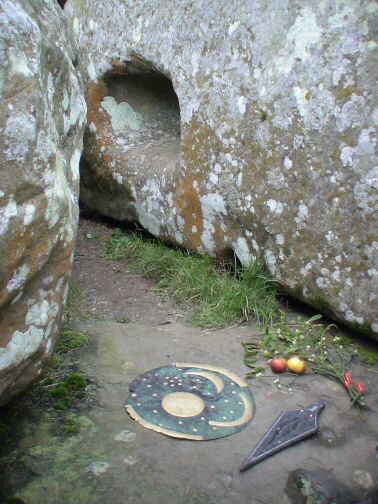
By the end of the 20th century it was generally accepted that the bluestones of Stonehenge had been moved manually from the Preseli Hills in west Wales to Wessex. This was essentially based on Thomas’ work who in 1923 recognised the geographical origin of the spotted dolerites, a main component of the bluestones, suggesting they were collected from outcrops on the main ridge of the hills including Carn Meini. He also recognised that the Altar Stone was not from the Preseli Hills but proposed that it was an extra, collected along the transport route taken by the collected bluestones. This suggested route rafted the bluestones from Milford Haven along the south Wales coastline to Somerset and Wessex.
2006: Ixer and Turner using transmitted light petrography and a manual point counter described the Altar Stone (using a standard thin section namely Wiltshire 61 #277 from the Southwest Group of Museums and Galleries Implement Petrology Committee Collections, labelled Altar Stone in Clough and Cummins 1988) in detail, contrasting it with examples of the Stonehenge Lower Palaeozoic Sandstone.
They concurred that the Altar Stone was probably from the Old Red Sandstone Senni Beds in South Wales. Thin section Wilts 277 was believed to be the only labelled and so only ‘known’ Altar Stone sample. Other Victorian thin sections labelled ‘Altar Stone’ included samples of sarsen and volcanic ash. Victorian and Edwardian descriptions of Altar Stone debris collected from their excavations and hence recorded in the literature were treated with caution.
Ref: R.A.Ixer and P.Turner. 2006. A detailed re-examination of the petrography of the Altar Stone and other non-sarsen sandstones from Stonehenge as a guide to their provenance. Wiltshire Archaeological and Natural History Magazine, 99, 1-15
2007: Ixer casts doubt on a sea route for the Stonehenge bluestones along the Severn Estuary from Milford Haven to the Somerset coast, showing petrographically that the Steep Holm ‘bluestone’ metamorphic rocks were unlike any from the Preseli Hills or from the Stonehenge Landscape. They are erratics or even ship’s ballast rather than ‘lost’ Stonehenge bluestones.
Ref: R.A.Ixer 2007. Waiting by the river: Stonehenge and the Severn Estuary. Abstract. Stone artefacts as material and symbolic markers in cultural landscapes. An international perspective. Implement Petrology Group Meeting. York. September 2007
2013: Using transmitted and reflected light petrography Ixer and Bevins describe three additional Altar Stone samples excavated from Stonehenge. Approximately 20 small Altar Stone samples from 21st century excavations were recognised as debitage knocked from the Altar Stone. Both the Altar Stone and the Lower Palaeozoic Sandstone were described as originating from Milford Haven by Atkinson in his 1970 Stonehenge book. In situ collecting of Old Red Sandstone sandstones from Milford Haven included the proposed site for the Lower Palaeozoic Sandstone at Mill Bay as described by Sir Kingsley Dunham in the late 1940s.
Ref: Rob Ixer and Richard Bevins 2013. Chips off the old block: the Stonehenge debitage dilemma. Archaeology in Wales, 52, 11-22
2017: With palynology plus detailed transmitted and reflected light petrography, Ixer, Turner, Molyneux and Bevins show that the non-Altar Stone sandstone debitage found in the Stonehenge Landscape, but said to be Old Red Sandstone in age and from Mill Bay (Milford Haven), was older than the Devonian Old Red Sandstone and probably Ordovician in age. The sandstone was formally designated (within the Stonehenge Landscape) as the Lower Palaeozoic Sandstone. Its age suggested a geographical origin to the north and northeast of the Preseli Hills.
Ref: R.A. Ixer, P. Turner, S. Molyneux and R.E. Bevins 2017. The petrography, geological age and distribution of the Lower Palaeozoic Sandstone debitage from the Stonehenge Landscape Wiltshire Archaeological & Natural History Magazine 110, 1-16.
2018: Bevins and Ixer review Thomas’ 1923 classical work on the Preseli Bluestones and their origins showing that his detailed provenances were unsound and probably not based on examination of newly collected samples from the field but on Victorian collected Stonehenge debitage. Earlier papers had shown this was also true of Thomas’ discussion of the Altar Stone, that too is unsound.
Ref: Richard Bevins and Rob Ixer 2018. Retracing the footsteps of H.H. Thomas: a review of his Stonehenge bluestone provenancing study. Antiquity 92 788-802
2019: Ixer, Bevins, Turner, Power and Pirrie use automated scanning electron microscopy (SEM-EDS) and linked energy dispersive analysis (QEMSCAN) on the newly described Altar Stone samples to compare Wilts 277 to other Altar Stone debitage. Quantitatively they confirm that all samples are the same lithology and in addition recognise the presence of an early cementing kaolinite, quartz and baryte in addition to the main carbonate cement; they also note the lack of potassium feldspar. The presence of significant baryte and lack of potassium feldspar become pivotal parameters in the subsequent search for the origin of the Altar Stone. They suggest that the origin should be sought within the eastern end of the Old Red Sandstone Senni outcrop in eastern Wales.
Ref: R. Ixer, R. Bevins, P. Turner, M. Power and D. Pirrie. 2019. Alternative Altar Stones? Carbonate-cemented micaceous sandstones from the Stonehenge Landscape. Wiltshire Archaeological & Natural History Magazine 112, 1-13.
2020: Ixer, Bevins, Pirrie, Turner and Power in a complementary paper and using the same techniques and methodology fully disassociate the Ordovician Lower Palaeozoic Sandstone from the Devonian Old Red Sandstone Altar Stone.
Ref: Rob A. Ixer, Richard E. Bevins, Duncan Pirrie, Peter Turner and Matthew Power. 2020. ‘No provenance is better than wrong provenance’: Milford Haven and the Stonehenge sandstones. Wiltshire Archaeological & Natural History Magazine 113, 1-15.
2020: Using petrography, modal analysis, age dating accessory zircons and initial clay mineralogy Bevins, Pirrie, Ixer, O’Brien, Parker Pearson, Power and Shail continue to fully differentiate between the Lower Palaeozoic Sandstone, Old Red Sandstone Cosheston sandstone at Mill Bay and Altar Stone samples. Clay mineralogy suggests an origin for the Altar Stone within southeast rather than southwest Wales. Some of the zircons gave very old dates and needed further investigation.
Ref: Bevins, R.E., Pirrie, D., Ixer, R.A., O'Brien, H., Parker Pearson, M., Power, M.R., Shail, R.K. 2020. Constraining the provenance of the Stonehenge 'Altar Stone': Evidence from automated mineralogy and U-Pb zircon age dating. Journal of Archaeological Science 120. doi.org/10.1016/j.jas.2020.105188
In 2020 it was still thought that the Altar Stone is most likely to be from eastern Wales or the Welsh Marches and the Lower Palaeozoic Sandstone from west or central Wales, north and east of the Preseli Hills; neither of these two Stonehenge-related sandstones is from Mill Bay, Milford Haven as had been suggested.
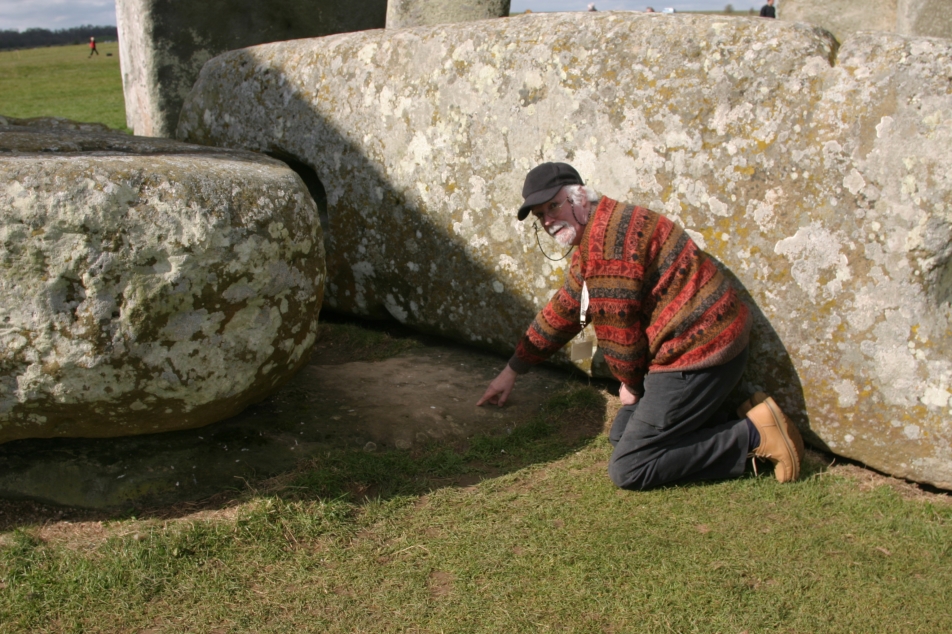
Rob Ixer points out the Altar Stone at Stonehenge
Showing the Mill Bay Old Red Sandstone rocks (as suggested by Dunham) to have no association with Stonehenge removes the main ‘proof’ for Milford Haven as an exit port for the Preseli Hills bluestones. Numerous other Stonehenge bluestones studies by the group showed that the some igneous bluestones came from the northern slopes of the Preseli Hills and not from the main Preseli ridge and that Carn Meini on the southern slopes could be discounted as a source. This also suggested that the bluestones were transported along a land route rather than sea.2021: Bevins enquired about Wilts 277 and it was discovered that a hand specimen of the Altar Stone collected in the 19th century had been curated in the Salisbury Museum collections, complete with label. Thin section Wilts 277, originally described in 2006 had been taken from this specimen, that itself had been directly collected from the underside of the Altar Stone. Wilts 277 and other investigated and suggested examples of the Altar Stone were now shown to be from the Altar Stone. Hence all earlier work and attributions was confirmed as correct.
2021-2022: Pearce and Bevins in 2021 and 2022 perform portable X-Ray Fluorescence (pXRF) analysis on the in situ Altar Stone at Stonehenge in order to compare with Altar Stone debitage samples from recent excavations and with the newly rediscovered hand specimen parent of thin section Wilts 277.
2022: Bevins, Pearce, Ixer, Hillier, Pirrie and Turner using portable X-Ray Florescence (pXRF) link Altar Stone debitage fragments to the Altar Stone based on the in situ analyses of the recumbent stone. The high Ba content present as cementing baryte in all the material was recognised as unusual and in marked contrast to Old Red Sandstone from Wales, hence raising the possibility it may not be Welsh. It was noted that the Ba content might be a determining characteristic in the search for a geographical origin for the Altar Stone.
Ref: Bevins, R.E., Pearce, N.J.G., Ixer, R.A., Hillier, S., Pirrie, D., Turner, P., 2022. Linking derived debitage to the Stonehenge Altar Stone using portable X-ray fluorescence analysis. Mineralogical Magazine 86, 1-13. doi.org/10.1180/mgm.2022.22
2022: Ixer, Bevins, Pearce and Dawson publish a popular account of the re-finding of the Altar Stone hand specimen (Salisbury Museum 2010K 240) concentrating on its Victorian label as a guide to authenticity but also giving some initial pXRF analysis obtained from the specimen and from the Altar Stone.
Ref: Rob Ixer, Richard Bevins, Nick Pearce and David Dawson Oct. 2022. Victorian Gifts - new insights into the Stonehenge bluestones Current Archaeology 391, 46- 50
A notable feature of the Altar Stone sandstone is the presence of baryte (up to 0.8 modal %), manifest as relatively high Ba in both the debitage and the Altar Stone. These high Ba contents are in marked contrast with those in a small set of Old Red Sandstone field samples, analysed alongside the Altar Stone and debitage fragments, raising the possibility that the Altar Stone may not have been sourced from the Old Red Sandstone sequences of Wales. This high Ba ‘fingerprint’, related to the presence of baryte, may provide a rapid test using pXRF in the search for the source of the Stonehenge Altar Stone.
2023: Bevins, Pearce, Pirrie, Ixer, Hillier, Turner and Power using petrography, automated SEM-EDS analysis and pXRF analysis compare in situ pXRF data from the Altar Stone and with petrography of the newly re-found hand specimen (Salisbury Museum 2010K 240, the source of thin section Wilts 277) and to other and earlier described Altar Stone thin sectioned samples. The data shows them all to be the same, confirming the attribution of 2010K 240 as an Altar Stone fragment (and Wilts 277 its thin section also). Hence ratifying all the earlier Altar Stone studies.
Ref: Bevins, R.E., Pearce, N.J.G., Pirrie, D., Ixer, R.A., Hillier, S., Turner, P., Power, M., 2023. Assessing the authenticity of a sample taken from the Altar Stone at Stonehenge in 1844 using portable XRF and automated SEM-EDS. Journal of Archaeological Science: Reports 49. https://doi.org/10.1016/j.jasrep.2023.103973
2023: Bevins, Pearce, Ixer, Pirrie, Ando, Hillier, Turner and Power using pXRF, automated SEM-EDS analysis and Raman Spectroscopic analysis compare the Altar Stone and numerous Old Red Sandstone sandstones from south Wales, Somerset and Welsh Marches. Data shows their mineralogy and geochemistry to be dissimilar and that the Altar Stone was not from the Devonian age Anglo-Welsh Basin.
Welsh Marches samples with a high Ba content are rare and display a different mineralogy to the Altar Stone and therefore can be discounted. They suggested looking further afield including northern England and Scotland, as well as considering younger terrestrial sandstone sources within Permian strata.
Ref: Bevins, R.E., Pearce, N.J.G., Ixer, R.A., Pirrie, D., Andò, S., Hillier, S., Turner, P., Power, M., 2023. The Stonehenge Altar Stone was probably not sourced from the Old Red Sandstone of the Anglo-Welsh Basin: http://www.academia.edu/108025525/ Time to broaden our geographic and stratigraphic horizons? Journal of Archaeological Science: Reports 51, doi.org/10.1016/j.jasrep.2023.104215 (Open Access)
2023: Ixer very briefly summarised the recent 2023 work and that now the search for the Altar Stone needed to be extended away from Wales and Southwest England.
Ixer Rob. Dec. 2023. Stonehenge Altar Stone probably not from South Wales. Current Archaeology 405. 8
2022-2023: Ixer, Bevins and Pearce (unpublished) examine a large collection of lithics collected by Cunnington in the 19th century and curated in the Salisbury Museum. Many sandstones were described as Altar Stone. Macroscopic identification confirmed by pXRF show a number to be Altar Stone. However, many others are shown to be Lower Palaeozoic Sandstone or Sarsen. The number of confirmed Altar Stone samples, although still few, potentially available for investigation, has been substantially increased.
2024: A new analysis of Stonehenge’s central six-tonne Altar Stone indicates that it is likely to have come from north east Scotland, at least 750 kilometres away from its current site in Wessex Plate tectonics and precise radiometric age dating are the keys to this discovery.
Clarke, A.J.I., Kirkland, C.L., Bevins, R.E. et al. A Scottish provenance for the Altar Stone of Stonehenge. Nature 632, 570–575 (2024).
http://www.nature.com/articles/s41586-024-07652-1
doi.org/10.1038/s41586-024-07652-1
(Page updated 14th August 2024 to add this section)
Read our introductory article by Drs Ixer and Turner here:
New Mineral analysis indicates Stonehenge’s Altar Stone originated from Scotland.


 We would like to know more about this location. Please feel free to add a brief description and any relevant information in your own language.
 Wir möchten mehr über diese Stätte erfahren. Bitte zögern Sie nicht, eine kurze Beschreibung und relevante Informationen in Deutsch hinzuzufügen.
 Nous aimerions en savoir encore un peu sur les lieux. S'il vous plaît n'hesitez pas à ajouter une courte description et tous les renseignements pertinents dans votre propre langue.
 Quisieramos informarnos un poco más de las lugares. No dude en añadir una breve descripción y otros datos relevantes en su propio idioma.