
Sacred Stones of Essex
Submitted by Thorgrim on Thursday, 22 December 2005 Page Views: 34323
EnglandCountry: England County: EssexInternal Links:

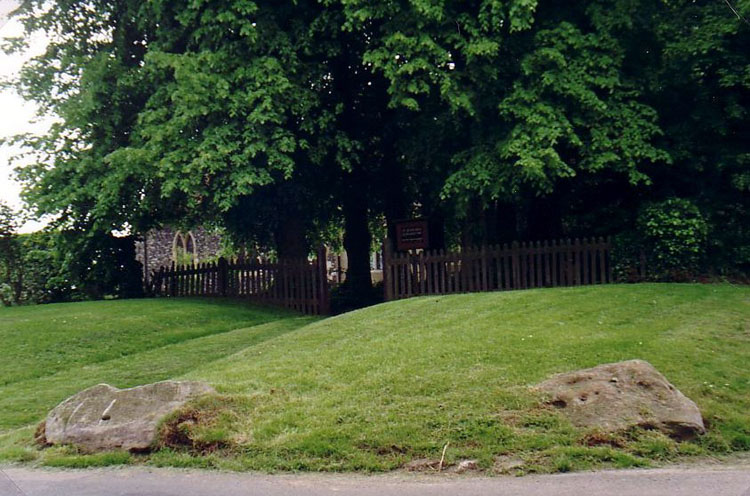
They are of two kinds: hard sandstone sarsens (from Saracen, meaning "foreigner") and puddingstone. The latter is a local speciality being a conglomerate of flints and other pebbles in a sandstone matrix like raisins in a pudding. Dismissed as erratics and curiosities, little attention has been made to their actual locations. Are they where the glaciers dropped them or have they been moved by men? If the latter is sometimes the case, then we do have sacred stones in Essex. Look at the Goddess form of the Standon stone (see main entry) - the breasts, buttocks and curve of the arm are so similar to the Venus of Willendorf - coincidence?
The archaeology of Essex is rich in Saxon finds, Roman roads and villas and the magnificent barrows at Mersea Island and Bartlow (largest in Britain). But what of what went before? Timber circles and buildings are coming to light near the coasts and archaeology at Stansted Airport is revealing Iron and Bronze Age settlements. At Stansted, a large recumbent monolith has been discovered and it is rumoured that it will be erected near one of the new passenger car parks. Assuming that standing stones elsewhere were sacred rather than cattle scratching posts, we can assume that this one too had a sacred purpose. In an area where large stones were very rare, their hardness and durability must have been very special and they survived. Surpringly perhaps, they were not broken up and used for building work.
Some examples:
Alphamstone TL 878354
Eleven sarsen stones surround the church built on a Bronze Age barrow. The stones are to be found on the circular raised mound of the churchyard. One has been built into the fabric of the west wall. The largest measures 4ft by 5ft. Some suggestion has been made that these stones form a circle, but possibly they are capping stones of the chambered barrow. Urns from the mound are in Colchester Museum. There is a similar arrangement at Chessum in Bucks with the church built on a ring of puddingstones.
Ingatestone TL 651997
There are six stones close to the church with two boulders on either side of the junction at Fryerning Road. Awkward but respected, they are in the way and a preservation order keeps them in situ. When the Saxons settled here, they named themselves "Ing-atte-Stone" - the people at the stone. Often, because we conveniently name epochs as "Saxon", "Neolithic", "Bronze Age" etc., we forget that human occupation, culture and development is a continuum. Did the Saxons honour and reuse the stones that they found? How had the stones been used previously?
The Leper Stone, Newport TL520349
The Leper Stone is the largest standing stone in Essex. A glacial erratic and a sarsen, but certainly erected by man. No stone falling from a melting glacier could stand itself on end so dramatically! It is said to have got its name by being situated alongside a leper hospital. A depression on top was filled with water and alms dropped in for the unfortunate lepers.
There are a hundred or so erratics in Essex and they are to be found in churches and churchyards, marking crossroads, fords and hilltops. Terry Johnson in "Hidden Heritage" (Capall Bann) and Stan Jarvis in "Hidden Essex" (Countryside Books) describe many, but there are others still to find. Dr Rudge and his wife began their research into puddingstones in the 1950's and they have suggested a "Puddingstone Trail" from Grimes Graves to Stonehenge. Dr Rudge died in 1984 when his work was published by the Pudding Stone Study Group.
Note: An exclusive illustrated article from Peter Herring

 We would like to know more about this location. Please feel free to add a brief description and any relevant information in your own language.
 Wir möchten mehr über diese Stätte erfahren. Bitte zögern Sie nicht, eine kurze Beschreibung und relevante Informationen in Deutsch hinzuzufügen.
 Nous aimerions en savoir encore un peu sur les lieux. S'il vous plaît n'hesitez pas à ajouter une courte description et tous les renseignements pertinents dans votre propre langue.
 Quisieramos informarnos un poco más de las lugares. No dude en añadir una breve descripción y otros datos relevantes en su propio idioma.