



Human Genes Provide Clues to Rise and Spread of European Agriculture
Submitted by coldrum on Tuesday, 02 October 2012 Page Views: 2945
DiscoveriesCountry: Sweden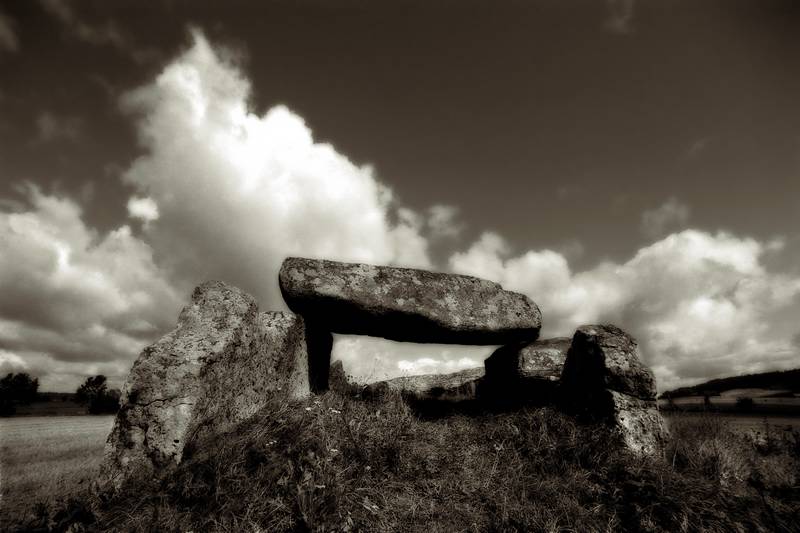
A joint Swedish-Danish research team may have finally found some answers.
Under the leadership of Assistant Professor Anders Götherström of Uppsala University, Sweden, and Assistant Professor Mattias Jakobsson, also of Uppsala University, researchers used advanced DNA techniques to study four skeletons of humans who lived in Sweden during the Stone Age, about 5,000 years ago. They analyzed the ancient remains of three hunter-gatherers of the Pitted Ware Culture , excavated on the island of Gotland, Sweden, and the remains of a farmer, a member of the Funnelbeaker Culture, excavated at Gökhem parish, Östergötland, also in Sweden.
"We know that the hunter-gatherer remains were buried in flat-bed grave sites, in stark contrast to the megalithic sites that the farmers built," said Jakobsson. "The farmer we analyzed was buried under such a megalith, and that's just one difference that helps distinguish the two cultures."
They then compared their findings with genetic data from living European individuals.
"After comparing our data to modern human populations in Europe", said study colleague and report author Pontus Skoglund of Uppsala University, "we found that the Stone Age hunter-gatherers were outside the genetic variation of modern populations but most similar to Finnish individuals, and that the farmer we analyzed closely matched Mediterranean populations.......The Stone Age farmer's genetic profile matched that of people currently living in the vicinity of the Mediterranean, on Cyprus, for example." Says Götherström, "The fact that the hunter-gatherers are most similar to Finns, Orcadians and other extreme-northern populations suggests that they were indeed the last major part of the Mesolithic meta-population that populated large parts of Europe before the early farmers appeared. And the fact that the farmer is most similar to southeastern Europeans makes sense too, as that is from where the spread of agriculture north and eastward started."
According to widely accepted interpretations of the archaeological record, agriculture is thought to have developed in the Middle East about 11,000 years ago. By about 5,000 years ago, it had spread to most of Continental Europe. But how it spread and how it affected people living in Stone Age Europe are questions that have been debated for many years.
Said Skoglund. "If farming had spread solely as a cultural process, we would not expect to see a farmer in the north with such genetic affinity to southern populations."
The research outcomes thus support the scenario that the spread of agriculture was driven by people migrating from Southern Europe northward. The results also indicate that the farmers lived side by side with hunter-gatherers for generations. "What is interesting and surprising is that Stone Age farmers and hunter-gatherers from the same time had entirely different genetic backgrounds and lived side by side for more than a thousand years, to finally interbreed," Jakobsson says.
The full report of the research can be found in the April 27th issue of the journal Science, which is published by AAAS, the nonprofit international science society.
For more, see popular-archaeology.com/issue/march-2012.
Note: "The results suggest that agriculture spread across Europe in concert with a migration of people."


 We would like to know more about this location. Please feel free to add a brief description and any relevant information in your own language.
 Wir möchten mehr über diese Stätte erfahren. Bitte zögern Sie nicht, eine kurze Beschreibung und relevante Informationen in Deutsch hinzuzufügen.
 Nous aimerions en savoir encore un peu sur les lieux. S'il vous plaît n'hesitez pas à ajouter une courte description et tous les renseignements pertinents dans votre propre langue.
 Quisieramos informarnos un poco más de las lugares. No dude en añadir una breve descripción y otros datos relevantes en su propio idioma.