



<< News >> Controversy in Mexico over changes to and use of Mayan palaces, Aztec pyramids
Submitted by coldrum and bat400 on Friday, 28 September 2012 Page Views: 5117
Pre-ColumbianCountry: Mexico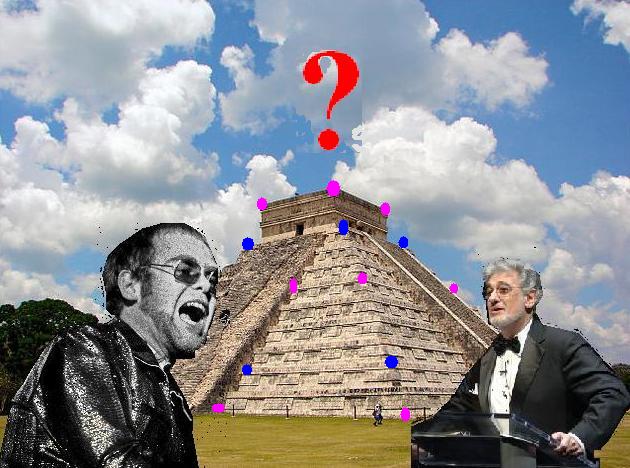
A recent decision by the government to erect a glass-and-steel facade on a portion of the historic Fort of Guadalupe in Puebla in time for the Mexican independence celebrations was the last straw. Archaeologists occupied Mexico’s prestigious National Museum of Anthropology, telling visitors that taking liberties with federally protected buildings was becoming commonplace.
The late-summer tourists who flock to the Chapultepec Park institution are greeted by banners, petitions and angry anthropologists with megaphones. A barefoot Mayan-speaking researcher in a white tunic blows into a conch shell to announce speeches in the lobby.
The occupying scientists have also declared: Admission is free.
Archaeologists are tweeting about “aggressions against patrimony” and using Facebook to decry tacky tourist development and New Age spectacles that they say will ruin the ruins.
Just when government officials were hoping to make money on the hype over Dec. 21 marking the end of the world, as predicted by the Mayan calendar, archaeologists are threatening to shut down the party even before it has begun.
“Our national monuments are being violated,” said Felipe Echenique March, head of the union that represents the National Institute of Anthropology and History (INAH), the government agency charged with protecting historic sites.
Authorities were largely silent until last week, when the agency’s archaeological council said in a communique that it “categorically denied the claims of union groups pursuing political aims.”
Echenique said authorities called him into the attorney general’s office Thursday and accused him of depriving the National Museum of Anthropology of more than $400,000 in revenue since the protest began late last month. Spokesmen for the attorney general’s office said they were unaware of the conversation.
“We do have a political aim,” Echenique said. “We want enforcement of the federal laws that protect patrimony.”
In recent days, protest banners have spread to sites such as the former palace home of Spanish conqueror Hernan Cortes in Cuernavaca and a church in Nuevo Leon, aimed at what one bulletin called “the enemy in the house” — ineffectual leaders of the INAH.
Archaeologists have come from Michoacan to protest the ongoing construction of a museum on a pre-Columbian base at the complex of circular pyramids at Tzintzuntzan, or “place of the hummingbirds,” the capital of the Tarascan people until the Spanish conquest.
“They should not build this in an archeological zone. There might be important tombs below,” said Celia Gutierrez Ibarra, a 33-year state historian and author who stopped by to sign a petition calling for the protection of historic monuments.
INAH architect Carlos Huitz pointed to protest posters showing gothic-style ceilings that have been grafted onto traditional arched brick ceilings during the reconstruction of colonial convents in Oaxaca.
“Local authorities saw these someplace else and just decided to copy them,” Huitz said. “These don't belong on these convents. They didn't care.”
Earlier this year, protest leaders sent letters to representatives of Paul McCartney, begging him not to hold a spring rock concert at the base of Chichen Itza, a famous pyramid in the Yucatán that has been the site of concerts by Placido Domingo, Pavarotti and Elton John.
The McCartney Chichen Itza concert never materialized, although McCartney played in May at the capital's Estadio Azteca and to 200,000 people at a free concert in the Zócalo.
Authorities said McCartney had prior commitments.
“These are not profit centers,” scolds the movement's website, under a photo of Chichen Itza and Teotihuacan, where workers drilled into the pyramid for a controversial but potentially lucrative light show that fizzled under pressure.
For more, see www.washingtonpost.com/world and www.mysanantonio.com.
Note: “Public archaeological sites are deteriorating. We are resisting this destruction.” Archaeologists Protest Use of Sites as Concert Venues and Construction Sites.
<< Prehistoric Human Hunters the Cause of Giant Herbivore Extinction in Australia,
Human Genes Provide Clues to Rise and Spread of European Agriculture >>


 We would like to know more about this location. Please feel free to add a brief description and any relevant information in your own language.
 Wir möchten mehr über diese Stätte erfahren. Bitte zögern Sie nicht, eine kurze Beschreibung und relevante Informationen in Deutsch hinzuzufügen.
 Nous aimerions en savoir encore un peu sur les lieux. S'il vous plaît n'hesitez pas à ajouter une courte description et tous les renseignements pertinents dans votre propre langue.
 Quisieramos informarnos un poco más de las lugares. No dude en añadir una breve descripción y otros datos relevantes en su propio idioma.