

How Tree and Vegetation Management Protects Historic Sites and Ancient Monuments
Submitted by Andy_B on Friday, 09 October 2026 Page Views: 6
Resources
While these plants enhance the value of such sites, unmanaged vegetation can be a hazard to the remains below.
Protection of such places must take in to account both the historic monument and the ecology surrounding it.
Why professional tree management matters when caring for historic sites
Historic land requires a more specialist approach to tree work than might be undertaken as normal grounds maintenance. A tree on a garden path may simply need pruning, but on an ancient earthwork there may be additional considerations relating to access, tree machinery and damage to the archaeology
Professional tree surveys and condition assessments can help owners of historic land to identify any unstable trees, branches of poor condition and any vegetation that could impact on the historic features.
For owners and managers of historic estates in Surrey, commercial tree care and estate management can enable planned pruning, crown management and tree maintenance to be carried out taking in to account any archaeological and conservation needs before work commences.
It is not a matter of removing trees from the vicinity of historic land, but identifying where such work is needed and determining how best to approach it with minimum impact.
How trees and roots can influence archaeological remains
Tree roots seek out moisture and nutrients in the ground, so on sites where the archaeology is close to the surface they have the potential to work their way into the joints of stones or break up the soil in which artefacts are buried.
The problem can become magnified if a mature tree falls, lifting a volume of earth with its root plate and exposing, or worse displacing, archaeological material that has lain undisturbed for centuries.
Standing stones and burial chambers can also be impacted by surrounding trees; branches can fall on to exposed structures and dense vegetation can limit visibility to enable close inspection of their condition.
The Megalithic Portal's discussion of Gwal y Filiast Chambered Tomb provides an example of where tree management and the needs of an ancient monument can conflict. Authors speak of the importance of established beech trees to the setting of the tomb as well as potential health and safety hazards posed by these trees and their possible impact on the archaeological site.
Balancing tree preservation with the needs of archaeology
Not every tree on a historic site will be removed as a conservation measure. Established trees can enhance the landscape and provide habitats for wildlife and even form part of the more recent history of a site.
The challenge is in identifying those plants which can be left alone from that which need addressing.
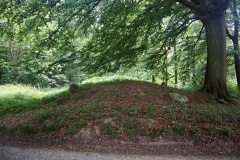
A tree beyond the edge of the archaeology may require little attention, but one growing on top of an earthwork might need more regular inspection, particularly if its roots are impacting on the structure or it has become more prone to windthrow.
The importance of the landscape to the history of the site should also be considered; trees planted as part of a designed estate landscape can form part of the archaeology even if much older remains lie beneath or nearby.
Therefore, decisions about tree maintenance should be made based on the condition of individual trees, the sensitivity of the monument and other conservation considerations.
Choosing between pruning, crown reduction and removal
There are different measures which can be taken to address problematic vegetation.
Selective pruning can remove dead and damaged branches which threaten exposed stonework or areas which are frequented by people. Crown reduction can be helpful in limiting the size and weight of a tree when a qualified tree surgeon has determined this is needed.
Crown lifting can be used to open up the understory of a tree, although any clearance work on or near archaeological sites should be carried out with appropriate caution.
Removal of a tree may be necessary due to potential risk to an ancient monument, but removal of the stump and roots can be even more damaging to the landscape.
Where appropriate, conservation specialists may suggest that a stump be left to rot rather than excavated through sensitive archaeological deposits.
The correct course of action will be depended on the tree, the monument and the potential impact of the proposed work.
Working with archaeologists and conservation specialists
Tree surgeons and estate managers should not attempt to make decisions about sensitive archaeological ground on their own.
An archaeologist can help to identify any buried ground features and advise on where excavation or ground disruption should not take place. Arboricultural specialists can offer advice on the condition of trees and suitable management options.
Landowners need to be aware of any legal status of the ground; in the UK, Scheduled Monuments have additional protection and works on or near them may require Scheduled Monument Consent. Tree Preservation Orders and conservation area restrictions may also apply.
Such considerations should be looked in to before any work is undertaken; even work which may seem like normal grounds maintenance may have implications for protected archaeological remains.
Protection of wildlife during vegetation clearance
Historic landscapes are often important habitats in their own right. Mature trees can provide nesting sites for birds and roosting sites for bats, while grassland and scrub can be home to insects, small mammals and other wildlife.
Vegetation clearance therefore needs to take in to account both the archaeology and any ecology which may be supported by the ground.
It is important that work does not disturb active bird nests and trees suspected of providing bat roosting opportunities should be surveyed by a specialist before any pruning work takes place.
In some cases, leaving areas of vegetation away from sensitive archaeological remains can offer both habitat and protection to the landscape.
A managed landscape does not need to be entirely cleared; maintaining a variety of appropriate vegetation types can help to support wildlife while ensuring any important historic features are protected and preserved.
Developing a long-term maintenance plan
Clearance work will only address immediate concerns, but vegetation will continue to grow.
A long-term maintenance plan can identify which trees should be monitored, where and how often scrub should be cleared and enable owners to keep track of works which have been done and any changes which may have taken place.
Using photographs and mapped surveys can help to monitor changes year on year, particularly if root systems are gradually working their way into sensitive ground features and this work is not immediately noticeable.
Maintenance options should also be chosen based on the sensitivity of the ground; heavy machinery or frequent vehicle use on the land can cause damage even if vegetation work is carried out with care.
Historic landscapes need to maintain continuity. Regular inspection of the vegetation and selective maintenance as required can allow landowners to reduce the need for more intrusive works in the future.
The trees and vegetation surrounding an ancient monument can form part of the landscape setting, but they need to be managed with an awareness of what lies beneath. Careful assessment and appropriate maintenance can help to preserve both the archaeology and the land it survives in.
