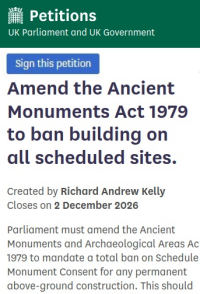
Featured: Please Sign the Petition: Amend the Ancient Monuments Act to ban all building on Scheduled Sites

Please Sign the Petition: Amend the Ancient Monuments Act to ban all building on Scheduled Sites

Das Raetiastein GPS by Thomas Walli

Das Raetiastein GPS by Thomas Walli

Login

Register here - as a registered user you get more features and fewer ads.

Who's Online

There are currently, 1261 guests and 7 members online.

Sponsors

Discovery of Bluestone at Stonehenge Cursus - possible setting for Lost Monument Wiltshire

Submitted by Andy B on Thursday, 31 August 2006  Page Views: 4731

Discoveries

<< News >>

Country: England County: Wiltshire
Internal Links:

Last week a sizeable fragment of what is presumed to be spotted dolerite, or bluestone from the Preseli Mountains in south Wales, was discovered in the southwestern quadrant of Woodhenge. At almost exactly the same time, a member of the archaeological team under the direction of Colin Richards discovered another much smaller piece in a test pit in a field close to the western end of the Cursus.

Colin’s team are looking for evidence of a lost bluestone monument, whose existence was first postulated by Wiltshire archaeologist J F S Stone in 1947, because he had excavated an area near the Cursus and discovered a scatter of bluestone fragments with a marked concentration near the Cursus itself, strongly suggesting that a monument had once stood there that had later been taken away to Stonehenge.

More: Eternal Idol, reporting from the 2006 excavations.

Please add your thoughts on this site

Stonehenge: Celebration and Subversion

Stonehenge: Celebration and Subversion

Sponsors

More News

See all News →

"Discovery of Bluestone at Stonehenge Cursus - possible setting for Lost Monument" | Login/Create an Account | 3 News and Comments
  
Go back to top of page    Comments are owned by the poster. We aren't responsible for their content.
Re: Discovery of Bluestone at Stonehenge Cursus - possible setting for Lost Monument by aknifethatfellfromthesky on Thursday, 13 August 2009
(User Info | Send a Message)
obviously there is nothing here to confirm the size of the 'fragments' but the very word 'fragment' suggests a cautious approach should be taken....maybe these fragments are just that, welsh dolerite carried by glaciers or maybe they are the left over from actually working the blue stone monoliths that are already on site at stonehenge and environs??

DD
[ Reply to This ]

Re: Discovery of Bluestone at Stonehenge Cursus - possible setting for Lost Monument by mountainman on Sunday, 31 August 2008
(User Info | Send a Message)
An early bluestone monument?

Sounds as if even more fragments have been found since 2006 in these "old" sites -- which means there was bluestone around on Salisbury Plain maybe a thousand years before the earliest stone settings at Stonehenge. That tends to confirm the "glacial transport" theory -- but it seems to me entirely unnecessary to think about an "early bluestone monument" which was later moved to Stonehenge. I may be wrong, but I suspect that archaeologists are wasting their time on this one......
[ Reply to This ]

Re: by mishkin on Friday, 01 September 2006
(User Info | Send a Message)
Fascinating account, it must be very exciting to find pieces of "evidence" to substantiate the fact that the bluestones look like they were brought from Wales and not the glaciation theory.
[ Reply to This ]

Your Name: Anonymous [ Register Now ]
Subject:


Add your comment or contribution to this page. Spam or offensive posts are deleted immediately, don't even bother

<<< What is five plus one as a number? (Please type the answer to this question in the little box on the left)
You can also embed videos and other things. For Youtube please copy and paste the 'embed code'.
For Google Street View please include Street View in the text.
Create a web link like this: <a href="https://www.megalithic.co.uk">This is a link</a>  

Allowed HTML is:
<p> <b> <i> <a> <img> <em> <br> <strong> <blockquote> <tt> <li> <ol> <ul> <object> <param> <embed> <iframe>

We would like to know more about this location. Please feel free to add a brief description and any relevant information in your own language.
Wir möchten mehr über diese Stätte erfahren. Bitte zögern Sie nicht, eine kurze Beschreibung und relevante Informationen in Deutsch hinzuzufügen.
Nous aimerions en savoir encore un peu sur les lieux. S'il vous plaît n'hesitez pas à ajouter une courte description et tous les renseignements pertinents dans votre propre langue.
Quisieramos informarnos un poco más de las lugares. No dude en añadir una breve descripción y otros datos relevantes en su propio idioma.