

Book Review: Terence Meaden: The Stone Circles of Cork and Kerry Guide, with Analyses
Submitted by Andy B on Tuesday, 09 June 2026 Page Views: 1354
Reviews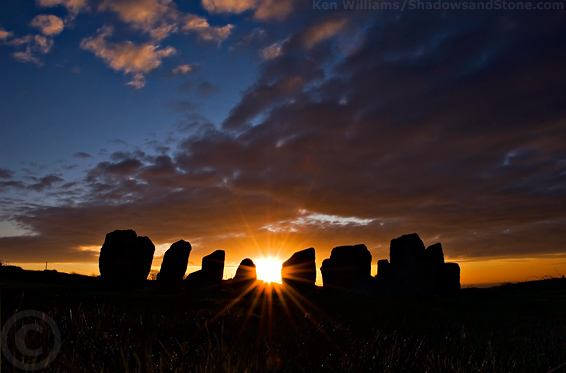
This is the Second in a series of three reviews of recent books by Terence Meaden, all of which are Open Access via the links below. The first covers his Pytheas book (2024), reviewed separately on the Portal. The third book covers The Sixty Long Barrows of North and Mid-Wessex (2025), read my review of this here.
What the Circles Were Doing
They are smaller than most people imagine - typically eight to twelve metres across, Bronze Age in date, and until recently poorly understood. Aubrey Burl, whose catalogues of British and Irish stone circles remain the standard field references, and Ruggles and Prendergast in a specific 1990s survey of the region, both concluded there was no systematic solar interest in these monuments. Meaden has spent years going to those same stones at sunrise, and this book is his sustained disagreement with that verdict.It's a more grounded book than his Pytheas volume, and to my mind a much more compelling one. The evidence here is shadow photographs taken at specific stones on specific dates - if you want to argue the point, you have to get up before dawn.
Meaden's core argument is that the Cork-Kerry circles were deliberately designed to mark eight recurring dates in the farming year: the solstices, the equinoxes, and the cross-quarter days that we know later as Beltane, Lughnasadh, Samhain and Imbolc. Each circle's axial stone - the recumbent stone lying opposite the entrance gap - is positioned to receive the shadow of an east-facing portal stone at sunrise on one or more of these dates. The spectacle of stone-to-stone shadow union was what - he asserts - these communities gathered to witness.
How did they know which day to gather? Meaden's answer is a wooden tally stick. Treat the winter solstice as Day 1 and cut a notch for every sunrise. No arithmetic involved: move a peg along pre-marked notches, and Day 92 brings the spring festival, Day 183 midsummer, Day 274 the autumn one. Meaden made his own from an old walking stick to test it. The full mechanics are in his 2016 book Stonehenge, Avebury and Drombeg Stone Circles Deciphered [Ref 1]. One consequence worth knowing: the resulting spring and autumn dates aren't quite the astronomical equinoxes - they fall at the midpoint between solstices by day-count, a degree or two off equal day and night. That's why compass bearings at these sites often show sunrise azimuths of 88 or 89 degrees rather than a clean 90. The stones do what the tally stick says, not what modern tables say.
Meaden divides the corpus into five types, the most useful distinction being between circles where a single axial stone serves all eight dates (Type-1, Bohonagh being the archetype) and those that need a second, separately positioned stone to handle the winter half of the year (Type-2, Drombeg ). This typology is original to Meaden and gives anyone visiting these sites a practical framework to work with.
Drombeg
The book earns its keep at Drombeg, which receives more sustained attention than any other site. The three carvings on the Drombeg stones - a vulva on the recumbent axial Stone 9, a phallus on portal Stone 17 (one of only two such carvings known from Bronze Age Ireland), and an egg-form on the lozenge Stone 16 - are read as expressions of a fertility religion, the union of sky and earth enacted visibly at each festival date. The shadow of tall, straight-sided Stone 1 falling across the carving on Stone 9 at midsummer sunrise is documented and repeatable.Figure 55 in this book, taken by John Davies on 21 June 2019, is the photograph to look at. Meaden finds the right words for moments like this elsewhere in his writing: "This is not astronomy. It is theatre. The sun rises from beyond the hill. Sunlight crosses the land and falls on the stones, the centre stone casting its shadow when the relevant date arrives upon a waiting calendar stone." Drombeg at midsummer is precisely that.
There's also a detective story running through the Drombeg chapters that I found genuinely gripping. Denham Franklin, a justice of the peace and secretary of the Cork Historical and Archaeological Society, measured a short stone in the central area of the circle in 1903 and described it precisely. By 1909 it had been taken away. Meaden searched, and found a plausible candidate at Drombeg House five hundred metres distant: a mottled sandstone, partly round, matching Franklin's measurements.
He constructed a full-size cardboard replica and placed it at the deduced original position at dawn on 17 December 2013. The winter-solstice alignment came into focus. More than that, the same position simultaneously serves two additional cross-quarter dates in late May and mid-July, completing what Meaden calls a 16-part calendar. "That it works so well," he writes, "intimates that the 16 dates were planned at the beginning." He is careful to present this as still a hypothesis, and that caution is right. But the experiment is real and the result is striking.
Beyond Ireland
The second half of Part 1 extends the method to Knowth and Newgrange in County Meath, then to the recumbent stone circles of northeast Scotland. The Scottish chapter is the strongest part of this extension. Meaden classified Loanhead of Daviot as a Type-2 circle by the Cork-Kerry typology, predicted which stones would serve which dates, and photographically confirmed the summer solstice alignment in June 2017. That's how hypothesis testing is supposed to work, and it's satisfying to watch.The chapter contains one of the book's better moments. Richard Bradley, after decades excavating at Scottish stone circles, told a student researcher he "no longer believed that the sites were aligned to the moon or the sun." Meaden's response is measured: he points out that Bradley's student wasn't observing from the right position and wasn't there at sunrise. This gets to the methodological heart of the whole disagreement.
Meaden's companion long barrows volume (2025, reviewed separately on the Portal) applies the same method to Wiltshire monuments two thousand years earlier. The same 8-fold calendar logic appearing in two unrelated monument traditions, each tested independently, strengthens the overall case.
Reservations
The shadow events are empirical and the photographs are there for anyone to examine. The interpretation built on top of them is a different kind of claim, and the book doesn't always keep the distinction clear.Meaden draws extensively on comparanda from Hindu temple tradition, from living communities in Jharkhand, from Greek literature, and from present-day Indian tribal fertility festivals to illuminate prehistoric Cork. Some of these comparisons are striking, particularly Subhashis Das's observation in his book Unknown Civilization of Prehistoric India [Ref 2] that hills in India are gendered in ways that parallel Meaden's stone-morphology arguments almost exactly. But comparative material illuminates, it doesn't prove. The Sacred Marriage of Sky and Earth is an ancient and widespread religious concept. That it may explain these stones is plausible.
Regarding Ruggles and Prendergast's 1996 study. Meaden's explanation for their negative result - that they observed from the circle centres rather than the axial stone, and weren't present at sunrise. This is plausible and may be correct. But it receives one mention rather than the sustained engagement a direct contradiction of the most careful previous study deserves.
Readers who come to this book from Meaden's long barrows study (Review to follow) will notice a difference in how carefully the hieros gamos reading is held. There it's explicitly hedged: "conceivably accompanies", "could have been prevalent", "it may be so". Here the same interpretation tends to harden into confident assertion by the later chapters. The calendar observations are the strong ground; the fertility religion built on top of them deserves the same caution in both books.
As a Field Guide
Part 2 is a gazetteer of all 60 multiple-stone circles, with coverage of the five-stone circle corpus too. Each entry has Irish Ordnance Survey grid references, a drawn stone plan, dawn photographs, and practical access notes. These are incredibly useful for potential visitors: they tell you which sites are on public land, which require speaking to a farmer first, and which involve a boggy approach you'll want wellie boots for.The coverage runs from perfectly preserved circles to destroyed and fragmentary sites, and for many of these monuments this is the most detailed published description available in a single volume. A short section on the Church-ordered removal of cult images from the circles also tells you something about how this landscape was perceived well into recent centuries.
Bohonagh and Drombeg are the obvious starting points if you're new to these circles. But on the Beara Peninsula, Ardgroom Outward deserves a morning of its own: positioned in marshland with the summer solstice sun rising between the Paps of Keecragh while horses graze in the foreground. Read it with the ebook open and our map nearby. Some of these sites are a long drive down narrow lanes and will need a boot scrape on the way back.
Verdict
This is the fullest account we have of what the Cork-Kerry circles actually do at sunrise, written by someone who has been going to them at dawn for many years and photographing the results. The shadow photography, the typology, the Franklin Stone detective work, the predictive extension to Scotland - these are amazing contributions, arrived at by fantastic fieldwork. The interpretive framework - fertility religion, hieros gamos, universal Sacred Marriage - is argued with consistency and comparative learning and is a compelling hypothesis.The late Prof. George Eogan, who spent forty years excavating at Knowth, wrote to Meaden: "I like your idea that the shadow of the pillar stone upon the positioned stone at Drombeg and another at the recumbent kerbstone at Knowth was a deliberate calendrical device." When someone who has spent that long at one of these monuments specifically endorses the core observation, it demands the fieldwork be taken seriously.
And set your alarm.
Book Review by Andy B.
Terence Meaden adds: "A major question is, how did it come about that all the academic archaeologists missed spotting the physically-present, annually-recurring, calendrical features. The observer must be present at sunrise. Once I realised this was the key, I went to the stone circles and long barrows at dawn to see what the rising sun actually did relative to the positioned stones. Be there to see the sun rising."
Terence Meaden: Guide to the Stone Circles of Cork and Kerry + Analyses and Gazetteer (2024) is available open access from the University of Buckinham Press:
https://ubpopenbooks.com/index.php/ubp/catalog/book/14
Other open access books by Terence Meaden
https://ubpopenbooks.com/index.php/ubp/search/search?query=meaden
Meaden's own account of the shadow events at Drombeg, with photographs:
https://www.silentearth.net/dr-terence-meadens-research-into-the-core-meaning-of-axial-and-recumbent-stone-circles-by-shadow-casting-at-sunrise/
References:
1. Meaden, G. T. (2016). Stonehenge, Avebury and Drombeg Stone Circles Deciphered: The archaeological decoding of the core symbolism and meanings planned into these ancient British and Irish monuments. Saarbrücken: Lambert Academic Publishing. A 228-page, all-colour volume features 180 photographs. You can access the text online through Academia.edu using the following link:
oxford.academia.edu/Deciphering-stone-circles-Drombeg-and-Stonehenge
The research is available via ResearchGate and physical copies can be purchased through Amazon and other booksellers
2. Das, S. (2014). Unknown Civilization of Prehistoric India. Kaveri Books, New Delhi
http://www.amazon.co.uk/exec/obidos/ASIN/8174791426/megalithicmyst0a
or
http://www.amazon.com/exec/obidos/ISBN=8174791426/megalithmysterieA/
http://www.exoticindiaart.com/book/details/unknown-civilization-of-prehistoric-india-uam527/
Video Lecture: Decoding Stonehenge, Drombeg and Avebury Stone Circles, Prof. Terence Meaden at Megalithomania
http://www.youtube.com/watch?v=KOFY-6sG1v0
More relevant writing by Prof. Meaden:
Peer-Reviewed Journal Papers
Journal of Lithic Studies (Drombeg Stone Circle): doi.org/10.2218/jls.v4i4.1919
Journal of Lithic Studies (Stonehenge & Avebury): doi.org/10.2218/jls.v4i4.1920
(also cited as doi.org/10.2218/jls.v4i3.1919)
Journal of Skyscape Archaeology (Stonehenge Lunar-Solar Calendar, 2023): doi.org/10.1558/jsa.26598
Expression Journal (the free e-journal where he has published dozens of papers): http://www.atelier-etno.it/e-journal-expression/
Megalithic Portal & Silent Earth Articles
Megalithic Portal Article (Was Tara the Earth Goddess at Avebury?):
http://www.megalithic.co.uk/article.php?sid=2146411660
Silent Earth Guest Post (Dr Terence Meaden's Research into the Core Meaning of Axial and Recumbent Stone Circles):
http://www.silentearth.net/dr-terence-meadens-research-into-the-core-meaning-of-axial-and-recumbent-stone-circles-by-shadow-casting-at-sunrise/


 We would like to know more about this location. Please feel free to add a brief description and any relevant information in your own language.
 Wir möchten mehr über diese Stätte erfahren. Bitte zögern Sie nicht, eine kurze Beschreibung und relevante Informationen in Deutsch hinzuzufügen.
 Nous aimerions en savoir encore un peu sur les lieux. S'il vous plaît n'hesitez pas à ajouter une courte description et tous les renseignements pertinents dans votre propre langue.
 Quisieramos informarnos un poco más de las lugares. No dude en añadir una breve descripción y otros datos relevantes en su propio idioma.