
Book Review: How Pytheas the Greek Discovered Iron-Age Britain and Stonehenge
Submitted by Andy B on Sunday, 07 June 2026 Page Views: 471
Reviews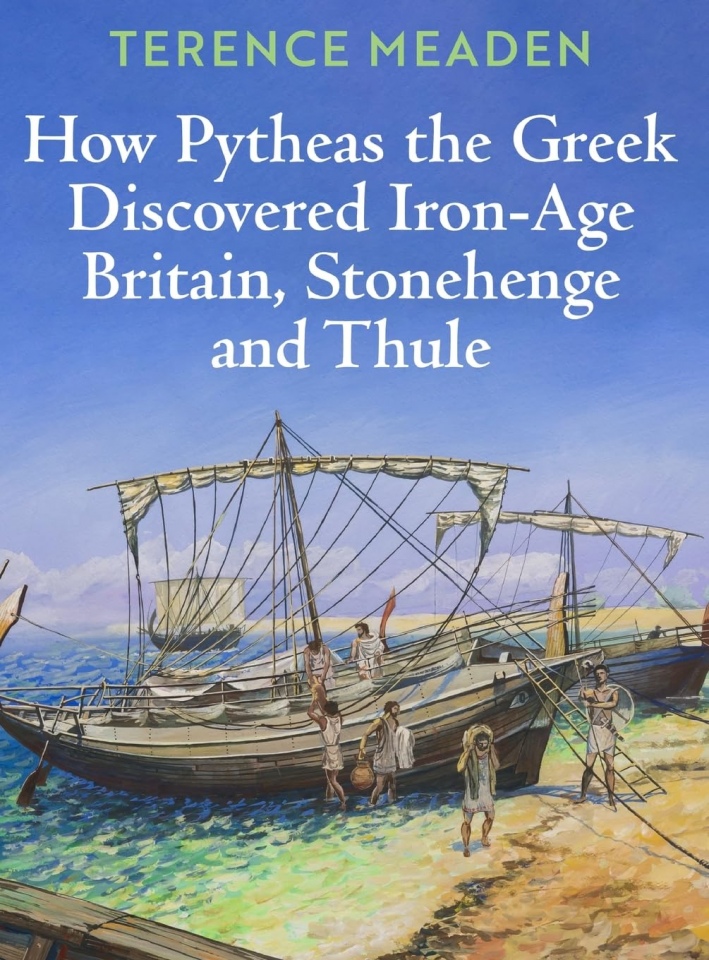 Book Review: Terence Meaden, How Pytheas the Greek Discovered Iron-Age Britain, Stonehenge and Thule, c.325 BC. Pytheas of Massalia (that's Marseille today) is one of those classical figures who lurks just past the edge of what we can realistically know. Around 325 BCE he sailed round Britain and brought back the first written description of these islands. His own book is lost. We learn about him through later Greek writers - some friendly, some not - and through one passage in particular - in Diodorus Siculus drawing on Hecataeus of Abdera, that describes a "spherical temple of Apollo" in the far north. Terence Meaden's book argues that the temple is Stonehenge and that Pytheas walked there in person.
 It is, of the three recent books of his I've been reading, the boldest and the one I'm least able to follow all the way to the conclusion.
Terence Meaden's work will be familiar to most long-time readers of the Portal - the systematic study of Irish and Scottish stone circles, the recurring fertility symbolism in stone morphology (tall thin stones as the male principle, broader flat ones as female), the dawn visits at the relevant festival dates with measurements and photographs. The fieldwork that grounds his other books is necessarily missing here. Pytheas left no monument, and the source trail is shaky in ways that standing stones aren't.
The Hypothesis
The chain of transmission is worth pondering on. Pytheas's book On the Ocean is lost. Hecataeus drew on it for his own writings, which are also lost. Diodorus drew on Hecataeus. Three removes, and Hecataeus is not a writer noted for literal fidelity to his sources.Meaden's response is to argue that the specific details in the surviving fragments - the circular temple, the singing priests, the peculiar language - are too geographically precise to be invented, and that Hecataeus preserved real observations within a mythological frame. It's a reasonable argument. It's also the point where one has to decide how much interpretive trust to extend to the hypotheses.
Britain is the obvious candidate for the location. The passage has never been satisfactorily explained, and Meaden's identification of it with Stonehenge has genuine logic. The key word in the source is sphairoeidē, usually translated as "spherical" - which sounds wrong for Stonehenge. Meaden argues the word means something more like "a three-dimensional circular construction"; specifically the quality of having height as well as circumference. That is precisely what the trilithon uprights and lintels give Stonehenge, unlike any other stone circle in Britain. Add the inner sanctuary and the nearby settlement of Durrington Walls as the associated town, and this is not a fanciful identification. I'd say it's the strongest single argument in the book.
The route argument is the most grounded part. Meaden has Pytheas landing on the Kent coast and walking west along the prehistoric ridgeway known as the North Downs Trackway or Harroway (the likely route of which runs past my house in Leatherhead incidentally). Headed towards Cornwall and its tin trade - the most plausible commercial purpose for the voyage. Meaden's explanation for why Pytheas walked rather than sailed is specific: Pytheas had no ship of his own, he relied on passing merchant vessels, that meant long waits in port, and at some point he simply set off on foot. The route is real and archaeologically evidenced, and it passes close enough to Salisbury Plain to make a Stonehenge detour at least geographically feasible.
The land-travel claim is not solely Meaden's - Polybius, who was openly hostile to Pytheas, recorded a complaint that Pytheas claimed to have traversed Britain on foot - the Greek word embadon. An unfriendly source independently confirming an inconvenient detail is exactly the kind of thing that keeps a hypothesis alive.
At Stonehenge
At Stonehenge itself, Meaden focuses on Bluestone 67, a roughly 2.5-metre ignimbrite rhyolite pillar standing near the centre. He argues it is not merely a stone with an accidentally phallic profile but a deliberately shaped one - its rounded top, tapered shaft and worked base suggesting intentional sculpting rather than natural form. He pairs it with the Altar Stone, a large recumbent slab roughly five metres long lying flat at the heart of the monument, and reads the two together as enacting a hieros gamos - a Sacred Marriage between male and female principles.The mechanics are specific. At summer solstice sunrise, the Heel Stone standing outside the entrance casts its shadow down the monument's central axis directly onto the Altar Stone below. The upright penetrating shadow falls on the prone flat stone at the one moment in the year when the sun rises furthest to the northeast. The shadow event itself is real and documented.
Simon Banton, an archaeoastronomer who spent six years as a visitor guide at Stonehenge carrying out his own observations of the monument's alignments, has noted that "the complex interplay of light and shadow at megalithic monuments is a mostly unremarked phenomenon" and that Meaden is "one of the few who have made a habit of turning their back to the sun and paying attention to where the shadows fall." His review of Meaden's earlier Stonehenge and Drombeg study is worth reading alongside this book.
If you've stood at Stonehenge in that particular morning light, you understand why it generated religious feeling. Whether it means what Meaden says it means is a different question, and one I'm not sure the book quite answers.
This is where I wanted more. Meaden is at his best presenting the observable facts - stone morphology, alignments, shadow events. As the argument builds, inferences accumulate, and the hedging that is entirely appropriate in exploratory work ("probably", "likely", "it seems reasonable to suppose") tends to drop away by the time the book pulls everything together. I'd have welcomed clearer signposting as the argument moves from hypothesis to conclusion. Some of what is presented as established in the later chapters is still, on examination, a chain of reasonable inferences.
Reservations
A few things deserved more space.Pytheas was first and foremost a navigator and scientist. He measured ocean tides and calculated latitude with striking accuracy, and his voyage took him far enough north to reach what classical writers called Thule, somewhere in the far north Atlantic. His primary mission was scientific and commercial, not religious. The case that he walked inland to Wiltshire to visit a temple is made, but the maritime route along the coast is at least as plausible, and it opens up other candidate monuments entirely. This was raised in the Portal discussion when the book was posted, and it's a fair challenge.
I'd also have liked more on the gap between Stonehenge's builders and the people Pytheas would have found there. By 325 BCE the monument had been standing for roughly two thousand years. The Iron Age Celts he encountered were separated from the Neolithic builders by as great a span of time as we are from the Romans.
Meaden goes further than simply noting the continuity of place. He posits a continuous lineage of priests maintaining the rites and the relevant knowledge from the original builders down to the Iron Age. That is a long time to hold anything intact. The latest dated construction activity at Stonehenge - the Y and Z holes - is around 1500 BCE, and after that the archaeological record at the monument goes quiet for over a thousand years before Pytheas arrives.
The chain has to bridge that silence. There's also the near-total replacement of the Neolithic population by Beaker-associated incomers around 2400 BCE to factor in. That replacement clearly didn't stop the monument being worked on - the late Bronze Age phases happen across it - but it does mean the people who finished Stonehenge were not biological descendants of the people who started it, and the people Pytheas met were further removed again.
Whatever the Iron Age community at Stonehenge were doing with those ancient stones was almost certainly their own reinvention of something they had inherited, rather than a pristine continuation. Whether any of the original intention survived that reinvention is the question I think the book doesn't quite face.
Verdict
None of this is a reason not to read it, especially via a free download. Meaden belongs to a tradition of researchers who take Stonehenge's astronomical and symbolic purpose seriously, and that seriousness produces observations more cautious scholarship tends to miss. The Pytheas hypothesis is bold and interestingly made. The route argument has real substance. The close attention to the stones themselves - Bluestone 67, the Altar Stone, the solstice shadow - is the work of someone who has spent time at the monument and looked properly.What I'd say, having read all three of the recent books together, is that this is the most speculative of them. The Cork and Kerry circles and the Wessex long barrows can be tested with a compass and an alarm clock. The Pytheas case rests on inferences from a source chain that lost two of its three links a long time ago, and on a continuity argument that ancient DNA makes harder rather than easier. Read it as a provocative interpretive essay alongside the more empirical companion volumes. It's the one of the three I'd argue with most cheerfully over a pint, and I think Meaden would take that as the compliment it's meant as.
Reviews of Meaden's other two recent books, Guide to the Stone Circles of Cork and Kerry (2024) and The Sixty Long Barrows of North and Mid-Wessex (2025), are coming shortly to the Portal.
Open Access Books
All of Terence's recent books are are available open access from the University of Buckingham Press, and as mentioned are very well worth your time.This book:
https://ubpopenbooks.com/index.php/ubp/catalog/book/7
Other open access books by Terence Meaden:
https://ubpopenbooks.com/index.php/ubp/search/search?query=meaden
They are also published on paper by New Generation, available at Amazon.co.uk and Amazon.com.
Book Review by Andy B.

 We would like to know more about this location. Please feel free to add a brief description and any relevant information in your own language.
 Wir möchten mehr über diese Stätte erfahren. Bitte zögern Sie nicht, eine kurze Beschreibung und relevante Informationen in Deutsch hinzuzufügen.
 Nous aimerions en savoir encore un peu sur les lieux. S'il vous plaît n'hesitez pas à ajouter une courte description et tous les renseignements pertinents dans votre propre langue.
 Quisieramos informarnos un poco más de las lugares. No dude en añadir una breve descripción y otros datos relevantes en su propio idioma.