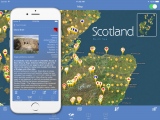
Featured: Explore Scotland (and everywhere else) with our Megalithic Portal iPhone app

Explore Scotland (and everywhere else) with our Megalithic Portal iPhone app

Megaliths, Stones of Memory

Megaliths, Stones of Memory

Login

Register here - as a registered user you get more features and fewer ads.

Who's Online

There are currently, 569 guests and 4 members online.

Sponsors

Stonehenge revelers get ready to celebrate summer solstice Stone Circle Wiltshire

Submitted by coldrum on Wednesday, 20 June 2007  Page Views: 4371

Stonehenge

<< News >>

Country: England County: Wiltshire Type: Stone Circle

Internal Links:

Thousands of modern-day druids, pagans and partygoers were converging on Stonehenge late Wednesday as people across the northern hemisphere prepared to welcome the summer solstice — the longest day of the year.

The sun will rise at 4:58 a.m. (0358GMT) Thursday, welcomed by an estimated 20,000 people expected to crowd around the ancient circle of stones in Wiltshire, southern England, to witness the event.

Solstice celebrations were a highlight of the pre-Christian calendar and in many countries bonfires, maypole dances, and courtship rituals linger on as holdovers from Europe's pagan past.

In more recent years, New Age groups and others have turned to Stonehenge to celebrate the solstice, and the World Heritage Site has become a magnet for men and women seeking a spiritual experience — or just wanting to have a good time.

But the celebrations can also attract their share of troublemakers — police closed the site in 1984 after repeated clashes with revelers. English Heritage, the monument's caretaker, began allowing full access to the site again in 2000.

Police will be on site just in case the hedonists get out of hand, and to prevent revelers from climbing the stones.

Solstice celebrations also take place in other countries, though most are deferred until the last weekend in June. Swedes will gather to sip spiced schnapps, Danes will light bonfires, and Balts and Finns will flock to the countryside to dance, sing, and make merry under the midnight sun in one of Scandinavia's most important holidays.

Stonehenge, on the Salisbury Plain 80 miles (130 kilometers) southwest of London, was built between 3,000 B.C. and 1,600 B.C. It is one of 20 monuments competing to be named one of the new seven wonders of the world in a massive online poll, but its purpose remains a mystery.

Some experts say the monument's builders aligned the stones with the sun as part of their sun-worshipping culture, although exactly how and why the monument was built remains shrouded in the mists of time.

iht.

Please add your thoughts on this site

Prehistoric Avebury

Prehistoric Avebury

Sponsors

More News

See all News →

"Stonehenge revelers get ready to celebrate summer solstice" | Login/Create an Account | 9 News and Comments
  
Go back to top of page    Comments are owned by the poster. We aren't responsible for their content.
Thousands at Stonehenge for summer solstice by coldrum on Wednesday, 20 June 2007
(User Info | Send a Message)
Thousands of modern-day druids, pagans and partygoers were converging on Stonehenge late Wednesday as people across the northern hemisphere prepared to welcome the summer solstice - the longest day of the year.

The sun will rise at 03.58 GMT Thursday, welcomed by an estimated 20,000 people expected to crowd around the ancient circle of stones in Wiltshire, southern England, to witness the event.

Solstice celebrations were a highlight of the pre-Christian calendar and in many countries bonfires, maypole dances, and courtship rituals linger on as holdovers from Europe's pagan past.

In more recent years, New Age groups and others have turned to Stonehenge to celebrate the solstice, and the World Heritage Site has become a magnet for men and women seeking a spiritual experience - or just to have a good time.
http://www.jpost.com/servlet/Satellite?cid=1181813087377&pagename=JPost%2FJPArticle%2FShowFull
[ Reply to This ]

Stonehenge menhirs oldest emblem of Europe's Celtic capital by coldrum on Wednesday, 20 June 2007
(User Info | Send a Message)
STONEHENGE is one of the most famous prehistoric sites in the world, and there is still an element of mystery attached to it. Why was this ancient monument built?

This prehistoric circle is located on Salisbury Plain, in Wiltshire, in southwest England. It consists of a circle of standing stones surrounded by earthworks. Archaeologists think the stones were erected around 3200 BC, which means they have been standing for some 5000 years.

Standing stones are literally what the name implies, solitary stones set vertically in the ground. These monoliths are generally of large size.

The word "henge" describes Stonehenge well as it means a prehistoric architectural structure that is nearly circular or oval-shaped sited on a flat area. This circle is enclosed and delimited by a boundary earthwork that usually comprises a ditch with an external bank. Generally there are up to four entrances to the circle.

However, archaeologists say that Stonehenge cannot be truly classified as a henge site as its bank is inside its ditch. Another theory is that the word henge comes from the old English word hinge, because the stone lintels hinge on the upright stones. Regardless of which is correct, Stonehenge is still a henge monument as it consists of large rocks in a circular formation.

At Stonehenge, the earthworks are not really noticeable as your attention is immediately drawn to the stones themselves. And the big question is, how and why were the stones put there.

It is thought the construction of the complex took over 3000 years. 8000 year old postholes have been found on the site of what is now the tourist car park, across the road from the main circle. Around 3100 BC the ditch and circular bank were constructed. Then maybe around 2600 BC up to 80 standing stones were erected. Some of these stones which weigh about 4 tonnes and are 2m high, came from a site 250 km away in south Wales. The central megalith is called the Altar Stone and weighs a staggering 6 tonnes.

But this was only the beginning. During the next stage of the construction, larger stones about 4m high and weighing 25 tonnes were brought in. 30 of these stones were erected to form a circle with a diameter of 33m, with a lintel of 30 stones resting on top. These lintels were joined using a tongue and groove join.

Inside this circle were 5 even larger stones arranged in a horseshoe shape. Some of these have been carved with images of axe heads and a dagger.

And why was this mammoth project built? During the first phase, it seems that Stonehenge was functioning as an enclosed cremation cemetery, which makes it the earliest known cremation cemetery in the British Isles. However the main reason seems to be religious. The northeastern entrance precisely matched the direction of the midsummer sunrise and midwinter sunset of the period. Stonehenge seems to have been used up until the Iron Age, and possibly until the seventh century. But even today, the Summer Solstice is celebrated here.

Another possibility is that Stonehenge was a scientific observatory. It is thought that some key sites correlate strongly with the rising and setting points of the sun and moon.

Of course there are many myths and legends surrounding the site. England is home to Merlin, the wizard who featured in King Arthur's legends. Some say that Merlin had Stonehenge built for himself.

Another common misconception is that the Druids used the site for sacrifices, but Druids only came into existence after 300 BC. Celtic society did give rise to the Druid priests, and nowadays modern Celts claim the site as their own and hold several festivals and ceremonies here throughout the year.

On the longest day of the year, the Summer Solstice, the sun shines directly through the centre of the structure, and this seems to indicate a religious purpose. Today Stonehenge is often associated with neo-Druidism.

Stonehenge was listed on the Unesco list of World Heritage Sites in 1986 along with Avebury henge monument, which is also in Wiltshire. Avebury is thought to be older than Stonehenge.

Stonehenge is also a legally protected Scheduled Ancient Monument. It is owned and managed by English Heritage while the surrounding land is owned by the National Trust. By the 20th century several of the stones had fallen or were leaning precariously, probably as a result of so many visitors climbing over them.

When I was a child there was no restriction about touching the stones, and I posed for many photos climbing up and sitting on the stones. Nowadays, visitors are kept well away from the circle in an attempt to preserve it. And English Heritage controls the Summer Solstice celebrations. This year, 2007, the solstice occurs between June 20-21.

Today, Salisbury Plain is devoid of trees, whereas 4000 years ago it was heavily wooded. And Stonehenge has two busy roads running past it. It attracts thousands of tourists, and there are always dozens of tour buses are parked in the car park. Visitors now walk around a path outside of the circle, listening to a tape recorded tour.

But despite these trappings of modernisation, Stonehenge remains one of the ancient wonders of the world.

The Brunei Times
[ Reply to This ]

Summer solstice fests have deep roots by coldrum on Wednesday, 20 June 2007
(User Info | Send a Message)
Summer solstice, the longest day of the year, inspired Shakespeare's "Midsummer Night's Dream" and is associated with the exile of Adam and Eve from the Garden of Eden. Solstice festivals abound in the United States, from Norwegian bonfires to pagan candlelight labyrinths and American Indian drumming rituals.

On the summer solstice, as the sun reaches its highest point directly over the tropic of Cancer at an angle of 23 degrees 27 minutes north, countless festivities will start to heat up.

Known variously throughout Europe as the Feast of Epona, Gathering Day, Johannistag, Litha, Vestalia and Midsummer, the summer solstice was viewed across cultures as a period of peak fertility and a time for weddings. The term "honeymoon" sprang from Celtic tradition and referred to the June moon and the fermented honey mead drunk at wedding celebrations.

Shakespeare's romantic comedy "A Midsummer Night's Dream" commemorates the magical pairings of the solstice, and Aragorn and Arwen hold their nuptials on that night in Tolkien's "Lord of the Rings" trilogy.

But romance isn't the only reason to party on the summer solstice, which arrives on or about June 21. For numerous religious and ethnic groups, it is a time to pay tribute to nature and express cultural pride.

In Europe, the first day of summer involves revelry with deep pagan roots as tourists and religious groups gather to dance, drum and chant at Stonehenge, a 4,000-year-old stone structure in England.

In North America, the holiday has become a melting pot of sorts, with celebrations crisscrossing the continent, mixing European traditions, American Indian spirituality and new-age environmentalism.

One such festival is the Pagan Spirit Gathering in Wisteria, Ohio, held each June at a 620-acre nature preserve in the foothills. Now in its 26th year, the eight-day event is expected to draw hundreds of people from across the country and abroad to commune with nature.

"Though there are variations, we start every summer with an opening ritual and follow with a potluck festival, workshops and a parade with torches and candles," said Selena Fox, senior minister of the Circle Sanctuary, a pagan spiritual group that hosts the event. "It is a very diverse celebration, combining Druid, Wiccan, Native American, Celtic, Greek, Roman, Egyptian, Baltic and Swedish traditions."

Ancient customs that honor the sun meld with modern feminism as festival-goers offer herbs and flowers to the sun, a symbol of what Fox calls "the divine feminine," and stroll through a labyrinth created by 1,000 candles forming a pattern from pagan Crete.

For many new age religions, the summer solstice is like Christmas, Hanukkah and Easter rolled into one.

"Today we see a lot of reinvented religions of nature," said Philip Lucas, professor of religious studies at Stetson University in Florida. "Pagans, neo-pagans, Wiccans, hedge witches, neo-druids and groups like the goddess spirituality movement all celebrate the solstice."

While the summer solstice is possibly the highlight of the pagan calendar, Jews and Christians have traditionally downplayed it, even though other holidays such as Yom Kippur, Passover, Easter and Christmas intersect with the changing of seasons.

But some modern Judeo-Christian groups are reviving solstice worship.

"Many of those who grew up in Jewish and Christian religion want to see the modern holidays in their agrarian origin," Lucas said. "These green Jews and green Christians are incorporating the solstice into their current practices."

Some religious groups point to biblical passages that may have occurred on the summer solstice, including the verse in Joshua 10:12 in which Joshua stops the sun in the sky. (The term solstice is actually from two Latin words meaning "sun stands still.")

"There is also a legend that Adam and Eve were cast out of the Garden of Eden on the summer solstice," said Rabbi Jill Hammer, director and cofounder of Tel Shemesh, a Jewish organization focused on the celebration of nature. "In the Jewish tradition, the summer is always about this trade-off: abundance but also danger. The summer is about exile and sorrow and loss."

For the past three years, Tel Shemesh has honored the solstice with immersions in water, dancing and discussions of casting off past regrets. Last year the event took place in New York's Central Park and featured a large sun made out of wood and cloth.

In other parts of the country, American Indian groups view the solstice as a time of rebirth and regeneration.

The Pan American Indian Association's Thunderbird Clan of Red River Lodge hosts an annual sweat lodge in Eureka featuring drumming and a potluck dinner on the summer solstice. "It is a very sacred time of year for indigenous people," said Skyhawk, the clan leader. "In the summer, we give thanks because we couldn't be here without the sun."

In Canada, June 21 – now known as National Aboriginal Day – is also a time for honoring native cultures.

"It's a day for Aboriginals to be proud of themselves and for all Canadians to celebrate their achievements," said Jean Ouellet, outreach manager for Indian and Northern Affairs Canada. The 10-year-old celebration includes potlatches, powwows, fashion shows and panel discussions on native life. "Last year we had 180 activities that went on around the country that we funded," Ouellet said.

Many communities in the United States that rely on summer tourism start the season with an annual solstice celebration. The population of Ephraim, Wis., rises from 353 to more than 1,000 when local residents and vacationers host the Fyr Bal Festival the weekend before the solstice.

"The festival's name, Fyr Bal, is a Scandinavian term meaning fireball, which symbolizes the sun," said Sue Sherman, a member of the Ephraim Business Council and owner of a local bed and breakfast called the Village Green Lodge.

The festivities honor community leaders through the annual crowning of a town chieftain who will arrive on a boat wearing a Viking hat to set the first bonfire. Afterward, whitefish is cooked over the fires while children perform Norwegian dances.

The giant flames set along the waterfront of Eagle Harbor near Lake Michigan hark back to the gala's roots in the ancient Norwegian practice of using summer bonfires to burn winter witches.

"Back in Viking times, the fires represented burning somebody," Sherman said, "but now it is a celebration of summer, and it really draws a lot of tourists."

http://www.ocregister.com/ocregister/travel/newsandnotes/article_1713297.php
[ Reply to This ]

Stonehenge bans Summer solstice Druids, vegans, goths (Satire) by coldrum on Wednesday, 20 June 2007
(User Info | Send a Message)
Druids, vegans and assorted goths are to be excluded from Summer solstice commemoration ceremonies at Stonehenge this week after locals branded them a pest to wildlife who habitually dump excessive tonnes of toxic human waste into the surrounding ecosystem.

"Each year we have to put up with acres of foreign lentils sprouting up in the fields surrounding this ancient monument after these hippies crap all over our pastureland," local Soil Association representatives have told the press.

"Mostly they are organic free-trade Peruvian-origin virulent strains that defy digestion and germinate in the lower gut before acts of nature deposit them in the ancient Wiltshire countryside.

"For the last five years we have had to spend over ten million pounds on heavy duty industrial crop busting machinery to uproot these foreign lentil varieties which spread like wildfire across the county."

Despite Ministry of Agriculture measures to contain the outbreaks the invasive legumes keep sprouting and often affect indigenous wildlife nesting in the myriad hedgerows of the nearby countryside.

"We've tried asking the solstice visitors to amend their diets before and during their annual pilgrimages to our country's most ancient monument, but do they listen?

"Even installing bio-degradeable lavatory facilities at vast cost to the taxpayer is a futile act because many of these vegan and Druid chappies only void in the open, under moonlight and according to their spiritual beliefs.

"Most of them appear to prefer soiling themselves than using one of our portable hygenic chemical toilet facilities," local health official reported.

A five mile exclusion zone has cordoned off the Stonehenge monument today in anticipation of an early influx of the annual travellers whose convoys have already been spotted on the nearby local bypass armed with their trademark teepees, wigwams and calor gas fry-up equipment.

The sun's annual ingress into the sign of Cancer takes place on Thursday evening this week.

You have been warned.
http://www.thespoof.com/news/spoof.cfm?headline=s1i20611
[ Reply to This ]

Holiday Inn celebrates summer solstice by coldrum on Wednesday, 20 June 2007
(User Info | Send a Message)
InterContinental Hotels Group (IHG) is pleased to announce the opening of a brand new Holiday Inn situated just one mile from one of the world’s most famous and revered prehistoric sites; Stonehenge.

The bold and stylish Holiday Inn Salisbury-Stonehenge opened on 11 June offering 103 fully air-conditioned en-suite bedrooms which provide guests with high speed internet access as well as the latest interactive TV facilities.

Guests can benefit from the hotel’s superb dining and drinking opportunities, including the state-of-the-art Solstice Brasserie. Top London chef Matt Bills heads up a talented team in the cutting-edge kitchen, serving the best of contemporary British cuisine in relaxed, modern surroundings.

Furthermore, those arriving at the hotel late in the evening can also enjoy the 24-hour lounge bar – Bar 303 - which offers an extensive wine menu and exclusive champagnes and whose intimate feel, set around an open fire, are certain to appeal.

As an added extra,...

Read the rest of this post...
[ Reply to This ]

British Authorities told to Host 'Free Parties' by coldrum on Wednesday, 20 June 2007
(User Info | Send a Message)
Illegal raves could sweep Britain this summer with many taking place around festival days.

In response, councils should tame the anarchic open-air gatherings by allocating land for "free parties" and helping organisers apply for event licenses, the Local Government Association (LGA) has said.

It is also advising authorities to keep an eye out to see where they are going to be held

Culture boss at the LGA, Cllr Chris White said: "We need the eyes and ears of local people. Some raves are nothing more than a nuisance, but others pose a serious threat to the environment and to public safety.

"Many party-goers take dangerous chemical cocktails with limited access to the emergency services putting themselves and others at great risk."

The LGA believe that raves are undergoing a rebirth from their hey-day in the 1990s, and that mobile phones and the internet have made them easier to organise than ever.

Mr Smith said: "The impact of raves can be more than just a bit...

Read the rest of this post...
[ Reply to This ]
    Re: British Authorities told to Host 'Free Parties' by Andy B on Wednesday, 20 June 2007
    (User Info | Send a Message)
    The Ambient Picnic is an excellent example of this, now moved from Guildford to Epsom:
    http://www.ambientpicnic.co.uk/
    Now refreshed after a year off in 2006, The Ambient Picnic Festival returns on a new site:
    HOOK ROAD ARENA in EPSOM
    SUNDAY the 8th of JULY 2007
    12 noon until 9PM
    [ Reply to This ]

Police plan for solstice spectacular by coldrum on Wednesday, 20 June 2007
(User Info | Send a Message)
WILTSHIRE police are gearing themselves up for a major operation at Stonehenge for this year's solstice celebrations when an even bigger crowd than last year's 19,000 is expected.

The Glastonbury Festival kicks-off the day after the Stonehenge summer solstice, and police are anticipating many Glastonbury fans will stop-off on their way down to Somerset.

This year, English Heritage will be opening Stonehenge an hour earlier than usual on Wednesday, June 20, but other than that minor change, arrangements will follow the same pattern as the last few years.

The A344 will be closed to all traffic from 4pm on June 20 through to 4pm on June 21.

A police spokesman said Wiltshire police will be mounting a major operation again, supported by English Heritage, which will bring in its own private security personnel.

Using private security firms means Wiltshire police can reduce the number of officers they have attending the solstice, but the spokesman said there will be sufficient...

Read the rest of this post...
[ Reply to This ]

Druids, pagans and party-goers prepare for the summer solstice by coldrum on Wednesday, 20 June 2007
(User Info | Send a Message)
Druids, pagans and party-goers prepare for the summer solstice

What is it? The solstice occurs twice a year when the Earth's axis tilts furthest towards or away from the Sun.

The name solstice is taken from the Latin "sol", meaning sun, and "sistere", meaning to stand still. The term also refers to the whole day on which this passage of the Sun occurs.

In some parts of the world the solstice begins the seasons, while in the UK they are considered to be centre points of the year, occurring within days of midsummer and midwinter.

The summer solstice is on 21 June and is the longest day of the year for the northern hemisphere, with about 17 hours of daylight in the UK.

Where will it be celebrated? English Heritage will be bracing itself for the annual influx of druids and pagans to Stonehenge in Wiltshire.

The stone circle is the big draw for people who mark the summer solstice and is one of the few times of year when visitors are allowed to walk among the stones....

Read the rest of this post...
[ Reply to This ]

Your Name: Anonymous [ Register Now ]
Subject:


Add your comment or contribution to this page. Spam or offensive posts are deleted immediately, don't even bother

<<< What is five plus one as a number? (Please type the answer to this question in the little box on the left)
You can also embed videos and other things. For Youtube please copy and paste the 'embed code'.
For Google Street View please include Street View in the text.
Create a web link like this: <a href="https://www.megalithic.co.uk">This is a link</a>  

Allowed HTML is:
<p> <b> <i> <a> <img> <em> <br> <strong> <blockquote> <tt> <li> <ol> <ul> <object> <param> <embed> <iframe>

We would like to know more about this location. Please feel free to add a brief description and any relevant information in your own language.
Wir möchten mehr über diese Stätte erfahren. Bitte zögern Sie nicht, eine kurze Beschreibung und relevante Informationen in Deutsch hinzuzufügen.
Nous aimerions en savoir encore un peu sur les lieux. S'il vous plaît n'hesitez pas à ajouter une courte description et tous les renseignements pertinents dans votre propre langue.
Quisieramos informarnos un poco más de las lugares. No dude en añadir una breve descripción y otros datos relevantes en su propio idioma.