
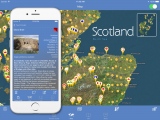
Featured: Explore Scotland (and everywhere else) with our Megalithic Portal iPhone app

Explore Scotland (and everywhere else) with our Megalithic Portal iPhone app

Visiting the Past: Finding and Understanding Britain's Archaeology

Visiting the Past: Finding and Understanding Britain's Archaeology

Login

Register here - as a registered user you get more features and fewer ads.

Who's Online

There are currently, 1490 guests and 0 members online.

Sponsors

South to Indus valley, axe is ‘link’ India

Submitted by coldrum on Friday, 30 June 2006  Page Views: 1592

Discoveries

<< News >>

Country: India A village teacher digging his garden has chanced upon late stone age tools that may buttress theories linking the Dravidian and Indus valley civilisations.

V. Shanmughanathan of Sembiyan Kandiyur village, near Mayiladuthurai in Nagapattinam, stumbled upon two 'polished neolithic hand-axes' - multi-purpose tools typical of the late stone age. One of them is engraved with symbols that resemble those on Harrappan seals.

With many scholars holding that the Indus valley civilisation was “pre-Aryan” and probably “proto-Dravidian”, the finds could have an impact on future readings of Indian history, say archaeologists.

The tools also suggest an “overlap” between the Indus valley civilisation and the neolithic age.

Shanmughanathan reported the finds to his friend G. Muthusamy, curator of the Tranquebar museum in Nagapattinam, who handed them over to the state archaeology department.

'One of the hand-axes contains four symbols closely resembling the (pictorial) Mohenjodaro-Harrappan script', said T.S. Sridhar, special commissioner in the state archaeology department.

Their polished surfaces suggest the tools date from the neolithic period (5000-1000 BC), for the earlier palaeolithic tools have rougher surfaces, Sridhar said.

Source: Telegraph India

Please add your thoughts on this site

Lines on the Landscape, Circles from the Sky: Monuments of Neolithic Orkney

Lines on the Landscape, Circles from the Sky: Monuments of Neolithic Orkney

Sponsors

More News

See all News →

"South to Indus valley, axe is ‘link’" | Login/Create an Account | 1 comment
  
Go back to top of page    Comments are owned by the poster. We aren't responsible for their content.
Burial urn dating to Megalithic period unearthed by Andy B on Monday, 29 November 2010
(User Info | Send a Message)
A five feet high burial urn dating to the Megalithic period (300 BC to 100 AD) and containing teeth and some other articles was unearthed by construction workers at a village near here today.
The urn was found at a depth of about eight feet at the backyard of a house at Thillayadi village and contained pieces of teeth and some articles commonly used by soldiers, officials said.

Speaking to reporters after visiting the spot, Tarangambadi Archaeological Curator Muthusamy said the urn was four feet wide, with a 2.5 foot diameter mouth. Two small pots, black and red in colour, a few mud plates, cups and pieces of teeth were found in it, he said.

Muthusamy said soldiers were usually buried with their belongings in urns during the Megalithic period. "Taking into account the shape, colour and other aspects of the urn, it appears to belong to the Megalithic period. In this particular urn a high ranking soldier might have been buried," he said.
Nagapattinam District Collector Munianathan, who also accompanied Munianathan, said the urn would be subjected to chemical treatment and put on public display at the Archealogical Museum inside the Danish Fort at Tarangambadi.

http://news.in.msn.com/national/article.aspx?cp-documentid=4623215
[ Reply to This ]

Your Name: Anonymous [ Register Now ]
Subject:


Add your comment or contribution to this page. Spam or offensive posts are deleted immediately, don't even bother

<<< What is five plus one as a number? (Please type the answer to this question in the little box on the left)
You can also embed videos and other things. For Youtube please copy and paste the 'embed code'.
For Google Street View please include Street View in the text.
Create a web link like this: <a href="https://www.megalithic.co.uk">This is a link</a>  

Allowed HTML is:
<p> <b> <i> <a> <img> <em> <br> <strong> <blockquote> <tt> <li> <ol> <ul> <object> <param> <embed> <iframe>

We would like to know more about this location. Please feel free to add a brief description and any relevant information in your own language.
Wir möchten mehr über diese Stätte erfahren. Bitte zögern Sie nicht, eine kurze Beschreibung und relevante Informationen in Deutsch hinzuzufügen.
Nous aimerions en savoir encore un peu sur les lieux. S'il vous plaît n'hesitez pas à ajouter une courte description et tous les renseignements pertinents dans votre propre langue.
Quisieramos informarnos un poco más de las lugares. No dude en añadir una breve descripción y otros datos relevantes en su propio idioma.