



<< Feature Articles >> Some of the Best Megalithic sites to visit in Germany
Submitted by Andy B on Tuesday, 25 June 2019 Page Views: 9970
Neolithic and Bronze AgeCountry: Germany Land: Schleswig-Holstein, Hamburg Type: Long BarrowInternal Links:


If you are visiting the EU from the UK you should really get an EHIC Renewal, to make sure you have a current European Health Insurance Card, to get free or reduced price health cover. The EHIC card replaced the E11 card in 2005, and if you have not visited Europe recently the chances are yours is out of date. So having reminded you of that, it's back to the megaliths!
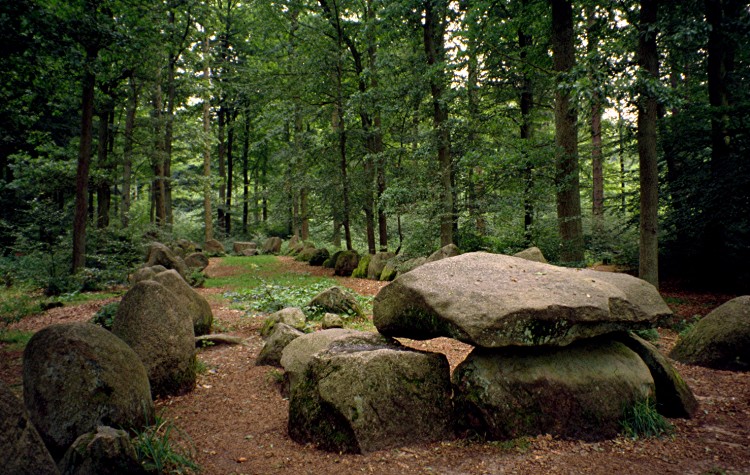 Sophienhof Dolmen (above left) is constructed with two pairs of orthostats (upright stones) on the long sides and one orthostat at the narrow northeastern side. The entrance was most probably in the south-east. The capstone measures 3.2m x 1.7m and is 1.2m thick and is covered with cup-marks.
Klecken Langbett (pictured right) is a long barrow in Lower Saxony. It's 45m long with with the chamber towards the northern end. Most of the mound is now gone but the chamber is still half-way embedded into what’s left of it.

Next, staying in Lower Saxony, is Glaner Braut 1. This is a wonderful chambered tomb oriented east-west, consisting of a 53m enclosure with 47 stones. There are the remains of a chamber two thirds towards the western end. The smaller long barrow of Glane II is just 10m to the east, and there are two other barrows very close by.

Again in Lower Saxony, we have Visbeker Braut, a huge rectangular long-barrow 80m x 7m. Near the south-western end is a chamber oriented parallel to the barrow. “Braut” means Bride - a well known legend tells this is a bridal procession turned to stone - the daughter of a wealthy farmer forced to marry a man she did not love. In her despair she begged God to turn her to stone to prevent the marriage. So it seems he fulfilled her wish! The petrified bridal procession of the bridegroom is the “Visbeker Bräutigam”. This site can get very busy with tourists and school trips so time your visit accordingly.

Kleinenkneter Steine I and II are two unique sites so let's look at these next:
Kleinenkneter Steine I in Lower Saxony is an amazing site you can go right inside - the covering of soil was reconstructed after excavation. The back of the chamber was left open a little so that light can enter the interior. It has a rectangular enclosure, 50m long and 7m wide, comprising of large erratic blocks, and at the centre is an irregular shaped burial chamber.
Very close by is Kleinenkneter Steine 2. Out of the several thousand Neolithic funnel-beaker sites in Northern Europe, this is the only one which has three passage graves within a single kerbed long-barrow enclosure. The site was excavated in 1934 and some restoration took place afterwards.
Also very close by to these two is a chambered tomb which was originally situated at the Wellohsberg, between Dötlingen and Wildeshausen, but for reasons best known to the authorities they relocated it here to be with its friends.
Finally, Goosefeld Dolmen
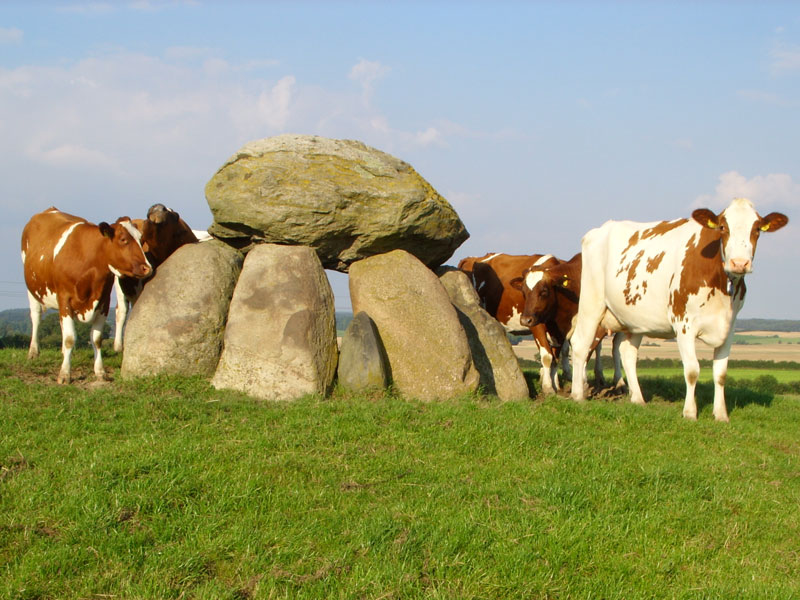 sits on the top of a hill in the midst of a very beautiful area on the Schwansen peninsula in Schleswig-Holstein - a lovely dolmen, also known as Lehmsie. It is one of the stand-out must-see megalithic sites in northern Germany, standing free, with no fence or obstructions, apart from some cows at times!
So just a brief taster of the many amazing sites you can find. With many thanks to Krautrock, Holger Rix, Greywether, Alex Hunger, RunaStera, and ehic.co.uk for their assistance with this article. There are thousands more long barrows, dolmens and other types of prehistoric and ancient sites in Germany, see our detailed listings for many more.

 We would like to know more about this location. Please feel free to add a brief description and any relevant information in your own language.
 Wir möchten mehr über diese Stätte erfahren. Bitte zögern Sie nicht, eine kurze Beschreibung und relevante Informationen in Deutsch hinzuzufügen.
 Nous aimerions en savoir encore un peu sur les lieux. S'il vous plaît n'hesitez pas à ajouter une courte description et tous les renseignements pertinents dans votre propre langue.
 Quisieramos informarnos un poco más de las lugares. No dude en añadir una breve descripción y otros datos relevantes en su propio idioma.