

Riding to the Stones: The Alentejo's Megaliths by Motorcycle from Lisbon
Submitted by Andy_B on Friday, 09 October 2026 Page Views: 47
Resources
Almendres: the big one
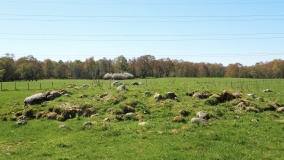
The Almendres stone circle sits on a gentle slope near the village of Guadalupe, roughly 15 km west of Évora. It is one of the largest groups of standing stones in the Iberian Peninsula, with around 95 granite monoliths arranged in two linked enclosures. Archaeologists date its first phase to the Neolithic, several thousand years before Stonehenge's sarsens went up, and the site was added to and rearranged over a very long period. Several stones carry carved motifs: circles, crook shapes and small cup marks that are easiest to see in low, raking light, so early morning or late afternoon is the time to be there.About 1.5 km away, in a field reached by a short walk, stands the Menir dos Almendres, a single stone around four metres tall. Many people miss it. Ask locally or follow the small signs from the track.
The last few kilometres to Almendres are unpaved. In dry weather any bike will cope at a sensible pace; after rain the clay gets slippery, and a bike with some suspension travel makes life easier.
Zambujeiro and the dolmens
South of Évora, near Valverde, the Anta Grande do Zambujeiro is counted among the largest dolmens in the Iberian Peninsula. It is worth the ride for the scale of its chamber stones alone, and the lanes around Valverde are quiet and well surfaced. The wider Évora district has dozens of smaller antas, many standing alone in farmland; a good regional map marks a surprising number of them.Monsaraz: stones above the lake
East of Évora, the road to the hilltop village of Monsaraz is one of the best rides in the region: long sweeping bends, little traffic and wide views over the Alqueva reservoir. Near Monsaraz you can visit the Cromeleque do Xerez, a stone enclosure that was moved to its present position when the Alqueva dam flooded its original site, and the Menir da Bulhoa, a standing stone decorated with carved lines and circles. Monsaraz itself is a walled village with a castle, and a good place to stop for the night.Planning the trip
Évora is about 130 km from Lisbon. The motorway gets you there in an hour and a half, but the old national roads through Montemor-o-Novo are more pleasant if you have the time. A realistic plan is:• Day 1: Lisbon to Évora, with an afternoon visit to Almendres and the menhir.
• Day 2: Zambujeiro in the morning, then east to Monsaraz, Xerez and Bulhoa.
• Day 3: Back to Lisbon through the cork and olive country around Arraiolos.
That is about 500 km in total, which suits a mid-size touring or adventure bike. Spring and autumn are the best seasons: the summer heat on the plain regularly passes 35°C, and there is very little shade at the sites.
Flying in and arranging a motorcycle rental in Lisbon is the simplest option for UK visitors. RENT.MOTO.PT has its pick-up point in Sobreda, on the south bank of the Tagus, which means you are already on the right side of the river for the Alentejo and avoid the city traffic. Helmets and insurance are included, and bikes such as the Honda Transalp 750 or Yamaha Ténéré 700 handle both the motorway and the gravel to the stone circle.
A few practical notes
• The stone circle and the menhir are open-air sites in the countryside.• Carry water. Cafés are in the villages, not at the monuments.
• Do not climb on the stones. Several have carvings that are slowly wearing away.
• Fuel stations are spread out in the interior; fill up in Évora before heading east.
The Alentejo's megaliths are less famous than Carnac or Avebury, and that is part of the appeal. On a weekday in March you may have Almendres almost to yourself, with only the sound of your engine cooling and the wind in the cork oaks.