

Relic linked to Seahenge
Submitted by vicky on Friday, 13 August 2004 Page Views: 4693
Discoveries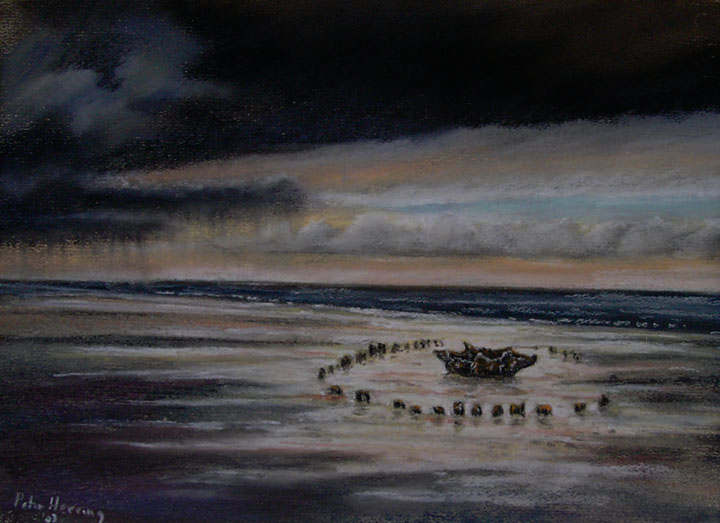
Archaeologists now believe instead of being composed of plain wooden posts, parts of a Bronze Age timber circle found close to the site of Seahenge could have been decorated with carvings resembling native American totem poles.
The revelation comes as an archaeological journal sheds new light on the discoveries at Holme Beach, near Hunstanton.
The carved figure dates back to 2200BC, close to the period when Seahenge was built. It is believed to be the earliest representation of the human figure in existence.
Yesterday Marie Taylor, marketing officer at Colchester Castle Museum where the idol is kept, said: “You can make a safe speculation between the two things.
“Most of archaeology is speculation and piecing things together.”
Today British Archaeology magazine will reveal that a second timber circle, also found at Holme, dates back to 2400BC, pre-dating Seahenge by hundreds of years. Parts of the relic, which consisted of a timber ring with two large logs in its centre, were swept away by last winter's storms.
It says the structure, which was almost certainly a burial mound, resembles similar circles found in the Netherlands. Leading archaeologists predict there could be more discoveries at Holme.
Mike Pitts, editor of British Archaeology, said: “On Holme beach there could be a vast area of ancient landscape preserved under the dunes.”
Mark Brennand, who led the Seahenge excavation, said: “We may be looking at the very last elements of it and the rest's out to sea, or we may be looking at the beginnings of it to the landward side.”
There were angry protests as scientists began removing Seahenge's ancient timbers and central tree stump from the beach.
But archaeologists later said examination of the oak posts had shed new light on Bronze Age civilisation, showing society was more advanced 5000 years ago than had been previously thought.
Seahenge's timbers have been conserved at Flag Fen, near Peterborough. They are due to go on display at King's Lynn Museum next year.
Source and Photo: EDP24 News 13/08/2004


 We would like to know more about this location. Please feel free to add a brief description and any relevant information in your own language.
 Wir möchten mehr über diese Stätte erfahren. Bitte zögern Sie nicht, eine kurze Beschreibung und relevante Informationen in Deutsch hinzuzufügen.
 Nous aimerions en savoir encore un peu sur les lieux. S'il vous plaît n'hesitez pas à ajouter une courte description et tous les renseignements pertinents dans votre propre langue.
 Quisieramos informarnos un poco más de las lugares. No dude en añadir una breve descripción y otros datos relevantes en su propio idioma.