Featured: Hare and Tabor T Shirts for discerning antiquarians

Hare and Tabor T Shirts for discerning antiquarians

Random Image

Circles of Stone - Max Milligan

Circles of Stone - Max Milligan

Login

Register here - as a registered user you get more features and fewer ads.

Who's Online

There are currently, 672 guests and 5 members online.

Sponsors

Ramparts restored at hill fort Hillfort Pembrokeshire

Submitted by PaulM on Friday, 01 November 2002  Page Views: 1359

Iron Age and Later Prehistory

<< News >>

Country: Wales County: Pembrokeshire Type: Hillfort

Internal Links:

Foel Drygarn Hillfort
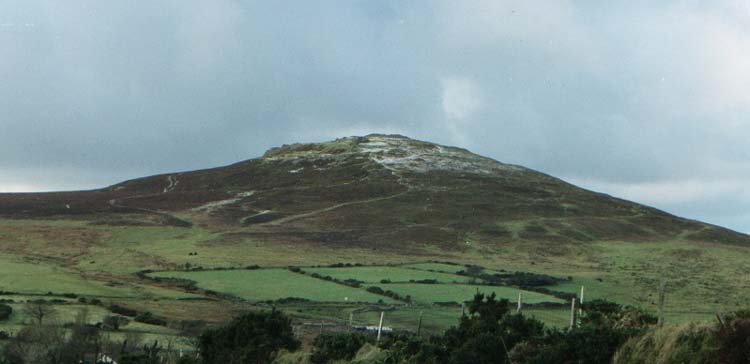
Foel Drygarn Hillfort submitted by PaulM : Foel Drygarn Hillfort, near Crymych, Pembrokeshire GR: SN15773360 This Late Bronze Age / Early Iron Age hillfort stands at the end of the Preseli range and is capped by three cairns which can be seen for miles around. Aerial photographs have revealed numerous hut circles on the summit. (Vote or comment on this photo)
The Pembrokeshire Coast National Park reports that ramparts on one of the finest Iron Age hill forts in Wales have been repaired, thanks to the efforts of the Park's Voluntary Wardens.

Two sections of the ramparts at Foel Drygarn, near Mynachlogddu, had deteriotated over the years and needed to be restored.

National Park Ranger Richard Vaughan and Estate Warden Geoff Severn joined with a work party of North Sector Voluntary Wardens and Cadw Welsh Historic Monuments staff to carry out the repairs.

Said Richard: “We used stone and earth to restore two of the ramparts and turf was brought to the fort from the local area. The voluntary wardens help with many projects during the year and this was one of the more unusual and historic.”

Foel Drygarn – which means ‘Hill of three cairns’ – dates from the Iron Age which in Wales was from around 650 BC to 70 AD, some 2,500 years ago. The cairns are probably from the earlier Bronze Age, c.1500 BC.

The fort – which is over 1,000 feet above sea level - covers an extensive area and dozens of house platforms have been identified. In 1899 excavations took place on the site and artefacts from the Iron Age and the Roman period, including glass beads, jet rings and pottery vessels, were found. Many of these are went to Tenby Museum.

Please add your thoughts on this site

Magic Stones: The Secret World of Ancient Megaliths

Magic Stones: The Secret World of Ancient Megaliths

Sponsors

More News

See all News →

"Ramparts restored at hill fort " | Login/Create an Account | 0 News and Comments
  
Go back to top of page    Comments are owned by the poster. We aren't responsible for their content.
Your Name: Anonymous [ Register Now ]
Subject:


Add your comment or contribution to this page. Spam or offensive posts are deleted immediately, don't even bother

<<< What is five plus one as a number? (Please type the answer to this question in the little box on the left)
You can also embed videos and other things. For Youtube please copy and paste the 'embed code'.
For Google Street View please include Street View in the text.
Create a web link like this: <a href="https://www.megalithic.co.uk">This is a link</a>  

Allowed HTML is:
<p> <b> <i> <a> <img> <em> <br> <strong> <blockquote> <tt> <li> <ol> <ul> <object> <param> <embed> <iframe>

We would like to know more about this location. Please feel free to add a brief description and any relevant information in your own language.
Wir möchten mehr über diese Stätte erfahren. Bitte zögern Sie nicht, eine kurze Beschreibung und relevante Informationen in Deutsch hinzuzufügen.
Nous aimerions en savoir encore un peu sur les lieux. S'il vous plaît n'hesitez pas à ajouter une courte description et tous les renseignements pertinents dans votre propre langue.
Quisieramos informarnos un poco más de las lugares. No dude en añadir una breve descripción y otros datos relevantes en su propio idioma.