

Peru Finds 70 years ago: Dead Men's Heads carved on Ancient Temple
Submitted by coldrum on Wednesday, 12 March 2008 Page Views: 2645
Multi-periodCountry: Peru Type: Ancient TempleInternal Links:

Mr. Collier, son of Commissioner of Indian Affairs, John Collier, is preparing his report for the Institute of Andean Research, which he represented.
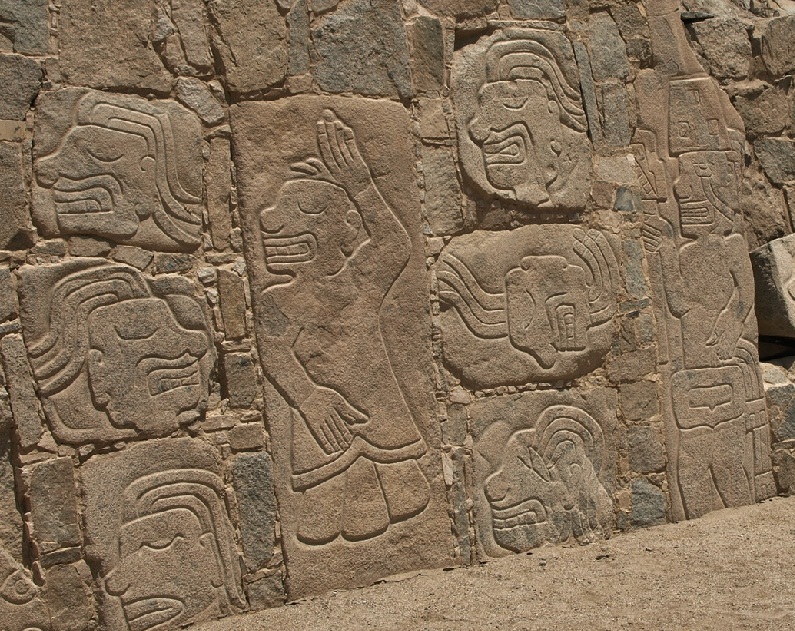
The weird art subjects were discovered, Mr. Collier said, when the expedition unearthed a remarkable ceremonial terrace of stone on the coast of northern Peru. On some stones, they found carvings of warriors making vigorous gestures. Other portraits had no bodies but were mere cadaverous-looking faces "all cut off obviously under the chin." (See front cover.)
"The supposition is that they had human sacrifice," he explained, "and one form was to take human heads—whether heads of their own people or those of enemies, we don't know."
Mr. Collier describes the stone temple, its art, and the cemetery nearby as all revealing a new kind of culture, unlike that of other Indians who lived in Peru before the great Incan Empire was formed. These ancient Indians who built the stone temple lived perhaps around 600 A.D., or around 900 A.D.—dating them is mere guesswork, Mr. Collier says. Aside from three kinds of pottery buried in strata of earth, there is nothing to suggest passage of time, or any particular era.
This is the first discovery of a temple of giant stones on the coast land of Peru. Such temples were built in Peru's mountains, but coast tribes used adobe architecture.
"This is the first indication," he said, "that some of the highland people came to the coast to live and built a temple, because it must have taken several years to construct the terraced pyramid with these blocks 10 feet high and several feet thick."
The mysterious stone workers had a highland background. But where they got their art ideas, and their plain style of pottery making, and their simple ideas of burial—very different from the elaborate mummy wrappings of some Peruvian graves—is still to be traced, so that science may fit these unknown Indians into the pattern of Peru's prehistory.
Source: Science News


 We would like to know more about this location. Please feel free to add a brief description and any relevant information in your own language.
 Wir möchten mehr über diese Stätte erfahren. Bitte zögern Sie nicht, eine kurze Beschreibung und relevante Informationen in Deutsch hinzuzufügen.
 Nous aimerions en savoir encore un peu sur les lieux. S'il vous plaît n'hesitez pas à ajouter une courte description et tous les renseignements pertinents dans votre propre langue.
 Quisieramos informarnos un poco más de las lugares. No dude en añadir una breve descripción y otros datos relevantes en su propio idioma.