

Featured: New Book: Astrometrology: The Science of Ancient Metrology by Christopher Willett

New Book: Astrometrology: The Science of Ancient Metrology by Christopher Willett

Inscribed Across the Landscape: The Cursus Monuments of Great Britain

Inscribed Across the Landscape: The Cursus Monuments of Great Britain

Login

Register here - as a registered user you get more features and fewer ads.

Who's Online

There are currently, 1330 guests and 7 members online.

Sponsors

New theory about the Stonehenge bluestones from Rob Ixer and Richard Bevins Wiltshire

Submitted by Andy B on Saturday, 26 February 2011  Page Views: 18168

Stonehenge

<< News >>

Country: England County: Wiltshire Type: Henge

Internal Links:

Stonehenge Grooved Bluestone
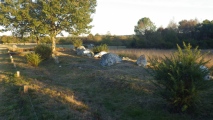
Stonehenge Grooved Bluestone submitted by vicky : A grooved bluestone in the bluestone horseshoe. (Vote or comment on this photo)
A new theory about the Stonehenge bluestones is set to divide geologists and archaeologists, and open new inquiries into how and why the famous stones reached Stonehenge.

The site's megaliths are traditionally classed into two groups, sarsens (a local sandstone) and bluestones. While the former, at an estimated total weight of 1,700–1,800 tonnes, outscale the 250- odd tonnes of the latter, the bluestones have dominated debate. The issues of where they came from and how they reached Stonehenge, have polarised into two widely divergent views:

•Most derive from the Preseli Hills in Pembrokeshire, south-east Wales, and were taken to Wiltshire by the builders of Stonehenge around 3000–2500bc

•Alternatively, they come from a variety of sources in south Wales, and reached Salisbury Plain as glacial erratics during the ice age, thousands of years before Stonehenge was built.

Most prehistorians believe people
moved the stones. This was what
geologist Herbert Thomas proposed,
when he first identified the Preselis as
the origin in 1920: a view endorsed by
geologists including Christopher
Green and James Scourse, and recently
by archaeologists Timothy Darvill and
Geoffrey Wainwright, who claim to
have found quarry outcrops and "sacred
springs" at the source of the megaliths
around Carnmenyn.

Geologist George Kellaway
proposed in 1971, by contrast, that the
bluestones had been transported by a
glacier. This view has been supported
by archaeologist Aubrey Burl, and (in a
differing glacial interpretation) an
Open University team of geologists
including Olwen Williams-Thorpe.
Last year the latter wrote on a BBC
Timewatch blog that the bluestones
"are a rag-bag mix… from all over south
Wales", and Brian John published The
Bluestone Enigma (see Books, page 55).

Now geologists Rob Ixer (University
of Leicester) and Richard Bevins
(National Museum of Wales) are
proposing a third option. They say
many bluestones came not from
Pembrokeshire, but from "a far wider
and, as yet, unrecognised area or more
likely areas" – perhaps north Wales
(Snowdonia, the Llyn Peninsula and
Anglesey), or even beyond.
[BUT see important update below].
The well known
spotted dolerite, is a Preseli
rock, they say – but Carngoedog was
the likely source, not Carnmenyn.

These conclusions derive from a new
study of thousands of Stonehenge rock
specimens: from near the west end of
the Cursus earthwork (where a lost
bluestone circle has been proposed),
collected in 1947 and excavated by the
Stonehenge Riverside Project in
2006/08; and from Stonehenge,
excavated by Mike Pitts in 1979/80 and
Darvill and Wainwright in 2008.

The geologists also found the Cursus
bluestones, which are all rhyolitic and
mainly tuffaceous (with no Stonehenge
dolerites), had significant mineralogical
differences from visually similar rocks
at Stonehenge. The Darvill and
Wainwright excavation produced
significant amounts of a type of
rhyolite or rhyolitic tuff "not recorded
in north Pembrokeshire and noticeably
absent in the Mynydd Preseli area".

How the stones were moved, Ixer
told British Archaeology, "is an
archaeological problem", though he
wondered if "different groups [of
people] brought different stones?"
Ixer and Bevins's detailed study will
be published in the 2009 Wiltshire
Studies. In WS 2006, Ixer and Peter
Turner suggested that the Stonehenge
Altar Stone (the largest bluestone)
came from an unidentified source far
from Milford Haven – the traditional
attribution said to indicate where the
Preseli stones were taken downriver
and out to sea by neolithic gangs

Source: British Archaeology Magazine iss Nov/Dec 09.


Note: Update: research casts doubt on the Milford Haven route for the Stonehenge bluestones, and we highlight the location of Pont Saeson, another likely source


has found this location on Google Street View:

Please add your thoughts on this site

Children Of The Stones DVD

Children Of The Stones DVD

Sponsors

More News

See all News →

"New theory about the Stonehenge bluestones from Rob Ixer and Richard Bevins" | Login/Create an Account | 23 News and Comments
  
Go back to top of page    Comments are owned by the poster. We aren't responsible for their content.
Re: New theory about the Stonehenge bluestones from Rob Ixer and Richard Bevins by Anonymous on Tuesday, 15 March 2011
The article opens by asking two questions, how and why did the bluestones reach Stonehenge. The text continues with comments on various 'hows' but no answer to 'why'.
An answer to 'why' is contained in ''Stonehenge Sacred Symbolism'', the Sun calendar of sixteen months a year, each month of four weeks, weeks of five days, Sunday, Moonday, Wodensday, Thorsday and Freyrday.
See
[ Reply to This ]

Re: New theory about the Stonehenge bluestones from Rob Ixer and Richard Bevins by Anonymous on Tuesday, 01 March 2011
While geology and glaciology are clear in there statements regarding the movement of these stones via glaciers, the archaeologists have no evidence of any kind regarding their movement. I stand with the evidence...glaciers moved these rocks not men. Why is not Pembroke covered with monuments built of 'bluestones' if they were so important?

Harry Sivertsen
[ Reply to This ]

Re: New theory about the Stonehenge bluestones from Rob Ixer and Richard Bevins by Anonymous on Monday, 28 February 2011
If the bluestones are glacial erratics, that pre-supposes that absolutely every bluestone that was deposited in the wider Stonehenge landscape was gathered up by the Henge builders and incorporated into one or another monument unless, of course, anyone has yet identified bluestones on Salisbury Plain that are both verifiably independent of any human agency and clearly within a morainic context.
With sufficient time and resources (oh yes, and funding), all logical and credible routes from the supposed source quarries could be explored to search for stones that didn't "make it" to Wiltshire, including those that inevitably were lost in the sea or river journeys. Just one bluestone found in isolation from its geological context would be sufficient nail down the debate.
[ Reply to This ]
    Re: New theory about the Stonehenge bluestones from Rob Ixer and Richard Bevins by Andy B on Monday, 28 February 2011
    (User Info | Send a Message)
    There was a lot of interest in one thought to be submerged in Milford Haven area. You'd think there would be at least one that was lost underwater somewhere and as a flippin big stones, divers should be stumbling across them now and then. Unless...
    [ Reply to This ]

Re: New theory about the Stonehenge bluestones from Rob Ixer and Richard Bevins by Anonymous on Sunday, 27 February 2011
given the incredible difficulties associated with moving stones of that size with the resources available then i would start with the assumption that the builders of stone henge would use as local as possible sources of stone. assuming that i would try and determine the possible tracts of glaciation and "backtrack" to find the source. the simplest solution to a problem is usually the most likely "except when dealing with religion" but its worth a look
[ Reply to This ]
    Re: New theory about the Stonehenge bluestones from Rob Ixer and Richard Bevins by davidmorgan on Sunday, 27 February 2011
    (User Info | Send a Message)
    I guess you'd have to find some glacial erratics in Somerset and then find their source. I'm not sure about the "incredible difficulties" aspect, the Egyptians were shipping 80 ton stones 500 miles down the Nile at about the same time that Stonehenge was built.
    [ Reply to This ]

Re: New Discovery in Stonehenge Bluestone Mystery by Runemage on Sunday, 27 February 2011
(User Info | Send a Message)
Thanks Andy, it's not that far away from Carn Meini,
I've put a link on the site-page if anyone wants to compare both locations re distance terrain etc.


[ Reply to This ]

Re: New Discovery in Stonehenge Bluestone Mystery by Anonymous on Sunday, 27 February 2011
Am I missing something here - why does a potential Bluestone source that is less than 8km from the coast preclude that they were transported by sea? I'm not arguing for or against human agenmcy, just curious.

[ Reply to This ]
    Re: New Discovery in Stonehenge Bluestone Mystery by Andy B on Sunday, 27 February 2011
    (User Info | Send a Message)
    They say "it is unlikely that they would have transported the Pont Saeson stones up slope and over Mynydd Preseli to Milford Haven. If humans were responsible then an alternative route might need to be considered." So by sea but a different route to the sea. They then add:

    "However, some believe that the stones were transported by the actions of glacier sheets during the last glaciation and so the Pont Season discovery will need appraising in the context of this hypothesis."
    [ Reply to This ]
      Re: New Discovery in Stonehenge Bluestone Mystery by Anonymous on Thursday, 03 March 2011
      You have slandered us
      Neither Richard nor I have a pet theory other than most people do not really read what we carefully say!
      We make NO NO no no no statement on how the stones were moved That is a mugs game for fools.
      We just state where the outcrops are.
      Dr Rob Ixer FSA
      [ Reply to This ]
        Re: New Discovery in Stonehenge Bluestone Mystery by Andy B on Thursday, 03 March 2011
        (User Info | Send a Message)
        Dear Dr Rob, my sincere apologies for the error, I was reading a subtext into the comment that wasn't there and have removed the remark.
        [ Reply to This ]
    Re: New Discovery in Stonehenge Bluestone Mystery by davidmorgan on Sunday, 27 February 2011
    (User Info | Send a Message)
    Sounds pretty easy to me - roll (or raft) them down to Newport and pop them on a boat. Maybe those guys doing the neolithic grand tour picked them up on the way home from Newgrange.
    [ Reply to This ]
      Re: New Discovery in Stonehenge Bluestone Mystery by PAB on Sunday, 27 February 2011
      (User Info | Send a Message)
      As davidmorgan comments: "roll (or raft) them down to Newport and pop them on a boat." If I understand these things correctly, there was a fair certainty at the time that there would have been a very good covering if ice/snow every winter with the climate being what it was?

      'They' could therefore count on perfect conditions for moving any large stones - in the knowledge that, even if they didn't get where they wanted in one year, there'd be another perfect sledging winter not too far off. IF therefore humans took the bluestones from Preseli to Stonehenge, they would have had completely different 'surfaces' to use compared to those which we are used to. Whether via Newport or Milford Haven seems neither here nor there....I wonder if there are examples from elsewhere where huge stones etc have been transported over ice or packed snow?

      I rather think that ice is going to end up being the only logical answer....but I am not yet convinced that we humans had to be involved.

      I...

      Read the rest of this post...
      [ Reply to This ]

Re: New Discovery in Stonehenge Bluestone Mystery by Andy B on Sunday, 27 February 2011
(User Info | Send a Message)
Good point, I've created a site page to show the location:
http://www.megalithic.co.uk/article.php?sid=28658
[ Reply to This ]

Re: New Discovery in Stonehenge Bluestone Mystery by Anonymous on Sunday, 27 February 2011
Street View of rocks at Pont Saeson -
View Larger Map
[ Reply to This ]

Re: New Discovery in Stonehenge Bluestone Mystery by Runemage on Sunday, 27 February 2011
(User Info | Send a Message)
A map would have helped the layman see how far away this deposit of rhyolite bluestones is from the one previously thought to have been the source of all of them.

Perhaps in time and with further analysis it will be shown that each bluestone came from a slightly different area in the same way as Silbury was founded with deposits of earth from different areas as described in 'The Story of Silbury Hill'.


[ Reply to This ]

New Discovery in Stonehenge Bluestone Mystery by Andy B on Saturday, 26 February 2011
(User Info | Send a Message)
The source of the bluestones at Stonehenge has long been a subject of fascination and considerable controversy. One type of bluestone, the so-called ‘spotted dolerite’, was convincingly traced to the Mynydd Preseli area in north Pembrokeshire in the early 1920s.

However, the sources of the other bluestones - chiefly rhyolites (a type of rock) and the rare sandstones remained, until recently, unknown. Now geologists at Amgueddfa Cymru – National Museum Wales have further identified the sources of one of the rhyolite types, which also provides the opportunity for new thoughts on how the stones might have been transported to the Stonehenge area.

Their findings are published in the March 2011 edition of the Journal of Archaeological Science.

Dr Richard Bevins, Keeper of Geology at Amgueddfa Cymru, in partnership with Dr Rob Ixer, University of Leicester and Dr Nick Pearce of Aberystwyth University, have been working on the rhyolite component of the bluestones, which leads them...

Read the rest of this post...
[ Reply to This ]

Stonehenge and Avebury seminar at Devizes, May 2010 by Andy B on Monday, 21 June 2010
(User Info | Send a Message)
Rob Ixer’s presentation on the geological origins of the bluestones was difficult for a non-specialist to follow, and I was surprised that his current thinking seems to have located all the bluestones in the Preseli/Fishguard area after his recent British Archaeology article, where he points out that the original source [of the rhyolite stones] came not from Pembrokeshire, but from “a far wider and, as yet, unrecognised area or more likely areas – perhaps north Wales (Snowdonia, the Llyn Peninsula and Anglesey), or even beyond.” Discussion in Eternal Idol article here:
http://www.eternalidol.com/?p=5005
[ Reply to This ]

Re: Issue 108 of British Archaeology, September / October 2009 now online by Aluta on Monday, 26 October 2009
(User Info | Send a Message)
More to corroborate the notion that Stonehenge was built as a theory generator!
[ Reply to This ]

Issue 108 of British Archaeology, September / October 2009 now online by Andy B on Monday, 26 October 2009
(User Info | Send a Message)
Issue 108, September / October 2009

All the latest archaeology news from around the country
features
THE BIG DIG: Fetternear

Penelope Dransart reports on the topical issue of MPs claims expenese, at Kettlethorpe Hall
London: the mud of ages

Lorna Richardson reports on the discoveries made by the Thames Discovery Programme community initiative and Nick Booth describes his Foreshore Group training
For the sake of the worms

As we celebrate Charles Darwin, Matthew Law considers one of his less well-known interests that led him to excavate at ancient sites
on the web

Caroline Wickham-Jones reviews How to get active with archaeology, and John Schofield looks at Flash methods to view the evolution of graffiti
letters

Your views and responses, with further Beneath the Sea coverage
book review

Paul Bidwell of Tyne and Wear Museums reviews a new publication on the Vindolanda Roman Fort.
CBA Correspondent

Mike Heyworth welcomes new HLF money for training, and...

Read the rest of this post...
[ Reply to This ]

Important revision to Stonehenge bluestone theory by Andy B on Monday, 26 October 2009
(User Info | Send a Message)
Important revision to Stonehenge bluestone theory

In the News pages of the Nov/Dec 2009 issue of British Archaeology, it is reported that new petrographical work by Rob Ixer (University of Leicester, Department of Geology) and Richard Bevins (National Museum of Wales) had suggested that some of the Stonehenge bluestones had not come from Pembrokeshire, but (in Ixer's words) from "a far wider and, as yet, unrecognised area or more likely areas". As the magazine was being printed, however, Bevins was out in the field, and found an apparent source for the rocks in question north of the Preselis. Ixer and Bevins have kindly written this interim note on this latest development.
Stilpnomelane-bearing rhyolites/rhyolitic tuffs at Stonehenge are most probably from the Preseli Hills region

Field and petrographical work continues on new Stonehenge lithics and on in situ material from areas around the Preseli Hills. This includes excavated material from the Avenue at Stonehenge, and...

Read the rest of this post...
[ Reply to This ]
    Re: Important revision to Stonehenge bluestone theory by mountainman on Tuesday, 27 October 2009
    (User Info | Send a Message)
    This new revision is interesting, and brings us back to the idea that the igneous rocks at Stoneghenge and its environs are essentially from the Preseli Hills region -- rather than from N Wales. Even more interesting is that the outcrops of rhyolite near Pont Saeson are not at all prominent -- and this means that (like the rather small outcrops at Carn Clust-y-ci and Carn Llwyd) erratics have been entrained from the N side of Preseli from sites not particularly significant in the landscape. I hope that we can now dispose of the idea -- which has been around since the days of Herbert Thomas in 1921 -- that Neolithic tribesmen collected their bluestones up from prominent or auspicious crags on the mountain summits , because they were somehow invested with spirituality or sanctity.

    And we have yet another source site for the infamous bluestones. I'm losing count -- are we up to 27 or so now? Do our learned professors still want 27 quarries?
    [ Reply to This ]
    Re: Important revision to Stonehenge bluestone theory by johnchristie on Friday, 30 October 2009
    (User Info | Send a Message)
    Not being a geologist I can't debate the pros and cons of the arguement set out in this article, except to say that when I made my visit to the Presceli Hills, it struck me that, with such a ready sourse of numerous, ideally shaped stones, there would have been no need for those entrusted with the task of selecting and transporting them to Stonehenge, to search further afield.
    Beyond that, when I searched for a probable overland route to a suitable launch site, I found that even in that deeply riven area of Wales they would have only had to cross one slope sided ravine to reach an ideal launch site on the nearby River Cleddau.
    In closing I make the point; with so much readily available material so easily obtained and moved to such a suitable site for preperation for a voyge, why would our ancesters have gone as far as Snowdonia or other hard to reach parts of Wales?
    [ Reply to This ]

Your Name: Anonymous [ Register Now ]
Subject:


Add your comment or contribution to this page. Spam or offensive posts are deleted immediately, don't even bother

<<< What is five plus one as a number? (Please type the answer to this question in the little box on the left)
You can also embed videos and other things. For Youtube please copy and paste the 'embed code'.
For Google Street View please include Street View in the text.
Create a web link like this: <a href="https://www.megalithic.co.uk">This is a link</a>  

Allowed HTML is:
<p> <b> <i> <a> <img> <em> <br> <strong> <blockquote> <tt> <li> <ol> <ul> <object> <param> <embed> <iframe>

We would like to know more about this location. Please feel free to add a brief description and any relevant information in your own language.
Wir möchten mehr über diese Stätte erfahren. Bitte zögern Sie nicht, eine kurze Beschreibung und relevante Informationen in Deutsch hinzuzufügen.
Nous aimerions en savoir encore un peu sur les lieux. S'il vous plaît n'hesitez pas à ajouter une courte description et tous les renseignements pertinents dans votre propre langue.
Quisieramos informarnos un poco más de las lugares. No dude en añadir una breve descripción y otros datos relevantes en su propio idioma.