

First Australians may have been migrants rather than drifters
Submitted by coldrum on Wednesday, 04 December 2013 Page Views: 3660
Other Archaeology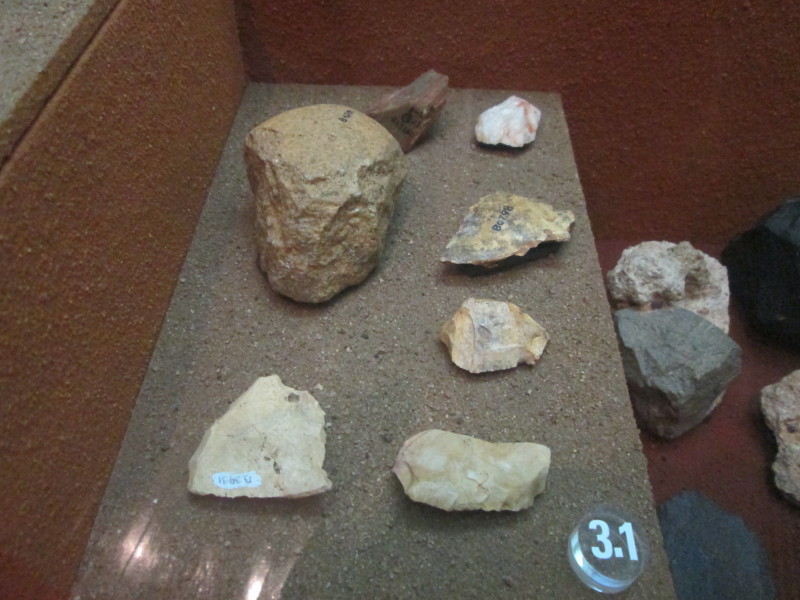
The prehistoric settlement of Australia has long been considered a simple story: a founding group of 150 people or fewer made it to the Australian mainland 50 millennia ago and grew to no more than 1.2 million by the time European settlers arrived in 1788. Debate focused on whether the founding population grew immediately after colonization or boomed later, in the past 5,000 years.
But a paper published today in Proceedings of the Royal Society B1 uses radiocarbon dating to estimate prehistoric populations, and reveals a more complex plot.
To tease out a demographic signal from the past, Alan Williams, an archaeologist at the Australian National University in Canberra, amassed the most comprehensive radiocarbon data set ever put together for the continent, from both published and unpublished sources. He analysed the dates of 4,575 artefacts from 1,750 archaeological sites.
Applying methods that others had developed to analyse a similar dataset from North American artifacts2, Williams graphed the number of data points for each 200-year period, and made the assumption that for each given area, changes in the number of data points from one period to the next were a good indication of changes in population size — while correcting for the fact that some types of archaeological site can be lost over time owing to processes such as erosion. Assuming that the population would be between 750,000 and 1.2 million by the eighteenth century, he fit a smooth population curve to the data.
According to Williams' curve, 1,000–2,000 founders would be necessary to reach the population that was in place when the Europeans arrived. After the founders arrived, the population would have stabilized at low levels, but crashed during the most recent Ice Age, around 20,000 years ago. “To quantify the impacts of the last glacial maximum — and see a 60% reduction in population — is quite horrendous,” says Williams. After the Ice Age, population growth rates began to increase in pulses, starting 12,000 years ago.
A large founding population suggests the potentially controversial notion that the first settlers arrived through deliberate migration, rather than being accidentally stranded on the Australian mainland, as has been assumed, says Williams.
The technique of using radiocarbon dates as a proxy for demographic numbers is gaining traction among researchers. “This is the first time an actual evidentiary data set has been used to construct continent-wide pre-European demographics, which is a significant step forward,” says Sean Ulm, an archaeologist and director of the Tropical Archaeology Research Laboratory at James Cook University in Cairns, Australia.
But not everyone has embraced it. “Using radiocarbon dates to reflect levels of human activity is not a method well-substantiated among archaeologists,” says Peter White, an archaeologist at the University of Sydney in Australia and editor of Archaeology in Oceania. The quantity and locations of radiocarbon dates measured by researchers at archaeological sites has little to do with past human activity, he says. (Williams' work shows more data points in the eastern half of Australia than in the west, not because more prehistoric peoples necessarily lived there, but because most of the country’s archaeologists live and work in the east.)
Simon Holdaway, an anthropologist at the University of Auckland in New Zealand, agrees — but thinks that Williams adequately acknowledges these concerns. And Holdaway expects the trend towards analysing continent-wide data sets to continue, encouraging researchers to refine the data sets. “Any proxy measure brings with it a series of concerns that we need to understand,” he says.
Source and further reference, see www.nature.com
Note: Study uses Radiocarbon Dating as proxy for demographic numbers. Is analysis of continent-wide data sets valid?


 We would like to know more about this location. Please feel free to add a brief description and any relevant information in your own language.
 Wir möchten mehr über diese Stätte erfahren. Bitte zögern Sie nicht, eine kurze Beschreibung und relevante Informationen in Deutsch hinzuzufügen.
 Nous aimerions en savoir encore un peu sur les lieux. S'il vous plaît n'hesitez pas à ajouter une courte description et tous les renseignements pertinents dans votre propre langue.
 Quisieramos informarnos un poco más de las lugares. No dude en añadir una breve descripción y otros datos relevantes en su propio idioma.