
Common Wealth, The Origin of Sacred Sites by Freddy Silva
Submitted by Andy B on Wednesday, 08 June 2011 Page Views: 6388
Multi-periodCountry: Egypt Type: Pyramid / MastabaInternal Links:

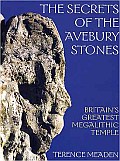
The size and typeface for the title is cleverly chosen, so that the second O of Common sits atop the T of Wealth and forms the Egyptian symbol Ankh, the Key of Life. Before you even open it, you are aware that a lot of careful thought has gone into all aspects of this book. It sets out to answer the question "Can temples transform humans into extraordinary beings?" The term temple is used to denote any sacred site and I’ve followed that practise in this review.
Written in three Acts, Common Wealth is very well-researched and well-referenced. It takes ideas formed from looking at the ancient world globally over a vast timescale and transmutes them into relevance for us today. Somehow, Silva seems to pack so much more information into every page than anyone else. Within the first fifty or so, we’ve traversed the globe, compared creation legends and myths from many societies and eras and discovered a common thread that they all share. Whilst that may look like a brevity of space to explore so many varied concepts, nothing is lacking - and the print isn’t tiny, either! The first Act is the longest and covers a massive array of information presented in such a way that it’s so easy to read and understand.
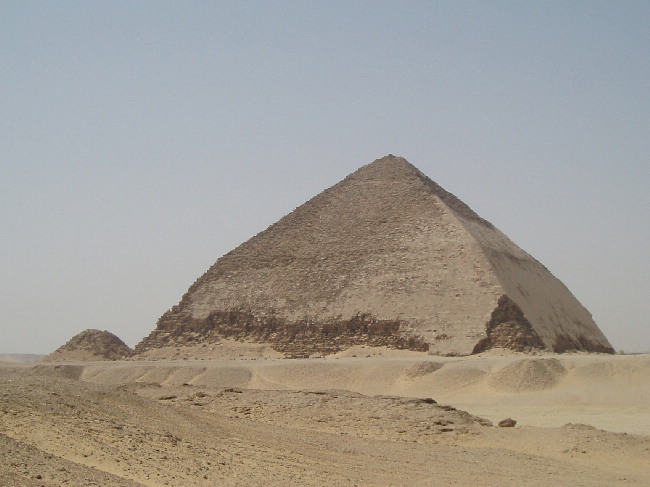
From the outset, I need to be very clear that Freddy does not support the traditional archaeological view of the reason for the construction of what he calls temples and this book focuses particularly on his interpretation of the construction and function of the Bent Pyramid. Don't expect a conventional scientific viewpoint as that's not what this book is about.
You can also read about this on his web site, which will also give you a very good indication of the style and content of his book.
"Orthodox archaeologists postulate that due to the steepness of the original angle of inclination the structure may have begun to show signs of instability during construction, forcing the builders to adopt a shallower angle to avert the structure's collapse. In essence, what the peopel are suggesting is that this beautiful edifice was a mistake, even if their theory is unproven."
Freddy asserts that "Given the track record of Egyptian monuments, errors were not part of the temple builders' vocabulary. Throughout this ancient land of Al Khem vast temple complexes were designed and encoded with advanced mathematics, sacred geometry, astrological and astronomical alignments, mirror imaging of entire constellations, and the list goes on. Errors simply did not factor into such precise observations."
The history of the development of the pyramids of Snefru's period are covered on our pages, Meidum Broken Pyramid, Sneferu's Bent Pyramid, Red Pyramid and elsewhere.
Sneferu's uniquely shaped pyramid is generally considered to be the first attempt at building a true pyramid and the largest that had been attempted up to that time. J.P Lepre asserts that "with the interior design of the Bent Pyramid the architect was groping and experimenting, taking maximum advantage of the huge volume of the monument"
For readers who favour the orthodox approach Freddy's view of the great power of the Ancient Egyptians will appear over simplistic when there seems a reasonable explanation of what happened in this particular case via Occam's razor or even Sod's law. With the best will in the world sometime real life problems get in the way of the best laid plans.
Be that as it may there is much still to enjoy in this book. The illustrations are well placed and their quality is superb. So often black and white photographs and diagrams can leave a lot to be desired but these have atmosphere aplenty and enrich the text. Anyone who loves ancient sites will enjoy spotting many they already know and some new ones to investigate, possibly with a different outlook after reading about their purpose.
Act ll starts with personal experiences. It’s a brave person in this age of cynicism who will candidly tell of the metaphysical aspect of their lives and here Silva relates some of his own journey with an honesty, humour and humility that is refreshing and uplifting to read.
The larger part of this Act is about the seven principles of sacred space.
"Ancient people discerned and marked a place that was energetically different because it empowered them to experience contact with the subtle realms."
This step by step section explains these metaphysical concepts so well, especially those that are often little understood or misunderstood. Silva has taken them and made them into a natural progression instead of being cloaked in dogma and secrecy. What would take a student of traditional mystery school practises a lifetime to comprehend about only one or two aspects is all here for the asking, straightforward and plain as can be. If you’ve ever wondered about the ‘how’ of sacred space, then this is the best instruction manual I’ve ever seen. Sacred Space 101. It’s in this section where the attributes of the bent pyramid featured on the cover are revealed.
Act lll is a quick overview of the rise and fall of temples and the damage that organised religion through the ages has done to prevent the temples being used for their original purpose.
He does caution that temple energies can be overwhelming for the unprepared and cites the case of Napoleon who had been scared out of his wits after spending a night in the Great Pyramid and would never tell a soul what actually happened. That reminded me of the story of the Vikings who broke into Maeshowe to shelter from a snowstorm and left us their graffiti, among which was the tale of two of their company that went mad.
Coming into recent history and the present, Silva weaves his thread of temple construction from what is the simplest and most instructive breakdown of the sacred geometry of Chartres I’ve ever read, through to the layout of Washington DC and an area he spent many years investigating, crop circles.
He finishes with a question, which is a nice touch and on the very last page, after the references, credits and index, there’s a short bio of him with a photograph and he’s wearing a chain with the ankh symbol on it.
On his website there is another clever graphic, the L in both words aligns and forms a column of light, the significance of which is explained in his books. There are extracts from ‘Common Wealth’ and much more that will interest anyone who likes to look beyond the physical.
‘Common Wealth’ should appeal to a large audience. Although some of the subjects it covers are very specialised, Freddy Silva has a natural talent for explaining them in such a way that if it’s something new to you there’s no struggle to understand the concept and simultaneously if it’s a subject you know about, he has something to add to that knowledge.
 Review by Runemage with contributions from David Morgan
Common Wealth - The Origin of Sacred Sites and the Rebirth of Ancient Wisdom
By Freddy Silva
Paperback 319 pages
Currently only available in the US from www.invisibletemple.com
It will be published in the UK in 2012
ISBN US Edition 978-0578-06826-8
There is a 60 page sample PDF and a video interview on Freddy's web site.


 We would like to know more about this location. Please feel free to add a brief description and any relevant information in your own language.
 Wir möchten mehr über diese Stätte erfahren. Bitte zögern Sie nicht, eine kurze Beschreibung und relevante Informationen in Deutsch hinzuzufügen.
 Nous aimerions en savoir encore un peu sur les lieux. S'il vous plaît n'hesitez pas à ajouter une courte description et tous les renseignements pertinents dans votre propre langue.
 Quisieramos informarnos un poco más de las lugares. No dude en añadir una breve descripción y otros datos relevantes en su propio idioma.