
Charging tanks help save history of Salisbury Plain
Submitted by Andy B on Tuesday, 14 May 2002 Page Views: 2257
Discoveries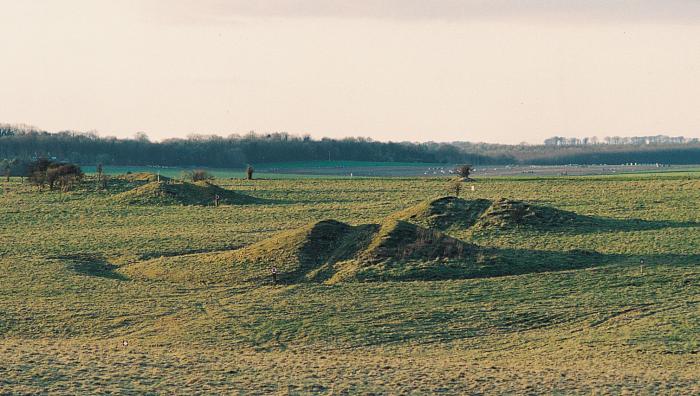
The results of more than a decade of aerial and ground surveys have been published in a book by English Heritage, to cement the reputation of the Army's estate north of Stonehenge as one of the most important landscapes in Europe.
Monuments from the past 5,000 years discovered over the past decade include carpets of ancient fields, Bronze age barrow cemeteries and large Romano-British villages linked by fields and tracks that can be walked along today.
The finest and largest of 11 villages was found at the heart of the Army's central impact area where 8 million shells have landed, 10000 of which are unexploded.
Aerial surveys also revealed miles of Celtic field systems from the second millennium BC, showing the first enclosures in Britain. These were clearly laid out in a society that exercised control over the efforts of each farmer.
David Field, one of three authors of The Field Archaeology of Salisbury plain Training Area said "The surprising thing is that the Army has protected this archaeology rather than destroyed it. Shelling and tank hulks are pinpricks compared to the deep ploughing of the past 100 years."
Features discovered on the plain - about the size of the Isle of Wight - include field boundaries a few inches high, visible only from the air in the right light or with a dusting of snow; prehistoric barrows and Iron Age forts up to 20 feet high. Roman village remains stand a yard above the plain.
The cultivation of the plain has ebbed and flowed. In Napeoleonic times the most marginal areas of download were not much used. For centuries the high downs were sheep pasture and a haunt of highwaymen.
But in pre-history the light soils attracted farmers and in the Romano-British era the downs were intensively farmed. The plain from the air is now a brownish island of native chalk grassland, with a proliferation of wildflowers amid a green sea of crops.
Surveys show Romano-British estates centred on villas and surrounded by settlements. The largest on Charlton Down in the central impact area, extends to 64 acreas and is 2/3 of a mile long.
Graham Brown, another author said "Nobody has excavated it, as the shells make it one of the most dangerous areas in Britain. There are the remains of quite substantial houses, door latches, tiles and pottery thrown up by the explosions. There are platforms and banks where the fields were."
The roman fields spread out on top of the remains of a Celtic field system marked out by surveyors 1000 or more years before.
The implications of the surveys are great, both for the Area's management of the training area - it has already planted banks of trees to channel tanks away from a ridge crowned by a Romano-British village - and for the understanding of how landscape evolved elsewhere.
David McOmish, the principal author said "You can see one landscape on top of another, utilising another. Once a landscape feature is built, whether it is ditch or a field, it is very difficult to eradicate. People will take advantage of it and use it again and again, perhaps for a boundary or trackway."
Similar features exist on Dartmoor and on the Cheviots and did on the Marlborough downs until deep ploughing destroyed them.
The Army employs a full-time archaeologist on the plain, enshrines the protection of landscape features in standing orders and shows recruits archaeological videos.
Mr McOmish said the discoveries showed that the Army needed to take more care. But beyond that, not much needed to be done.
The Romano-British villages in the central impact area continue to be violently shaken. But since it is unsafe for the land to be used for any other purpose, their preservation is better assured than that of most archaeological sites in England.
Source: Daily telegraph, 29 March


 We would like to know more about this location. Please feel free to add a brief description and any relevant information in your own language.
 Wir möchten mehr über diese Stätte erfahren. Bitte zögern Sie nicht, eine kurze Beschreibung und relevante Informationen in Deutsch hinzuzufügen.
 Nous aimerions en savoir encore un peu sur les lieux. S'il vous plaît n'hesitez pas à ajouter une courte description et tous les renseignements pertinents dans votre propre langue.
 Quisieramos informarnos un poco más de las lugares. No dude en añadir una breve descripción y otros datos relevantes en su propio idioma.