

Book Review: The Megalithic Empire by MJ Harper and HL Vered
Submitted by sem on Sunday, 23 September 2012 Page Views: 7483
Alternative Archaeology
The authors begin with an explanation for the location of megaliths of all kinds, as signposts for travellers, and then expand this idea until the Megalithics (ie the people building the monuments) become an empire in their own right - termed Megalithia which dominated free-trade. Along the way the authors introduce topics as diverse as early navigation, folk/religious beliefs, ley lines and Megalithic Terraforming.
At this point I can hear MegP members musing 'Aaah, we’ve heard all this before', but there I’m afraid you are wrong. These chaps have come up with some of the most ingenious theories I have ever read. Not since Alexander Thom have such revolutionary ideas been put forward with such confidence!
To take two examples. Firstly Carnac, according to Harper and Vered, is a central depot where obelisks were stored awaiting collection and those left over when the system came to an end can still be inspected. They compare this to conventional archaeologist's theory in which Carnac’s inhabitants "..carved menhirs with crazed profuseness, arranged them in not very straight rows, did not align them to anywhere in particular, and did all this for the usual 'ritual purposes'". Secondly is a lovely rebuttal of the theory of some stone alignments as eclipse predictors - 'people had spotted that eclipses didn’t last very long and didn’t do anybody any harm.' Well you can't really argue with that can you?
Given my known opinion of experts, my personal favourite has to be the description of The Cheesewring - "This logan, or rocking, stone on Bodmin Moor is a pile of granite slabs balanced on top of one another. In Cornish folklore the Cheesewring was the work of giants; in the more rational era of the eighteenth century it was attributed to Druids; in the allegedly scientific twentieth century it was proposed that it was natural! And still is in the twenty-first century by the more credulous academics, ie all of them". How the authors managed to rework the biblical idea that "there were giants in the earth in those days" was breathtaking, along with the suggestion that science (or at least scientists) have been the downfall of mankind. I ask you dear reader!
For those interested in religion/folk belief, the central section (comprising 80 pages) will be fascinating. Personally I feel too much space is given here to wishy-washy ideas and could have been better used with the overall cut-and-thrust of supposedly scientific argument, common throughout the rest of the book.
At first I thought it was hogwash, but by about halfway I found myself enjoying it and to be fair the authors have done a lot of research. The tome weighs in at 253 entertaining pages, demolishing current archaeological theories with wit and an abundance of puns. It includes a comprehensive index and a number of maps and diagrams. Unfortunately there is no list of diagrams, but this will afford the reader many a happy hour searching through the book for that elusive illustration - or maybe just to count them.
I am sure this publication is destined to become a major source of research in revisionist history, and in the future will sit on many people’s shelves alongside such seminal works as 1066 and All That. (Note to publishers - if you want to quote me on that please make sure you include the second section!) I'm glad I didn't have to pay £20 for my copy, which is now lying adjacent to the aforementioned classic from Sellar and Yeatman. Good luck to the authors!
PS If you get any flack from this Andy, please refer it to me!
Review by Simon Charlesworth (Sem)
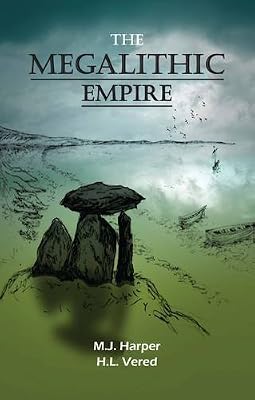 The Megalithic Empire by MJ Harper & HL Vered
Published by Nathan Carmody
Published price £19.95
Available from Amazon.co.uk
Editor's footnote. This book arrived with an accompanying letter from the publisher reminding me how much our previous reviewer Jezreel had hated Mr Harper's previous book - I had forgotten so thanks for that! The publisher suggested that we would probably disagree with the thesis advanced by the book but hoped it might have a certain 'crossover appeal' and that it might 'get the wider Megalithic Debate going again - putting the academics under a bit of pressure which they haven't been since Thom, Hawkins et al.'
Neither the reviewer of the previous book or Sem here were put under any influence by myself to follow any kind of editorial line, and in the interests of fairness I didn't made Sem aware of the findings of the previous review or of the letter from the publisher.

 We would like to know more about this location. Please feel free to add a brief description and any relevant information in your own language.
 Wir möchten mehr über diese Stätte erfahren. Bitte zögern Sie nicht, eine kurze Beschreibung und relevante Informationen in Deutsch hinzuzufügen.
 Nous aimerions en savoir encore un peu sur les lieux. S'il vous plaît n'hesitez pas à ajouter une courte description et tous les renseignements pertinents dans votre propre langue.
 Quisieramos informarnos un poco más de las lugares. No dude en añadir una breve descripción y otros datos relevantes en su propio idioma.