


Book Review: An Archaeology of the Senses - Prehistoric Malta by Robin Skeates
Submitted by Andy B on Friday, 02 March 2012 Page Views: 8459
Neolithic and Bronze AgeCountry: Malta As the title makes clear, this book is about two separate, but overlapping themes. The majority of the book is about the prehistoric sites of Malta, but the book is also constructed around the overarching theme of how to interpret archaeological sites with senses other than conventional sight and reading.
I will spare you my full multi-sensory review of this book, if you’d like that pleasure please see (or should that be, experience) my recent review of Great Crowns of Stone which was inspired by my initial looks at this book.
As well as considering the conventional four other senses (which allow an opening to such things as ringing / roaring rocks and texture), Skeates considers synaesthesia - joining or overlapping of the senses, spatiality - including procession and movement, balance / proprioception, and lastly 'sixth sense'. In his view, this last area should be considered in a broader way than to just considering matters of shamanism, ecstasy or traumatic emotional experience. He feels research in this area focussing on European rock art has been disappointing and over generalised in the past.
The full emotional response should be considered, to include “strong emotional and intuitive feelings, embodied experiences and perceptions, including love, joy, disgust, anger, hatred, grief, shame, loneliness, fear and mental pain or suffering”. To give one example of how to approach this, consider how that “very small objects may become precious and personal”, whereas “very large objects may be experienced as imposing or threatening”.
The first section gives a brief guide to how to undertake a sensual study, including creating a detailed inventory of the complete sensory profile of a particular culture, experimentation, ‘thick description’, reflexivity (I will let you look those two up) and creative writing. These are good summaries with numerous references as to where else each of these sensory issues have been discussed in an archaeological context.
The book then switches to a detailed history of the study of the Maltese 'temples', going right back to Malta Illustrata from 1647, to early illustrations in the18th and 19th century. It would have been very useful to have some more of these shown instead of wordy descriptions of them.
The influx of antiquarian and 'grand tour' visitors is considered, how they experienced the island and were affected by their upper class and colonial attitudes, and a taste of how the labourers worked, with 'kid fags' (?!), the youngest being sent off to fetch cool clear water. On to the 20th century, there is a look at the political and cultural aspects of the way the Maltese people saw their own ancient sites, and how, in 1949 the facade of Hagar Qim was rather clumsily ‘restored’ - although there is rather too much on how the various museums were founded to keep my interest here.
In the 1950s, Maltese temples were featured in a series of popular lectures on BBC Radio's Third Programme, and the TV film from the “Buried Treasure” series, which included an experiment into the use of the well known cart ruts with a specially built slide car. These curious impressions are returned to further on, and are now thought to have been from the later Bronze Age - significantly after the period of megalithic construction. Modern problems with bird hunters damaging the monuments and recent restoration work are also looked at.
This book is nothing if not a grand tour of ideas, from acoustic resonance and music, to anthropomorphic figurines considered “just the right size and weight to be held by hand”, although few things get more than a couple of paragraphs. Archaeoastronomy gets a brief mention, as does the controversial Atlantis research of Dr Hubert Zeitlmair and his divers off the coast. More space is given to the seemingly all pervasive goddess movement, and how deeply embedded these ideas now are as a ‘unique selling point’ for the islands in the mind of the official tourism authority - much to the annoyance of some locals. The author generally remains impartial, letting the comments of other archaeologists ridicule the movement rather than weighing in himself.
The next particularly interesting part is how the islands came to be settled. There is a lot of detailed archaeology here, and also some flights of imagination, to illustrate just what a huge step it would have been for people to colonise these relatively remote islands, probably from Sicily in around 5200BC, and certainly with insubstantial prehistoric boats. The cargo must have included crops, sheep, goats, pigs, even cows and, intentionally or not, rats and mice as well.
Much careful planning, and much emotion as well, just imagine large domestic animals constrained on these boats. Skeates explores this in one of his many charming pieces of creative writing dropped into the text in blocks. It is made clear that these long distance relationships were maintained over time, with imported goods such as flint, obsidian and alabaster being important to the later society.
Amongst other things we learn (in this case from isotope analysis) is that the people buried around the Xaghra circle had no fish in their diet, yet fish were carved into the ‘altar block’ at Buggiba temple, giving the possibility of them being a sacred animal People did however eat seabirds and shellfish and deposited pig remains in an apparently ritual way, all of which is explored.
There is a good section on underground religion, from simple cave deposits at Ghar Dalam, to the human-embellished natural caves at the Xaghra circle mortuary complex. Here there is another imaginative word-reconstruction of what it might have been like to attend and participate in an underground funeral. The extraordinary acoustic properties of the ‘Oracle Chamber’ at the Hal Saflieni hypogeum are much noted, but the evidence seems to show that it was filled with enough bones and other detritus to well dampen the acoustic properties. That is not to say resonances were not important but you would have been equally hit by the stench of ‘foul reeking caves of the dead’. Skeates makes a strong case for repeated performance of underground rituals of burial, reburial and initiation, carefully spatially controlled, as the form of underground structures themselves became more complex..
Building of the ‘temple’ monuments is thought to have started around 3350BC, possibly as extensions of the ideas of rock-cut tombs or possibly as ‘house shrines’. Either seems plausible and both are discussed. There seems to have been peaceful competition by huge monument building going on for some 700 to 850 years. Many were built with south-facing, down-slope facades to accentuate the monumental effect. Decorations of wood, fossil shells, plaster, pebbles. Pitted patterns on the walls with animals, not humans being shown - other than as imposing and profound statues and ‘portable votive objects’.
Something that isn’t properly explained is how archaeologists manage to conclude that the rotund figures that crop up again and again are not particularly feminine. This seems a suprising conclusion, given the number of very chubby and clearly female images that do exist from this period, and gives the appearance of a convenient layer of armour constructed against the goddess botherers. To be fair Skeates professes an open mind later in the text but the fact that the figurines could represent important females, goddess or otherwise, isn’t really considered. No creative writing allowed here!
Overall there is a lot in this book, it is a pity more will not be able to read it due to the cost. If either of the main topics pique your interest then you will find this book invaluable and enlightening.
Review by Andy B
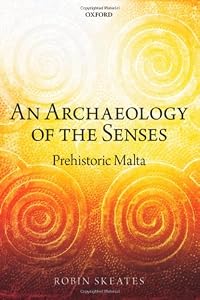 An Archaeology of the Senses - Prehistoric Malta by Robin Skeates
Hardback, 304 pages
Published by Oxford University Press
Price £75
ISBN: 0199216606
Available from Amazon.co.uk
Link to the scan of Malta Illustrata from 1647 and the full text, albeit a bit mashed up.

 We would like to know more about this location. Please feel free to add a brief description and any relevant information in your own language.
 Wir möchten mehr über diese Stätte erfahren. Bitte zögern Sie nicht, eine kurze Beschreibung und relevante Informationen in Deutsch hinzuzufügen.
 Nous aimerions en savoir encore un peu sur les lieux. S'il vous plaît n'hesitez pas à ajouter une courte description et tous les renseignements pertinents dans votre propre langue.
 Quisieramos informarnos un poco más de las lugares. No dude en añadir una breve descripción y otros datos relevantes en su propio idioma.