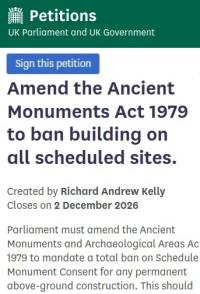
Featured: Please Sign the Petition: Amend the Ancient Monuments Act to ban all building on Scheduled Sites

Please Sign the Petition: Amend the Ancient Monuments Act to ban all building on Scheduled Sites

Random Image

Das Raetiastein GPS by Thomas Walli

Das Raetiastein GPS by Thomas Walli

Login

Register here - as a registered user you get more features and fewer ads.

Who's Online

There are currently, 1712 guests and 5 members online.

Sponsors

Archeologists unearth skeleton clutching a PINT OF BEER

Submitted by coldrum on Tuesday, 20 May 2008  Page Views: 2850

Discoveries

<< News >>

A 4,000-year-old skeleton has been unearthed by experts working on building Britain's biggest ever greenhouse - clutching a pint of beer.

The Bronze Age man's body was dug up by archaeologists who were called in after a team of builders working on the construction of the giant Thanet Earth project in Monkton, Kent, uncovered the skeleton last week.

According to experts the skeleton - that of a high status male - was found in shallow grave holding a "type of beer mug".

Marion Green, of the Canterbury Archaeological Trust, said that the find last week was one of the best preserved Bronze Age skeletons she had ever seen.

She added: "It is a beautifully decorated pot which could have been used as a type of beer mug."

Tests on beer mugs from other sites show that Bronze Age man was an ale lover - making the booze from grain.

Thanet Earth spokeswoman Judy Whittaker said: "There have been several interesting finds, but this is the most exciting.

"The man will eventually go on display at a museum."

The giant Thanet Earth greenhouse - the size of 70 football pitches - will be used to grow peppers, cucumbers and tomatoes for supermarket shoppers.

dailymail

Please add your thoughts on this site

Fairy Paths and Death Roads - Paul Devereux

Fairy Paths and Death Roads - Paul Devereux

Sponsors

More News

See all News →

"Archeologists unearth skeleton clutching a PINT OF BEER" | Login/Create an Account | 3 News and Comments
  
Go back to top of page    Comments are owned by the poster. We aren't responsible for their content.
Giant who came from Kent's Isle of the Dead by coldrum on Tuesday, 20 May 2008
(User Info | Send a Message)
Giant who came from Kent's Isle of the Dead

He's tall, well-preserved, and enjoys archery and gritty food. And despite his bad teeth, a slight stoop and an unfortunate growth on his face, he may be looking for a (very) mature woman.

If this description sounds all too familiar, then you may have found a direct descendant of Thanet’s Bronze Age man.

Experts examining a skeleton found on the Isle last week have painted a vivid picture of how the 4,000-year-old stranger might have looked – and he definitely wasn’t pretty.

The beautifully preserved remains were found during a routine archaeological dig on development site near Monkton on which a fresh fruit produce centre is set to be built.

The Canterbury Archaeological Trust (CAT) has since carried out extensive tests on the remains, and the results are fascinating.

The man is thought to have lived between 2200 and 2400 BC, and was buried in a ‘double ring-ditch’ funery mound, where one circular ditch lies within another – a ‘high status’ grave of which there are few in Kent.

There was a small dagger at his shoulder, and a very rare archer’s wrist guard on his arm.

Director of CAT Paul Bennett said: “We can see the man was about 30 or 40 years old and was very tall for the time – between 5ft 8 and 5ft 10in, which would have been abnormal.

“He also suffered from a number of diseases or deformities.”

The man had several infused vertebra, and would have suffered from ongoing back problems, and his teeth were also in a very poor state due to the amount of grit present in food at the time.

The man also had an unusually thick skull and a growth between his eyes that could have been a tumour, an infected wound or a birth deformity.

“His teeth were very worn down and would have been painful,” Mr Bennett added. “We can see he lost two adult teeth, so he probably took a trip to a Bronze Age dentist at some point.

“It’s safe to say he wasn’t pretty.”

Mr Bennett said it is possible, given the man’s abnormal height, that he may have been a traveller and not native to Thanet, but could also have been a local man with a series of unfortunate congenital defects.

Further test are being carried out to determine the ancient man’s likely profession and origin.

http://www.kentonline.co.uk/news/default.asp?article_id=39348%3Cbr%3E%3Cbr%3E
[ Reply to This ]

Bones put flesh on an ancient myth by coldrum on Tuesday, 20 May 2008
(User Info | Send a Message)
Bones put flesh on an ancient myth

For some, the Isle of Thanet is an area of great economic potential and a new hub for culture vultures. Others see it as a poor shadow of its glory days as a thriving 1950s seaside resort.

But the dramatic discovery of a Bronze Age skeleton has resurrected considerable historical interest in the district and may just prove that a long-forgotten definition of its name is not merely based on myth and legend.

For Thanet is, literally, the Isle of the Dead.

Experts examining the remains of the 4,000-year-old skeleton, discovered by the Canterbury Archaeological Trust (CAT) near Monkton last week, say the find is an example how densely populated the land once was with burial mounds.

Director of CAT Paul Bennett said: “Thanet was covered with small burial mounds, many of which were in groups and clusters across the land – the area is not unique in that respect, but there are definitely a large number there and they would have been conspicuous.

“It had a rich agricultural landscape, and the mounds would have been visible to all probably up to medieval times when farming reduced them to flat land.”
He added: “There is also the fact that the word ‘Thanet’ is thought to be derived from the Latin Thanatus, which means Isle of the Dead.”

East Kent is also thought to be the basis for the Greek legend of Ynys Thanatos (Isle of the Dead), where un-manned boats once rowed across the sea carrying bodies to the isle and returned empty before dawn.

But regardless of its gruesome past, the isle remains an archaeological hotspot.

The Ringlemere Cup, now on display in the British Museum, was discovered near Woodnesborough in 2001. This prompted further excavations of the area which uncovered a mass of Anglo-Saxon graves in 2005 and 2006.

Mr Bennett said: “The whole of East Kent has a very rich archaeological landscape, including Thanet, with many burial mounds, roman farms and villas, and settlements.”

Canterbury Archaeological Trust is looking for volunteers to help excavate the ancient burial site in Thanet. Volunteers need to commit several Saturdays to the project. It would be ideally suited to anyone studying or considering studying archaeology. Contact CAT on 01227 462062 or email [email protected]

http://www.kentonline.co.uk/news/default.asp?article_id=39349
[ Reply to This ]

Bronze Age burial 'with beer mug' by coldrum on Tuesday, 20 May 2008
(User Info | Send a Message)
A 4,000-year-old Bronze Age skeleton has been unearthed by archaeologists working on a site in east Kent.

Canterbury Archaeological Trust said the curled-up skeleton was an example of a "Beaker" burial because of the pottery vessel placed at its feet.

Education officer Marion Green said the "beautifully decorated" pot could have been "a type of beer mug".

She said tests on beakers from other sites suggested Bronze Age man was brewing a type of beer from grain.

The body was in a "crouched" position typical of the period, with knees drawn up to the chest, she added.

Possibly ceremonial objects were found buried with the individual, who could have been a high-status male, she said.

The bones were found in a small grave at the centre of a double ring ditch, made out of two circles.

And Ms Green said soil would have been built up to form a burial mound, known to archaeologists as a "barrow".

The bones, which are expected to end up on display, have been removed for tests to confirm the skeleton's age and gender, and any disease or injury.

"People might think finding skeletons is spooky, but it is really awe inspiring," Ms Green said.

"It's when you literally come face to face with the people from the past.

The 91-acre site near Monkton being excavated by 30 archaeologists will eventually house seven glasshouses for salad producer Thanet Earth.

Mr Green said Bronze Age burials were the oldest remains the archaeologists had found so far, but the history of the site was taking shape, and seemed to have had a "very long farming tradition".

Other burials have been found there, but this was the most elaborate, she added.

Archaeologists are excavating and recording finds on areas to be developed, but the remainder is to be left undisturbed.

http://news.bbc.co.uk/1/hi/england/kent/7300232.stm
[ Reply to This ]

Your Name: Anonymous [ Register Now ]
Subject:


Add your comment or contribution to this page. Spam or offensive posts are deleted immediately, don't even bother

<<< What is five plus one as a number? (Please type the answer to this question in the little box on the left)
You can also embed videos and other things. For Youtube please copy and paste the 'embed code'.
For Google Street View please include Street View in the text.
Create a web link like this: <a href="https://www.megalithic.co.uk">This is a link</a>  

Allowed HTML is:
<p> <b> <i> <a> <img> <em> <br> <strong> <blockquote> <tt> <li> <ol> <ul> <object> <param> <embed> <iframe>

We would like to know more about this location. Please feel free to add a brief description and any relevant information in your own language.
Wir möchten mehr über diese Stätte erfahren. Bitte zögern Sie nicht, eine kurze Beschreibung und relevante Informationen in Deutsch hinzuzufügen.
Nous aimerions en savoir encore un peu sur les lieux. S'il vous plaît n'hesitez pas à ajouter une courte description et tous les renseignements pertinents dans votre propre langue.
Quisieramos informarnos un poco más de las lugares. No dude en añadir una breve descripción y otros datos relevantes en su propio idioma.