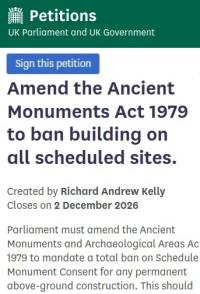

Featured: Please Sign the Petition: Amend the Ancient Monuments Act to ban all building on Scheduled Sites

Please Sign the Petition: Amend the Ancient Monuments Act to ban all building on Scheduled Sites

John Michell: From Atlantis to Avalon

John Michell: From Atlantis to Avalon

Login

Register here - as a registered user you get more features and fewer ads.

Who's Online

There are currently, 674 guests and 6 members online.

Sponsors

Archaeology under threat - 'Perfect storm' of proposed cuts throws field into ch England

Submitted by coldrum on Friday, 26 November 2010  Page Views: 19786

Site Watch

<< News >>

Country: England
Sutton Common Iron Age settlement
Sutton Common Iron Age settlement submitted by Andy B : Alison Roberts (20) from Exeter University works on one of the oak posts which formed an outer palisade during the first stage of Iron Age settlement at Sutton Common, near Askern in South Yorkshire. (Vote or comment on this photo)
UK archaeologists are facing a wave of cuts that they say will lead to a loss of skills and take the teaching of the subject "back to the 1950s". To cut the national budget deficit, the UK government has launched an austerity programme that will see research funding stay static for the next four years. But archaeology is expected to be hit particularly hard, because the subject depends on a combination of public institutions run by several different government departments that are all seeing simultaneous budget reductions.

"It seems like a perfect storm of factors is coming together," says Mike Heyworth, director of the Council for British Archaeology, an educational non-governmental organization.

Although precise details of where the axe will fall are still emerging, the trend is already clear. At least 200 jobs will go at English Heritage, the government-funded body charged with managing the historic environment.

English Heritage receives about £130 million (US$205 million) per year in government funding, but this will be cut by 32% over the next four years, greater than the 24% savings demanded of its parent body, the government's Department of Culture, Media and Sport (DCMS). As a consequence, new archaeological grants will be cut by a third.

"The cut to English Heritage's grant from government will be exceptionally challenging to manage after years of funding decline," said Kay Andrews, chair of English Heritage. "It will require us to make some tough decisions."

Museums will also face a squeeze from both local and national government. The DCMS has announced that it aims to transfer responsibility for the department's non-national museums to "other bodies". Four museums in the county of Hampshire are now to be run by volunteers, and Grantham Museum and Stamford Museum in Lincolnshire are to close. The Federation of Archaeological Managers and Employers has warned that in many parts of the country, there is now no museum space to store and preserve important finds uncovered by archaeological teams.

“There is a real danger we will start to get only students from wealthy backgrounds applying, and that will take us back to the situation in the 1950s.” - Anthony Harding, University of Exeter

Some counties are expected to lose their archaeological officer, the main adviser on archaeological matters involved in planning building work, prompting fears that sites will be destroyed by developers without being recorded.

At the University of Bristol, the department of archaeology is facing the loss of 4 out of a total of 16 staff posts, despite its high profile, having been closely involved in the popular Channel 4 TV show Time Team, as well as the BBC2 series Coast.

Some university field units, such as the University of Manchester Archaeological Unit, have already closed. "This will affect universities' ability to dig," says Chris Cumberpatch, vice-chairman of Rescue — the British Archaeological Trust, an organization trying to map the effect of the cuts as they emerge.
Only for the rich

In addition, the proposed government increase in university fees means that all students will now have to pay £6,000–9,000 per year to study. "Archaeology departments will have to charge at least £7,000 to stand still," says Anthony Harding, an archaeologist from the University of Exeter and chair of the archaeology section of the British Academy, Britain's national academy for the humanities and social sciences. "There is a real danger we will start to get only students from wealthy backgrounds applying, and that will take us back to the situation in the 1950s."

As yet, the British Academy itself has not had its funding cut, and is in discussion with its parent body, the Department for Business, Innovation and Skills, about its share of the overall research budget, says Robin Jackson, the academy's chief executive.

But according to Harding, the academy has already axed its Small Research Grant scheme, which may affect Britain's capacity to work overseas. "Archaeologists typically used this to set up international collaborations," he says. "So that alone will cause a big decline in archaeological research of all kinds."

"I am very disturbed to hear about the cuts," says Valerii Kavruk, director of the Museum of Eastern Carpathians, Sfântu Gheorghe, Romania. "For some years I have had a collaboration with British scholars funded by small grants from the British Academy and using students from British universities. Such projects will have great difficulty taking off in the future."

Although the cuts are intended to save money, Heyworth says that they could lose the country a valuable source of revenue. "We are facing a huge loss to national wealth because the government is ignoring what heritage contributes to tourism," says Heyworth. According to the Anholt-GfK Roper Nation Brands Index, which assesses and ranks the reputation of different countries, potential visitors to Britain rank museums as their fourth favourite activity out of 32 possibilities.

Toby Sergeant, a spokesman for the DCMS says: "These are tough times but we hope that the cuts will not impact too much on frontline services."

Read more at Nature

Please add your thoughts on this site

Cornwall in Prehistory

Cornwall in Prehistory

Sponsors

More News

See all News →

"Archaeology under threat - 'Perfect storm' of proposed cuts throws field into ch" | Login/Create an Account | 11 News and Comments
  
Go back to top of page    Comments are owned by the poster. We aren't responsible for their content.
Re: Ireland's Heritage Sector Decimated by Punitive Cuts by frogcottage42 on Wednesday, 15 December 2010
(User Info | Send a Message)
Maybe it's about time that the people who stand to benefit from tourism etc actually got off their backsides and did some of this organisational work themselves instead of expecting governments to do it for them.
Many great strides forward in tourism and general heritage support have been made by local chambers of commerce and even wealthy entrepreneurs, there is no reason that most of the areas being cut could not be supported within communities and in the current economic climate there is no shortage of unemployed people to help out (including myself!!)
A more personal and less bureaucratic approach would undoubtedly favour many heritage sites and would serve to connect local people to places many of them hardly know the existence of.
[ Reply to This ]

Ireland's Heritage Sector Decimated by Punitive Cuts by Andy B on Tuesday, 14 December 2010
(User Info | Send a Message)
Ireland's Heritage Sector Decimated by Punitive Cuts - Heritage Council
warns of job losses and tourism setback

Punitive cuts, announced in last Tuesday's Budget,
will decimate the heritage sector and close many small enterprises that
are dependent on it. This will have detrimental effects on both our
national heritage and the quality of our tourism offering, according to
the Heritage Council.

The Department of Environment, Heritage and Local Government's Heritage
Unit, which has responsibility for protected structures, including world
heritage sites, suffered a 77% budget cut. National Parks and Wildlife,
whose remit includes the protection of our natural heritage and running
all our national parks, suffered a 56% cut. The Heritage Council, whose
role is to protect, preserve and enhance Ireland's national heritage,
suffered a 47% cut. This is on top of a 30% cut in 2010.

Speaking about the situation, Chief Executive of the Heritage Council,
Michael Starrett commented, "We are extremely concerned about the
disproportionate nature of the cuts to the Heritage sector. While the
heritage sector recognises that it must share the burden of the cuts
required to tackle the country's economic crisis, the cuts announced
last Tuesday are completely disproportionate in comparison to other
Departmental cuts. As a result, the future of heritage initiatives
nationwide which have created hundreds of jobs, empowered local
communities and enhanced the value of heritage as a tourism resource,
are severely threatened".

"In 2009, over three million overseas visitors engaged in
cultural/historical visits while in Ireland, and spent an estimated 1.9
billion Euros while here. In particular, 76% of tourists identified
landscape and nature as the primary reason for visiting Ireland, and
heritage is what defines the uniqueness of a country. Funding will now
no longer be available to protect and manage our iconic buildings,
unique and threatened species, landscapes, cultural collections and rare
artifacts, or indeed to support local communities in taking care of
their everyday heritage".

The majority of counties in Ireland have a County Heritage Plan which is
prepared by Local Heritage Fora on behalf of the local people and the
Local Authority. Research conducted in September 2010 by economist Jim
Power examined the economic value of these County Heritage Plans. The
implementation of these plans between 2004 and 2008 at a cost of 6.15m
Euros supported the creation of 1,012 full-time jobs in small businesses
across the regions, with an estimated return of 30.1 million Euros to
the economy. Between 2004 and 2008, the 6.15m Euros that the Heritage
Council invested over 26 local authority areas led to an additional
investment of around 10 million Euros from other sources.

Looking at the economic impact of an event such as the Irish Walled
Towns Day held in Youghal during National Heritage Week, KPMG analysts
found that support of 16,000 Euros to the Irish Walled Towns Network for
the day brought a return of 480,000 Euros in to the local economy.

Our shared heritage is the country's inheritance that we only get to
borrow for a time, enjoy, and benefit enormously from but we have an
obligation as a people to pass it on to future generations, Mr. Starrett
said. These punitive cuts put at risk, not just jobs which are
critically important, but also vulnerable aspects of the nation's unique
natural and cultural heritage which now may be lost for ever to the
country.

"At this point, the day to day implications of the cuts are hard to
fully estimate. What is clear from the Heritage Council's standing is
that we will no longer be in a position to provide support for local
community groups, non-governmental organisations, charities,
individuals, small businesses, local authorities and others. This will
make it extremely difficult for the survival of the wider heritage
profession of conservators, thatchers, ecologists, archaeologists,
conservation architects, museum curators and other specialist work such
as researchers and data collectors.

We cannot talk about the importance of marketing our heritage and
promoting tourism if we cut the funding to those who work tirelessly
behind the scenes to care for our heritage. The reality is that these
unique heritage skills may now be lost to the nation along with the
heritage assets and memory that these represent. We will all be poorer
economically, environmentally and socially as a result", added Mr.
Starrett.

* In 2009 114,000 Euros was offered to 19 building conservation
projects. Each grant required at least as much money again to be
expended on the project (50% match funding). This represents a minimum
two-times multiplier for the spend from the public purse. These grants
resulted in the direct employment of at least 5 people per year.
* In 2010 a total of 600,000 Euros was spent on conservation works
to significant churches and cathedrals of all denominations. This single
scheme created direct employment for 16 people.
* Conservation works to our historic walled town defences (such as
in Kilkenny, Cashel, Drogheda, Dublin city, Wexford) will be scaled back
with the loss of 25 contracting and supervisory jobs.
* A cessation in grants to historic buildings and thatched houses
will see this iconic vernacular architecture put at risk and the loss of
highly skilled thatchers.
* The Irish Strategic Archaeological Research Programme allocated 2
million Euros to advanced collaborative research in 2008-10. External
review considered this scheme to be 'a spectacular success and a model
for other countries to follow'. This created research posts for 25 young
researchers making sense of the vast amounts of archaeological
information generated during the recent boom. The survival of this
scheme is now questionable.

The Heritage Council is the statutory body charged with identifying,
protecting, preserving and enhancing Ireland's national heritage.
National heritage includes Monuments, Archaeological objects, Heritage
objects, Architectural heritage, Flora, Fauna, Wildlife habitats,
Landscapes, Seascapes, Wrecks, Geology, Heritage gardens and parks, and
Inland waterways.

Established under the Heritage Act 1995, and operating under the aegis
of the Department of Environment, Heritage and Local Government, the
Heritage Council provides advice to the Minister, and partners and
networks with Local Authorities and a wide range of other organisations
and individuals to promote Ireland's heritage.

http://www.heritagecouncil.ie/news-press/heritage-council-corporate-news/view-article/article/irelands-heritage-sector-decimated-by-punitive-cuts/?tx_ttnews[backPid]=6&cHash=ad6f5c64d4
[ Reply to This ]

Re: Archaeology under threat - 'Perfect storm' of proposed cuts throws field into ch by Equinox on Sunday, 05 December 2010
(User Info | Send a Message)
I would like to say that any hiatus in funding for archaeological excavation would be regrettable, but dare I say understandable, given the absolutely dire state of the nation's finances. The one bright side that I can see is that there just might be more published formal reports on past excavations. Many important sites have been uncovered in the last 15 years, but we seem to wait for years and in some cases decades before a formal report is published.
[ Reply to This ]

Re: Archaeology under threat - 'Perfect storm' of proposed cuts throws field into ch by Andy B on Saturday, 04 December 2010
(User Info | Send a Message)
More news from the Guardian

Greece's crumbling ruins mark a tragedy of neglect
Temple of Poseidon among country's greatest crowd-pullers but site in need of urgent attention
http://www.guardian.co.uk/world/2010/dec/03/greece-ruins-tragedy-neglect

Spain's cultural heritage under threat amid economic crisis
http://www.guardian.co.uk/world/2010/dec/03/spain-cultural-heritage-threat-chillida

Italy's abundance of heritage sites leads to indifference
Conservation does not rank high in a country sprinkled with aqueducts, amphitheatres and other sites of cultural importance
http://www.guardian.co.uk/culture/2010/dec/03/italy-heritage-abundance-indifference

Europe's heritage at risk from economic crisis
As budget cuts across Europe put heritage under pressure, some say it should be a spur towards better management
http://www.guardian.co.uk/culture/2010/dec/03/european-heritage-risk-economic-crisis
[ Reply to This ]

Re: Archaeology under threat - 'Perfect storm' of proposed cuts throws field into ch by Cernunnos on Saturday, 27 November 2010
(User Info | Send a Message)
Just look at what chronic underfunding has done to Italy's cultural heritage; short-term thinking almost always leads to long-term disaster.
[ Reply to This ]

Re: Archaeology under threat - 'Perfect storm' of proposed cuts throws field into ch by PastMaster on Saturday, 27 November 2010
(User Info | Send a Message)
This is on top of the cuts to university funding under the last government. A proportion of archaeology students, such as myself, have been older or retired people pursuing an interest in archaeology via a university degree. Since fees are no longer subsidised for those who already have a degree at the same level in another subject, students such as myself can no longer afford to study. This doesn't just affect us, and the world of archaeology where we may well be working, researching and publishing as unpaid volunteers, it also cuts down the number of potential students and may render courses unviable. The MA course I took at the Institute of Archaeology has already closed through lack of applicants. Things can only get worse!
[ Reply to This ]
    Re: Archaeology under threat - 'Perfect storm' of proposed cuts throws field into ch by praeceptor on Wednesday, 01 December 2010
    (User Info | Send a Message)
    In Denmark the fascist coallition government wants to cut down and close most small museums and have it replaced with a few large museums, that is expected to totally drop archaeology and archaelogists.

    Recently the government pushed through a merger of Langelands Museum and the Archipelago Museum at Faaborg. Now, "Cooperation problems" between Langelands Museum and the director of the Archipelago Museum at Faaborg led to the firing of the Curator and Professor of Archaeology Ole Grøn.

    Ole Grøn does not want to give additional information about the case. But he confirms that he regarded the matter "as a dismissal" and that a severance scheme gave him 9 months pay.

    The reason for the dismissal was prolonged "cooperative" problems between the Archipelago Museum director Peter Thor Andersen and Ole Grøn.

    One of the topics were a violation budget blunder by Peter Thor Andersen made immediately after his accession. Peter Thor Andersen was not aware that the state subsidy...

    Read the rest of this post...
    [ Reply to This ]
      Re: Archaeology under threat - 'Perfect storm' of proposed cuts throws field into ch by Anonymous on Wednesday, 01 December 2010
      i have forwarded this on to a Danish friend who is involved professionally with archaeology. I will post his reply as soon as I get more info.
      I have hundreds of images from Denmark's largest 5 museums and they have vast displays of artefacts. I can't believe they suddenly seem not to care anymore. They have the best lithics collections anywhere in Europe and are exceptionally proud of them. Far more than our museums are. For instance Manchester Museum has not a single European lithic on display. Not one.

      Keep rocking in the free world.

      [ Reply to This ]
        Re: Archaeology under threat - 'Perfect storm' of proposed cuts throws field into ch by praeceptor on Wednesday, 01 December 2010
        (User Info | Send a Message)
        I don't have inside connections or inside information. My information is based on the material published in the local news, and the fact that langelands Museum used to be a major archaeology player in the local area, where the museum at Faaborg - that has taken over - isn't an archaeology player.


        [ Reply to This ]
    Re: Archaeology under threat - 'Perfect storm' of proposed cuts throws field into ch by Andy B on Wednesday, 01 December 2010
    (User Info | Send a Message)
    That's not good, thanks for letting us know. We're happy to cover more archaeology news from Denmark if you'd like to send any over that you know about.
    [ Reply to This ]
      Re: Archaeology under threat - 'Perfect storm' of proposed cuts throws field into ch by praeceptor on Wednesday, 01 December 2010
      (User Info | Send a Message)
      This was based on newspaper information from:

      http://ugeavisenoboen.dk/article/1739876:UgeAvisen--boen--Museumschef-blev-reelt-fyret

      Ole Grøn, 56, is a very experienced gentleman in archeology. Following the archaeological exams in 1984, Ole Grøn worked many places on earth - including a period as "rating" archaeologist at Langeland Museum. Among other things, several years of fieldwork in Siberia.

      In 2004, Ole Grøn became Professor of Maritime Archaeology at University College London. Here was Ole Grøn until 2006 when he became leader of Langeland Museum.

      In recent years, Ole Grøn worked on the development of high-resolution seismic methods for use in marine-archaeological reconnaissance. These methods have Ole Grøn used on several assignments in Denmark and abroad, including in the port of Piraeus in Greece.

      Ole Grøn continue to live on Langeland.

      http://ugeavisenoboen.dk/article/1739883:UgeAvisen--boen--Professor-iMaritim-Arkaeologi

      [ Reply to This ]

Your Name: Anonymous [ Register Now ]
Subject:


Add your comment or contribution to this page. Spam or offensive posts are deleted immediately, don't even bother

<<< What is five plus one as a number? (Please type the answer to this question in the little box on the left)
You can also embed videos and other things. For Youtube please copy and paste the 'embed code'.
For Google Street View please include Street View in the text.
Create a web link like this: <a href="https://www.megalithic.co.uk">This is a link</a>  

Allowed HTML is:
<p> <b> <i> <a> <img> <em> <br> <strong> <blockquote> <tt> <li> <ol> <ul> <object> <param> <embed> <iframe>

We would like to know more about this location. Please feel free to add a brief description and any relevant information in your own language.
Wir möchten mehr über diese Stätte erfahren. Bitte zögern Sie nicht, eine kurze Beschreibung und relevante Informationen in Deutsch hinzuzufügen.
Nous aimerions en savoir encore un peu sur les lieux. S'il vous plaît n'hesitez pas à ajouter une courte description et tous les renseignements pertinents dans votre propre langue.
Quisieramos informarnos un poco más de las lugares. No dude en añadir una breve descripción y otros datos relevantes en su propio idioma.