
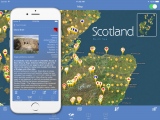


Featured: Explore Scotland (and everywhere else) with our Megalithic Portal iPhone app

Explore Scotland (and everywhere else) with our Megalithic Portal iPhone app

Random Image

The Stone Circles of Britain, Ireland and Brittany, Aubrey Burl

The Stone Circles of Britain, Ireland and Brittany, Aubrey Burl

Login

Register here - as a registered user you get more features and fewer ads.

Who's Online

There are currently, 954 guests and 7 members online.

Sponsors

Ancestors may have used bone tools to make smoothies

Submitted by coldrum on Tuesday, 12 May 2009  Page Views: 1966

Discoveries

<< News >>

Ancient humans might have used animal bones to grind fruit smoothies as well as dig up termites, a new analysis of mysterious 1 to 2 million-year-old tools suggests.

Researchers discovered the bones belonging to large mammals at several sites in South Africa, and their intended use has been the subject of equal parts contention and speculation.

Early 20th-century anthropologists who first uncovered the bones contended they were genuine tools and evidence for a bone-based tool culture in hominin species that predated early humans such as Paranthropus.

Those interpretations fell out of fashion after researchers discovered that scavenging animals and natural wear can create marks resembling those on purported tools.

However, in the last 20 years, researchers have employed electron and light microscopy as well as computer image analysis to compare marks on the bones to tools created experimentally. Unrooting vegetables called tubers looked like a good match, and a recent paper proposed termite digging.

"Certainly they were used in a stabbing motion while excavating the soil," says Francesco d'Errico, an anthropologist at the University of Bordeaux in France, who along with palaeontologist Lucinda Backwell of the University of Witwatersrand in Johannesburg, South Africa, used an optical scanner to quantify dozens of characteristics of marks left on the bones.

Anything more is difficult to determine with much certainty, d'Errico says. A quantitative analysis of the optical scans found that some bones resemble tools used for stabbing the ground to dig out tubers, yet some did not.

The striations on tools from one site, called Drimolen, also look like marks on bone tools used by South African villagers to scrape the vitamin C-rich pulp out of a fruit called marula.

The marks on some of the bones also proved a good match to newer tools used to burrow termites.

"You can say this is the closet match, but you cannot eliminate the possibility that there is another task that you haven't experimented," d'Errico says.
If I had a shoe

Pat Shipman, an anthropologist at Pennsylvania State University who proposed tuber digging as a potential use for the bones in the early 1990s, says the new approach brings statistical gravitas to the problem.

Chemical analysis of Paranthropus fossils points to a high protein diet, and Shipman now contends that the hominins probably used the bones to dig up termites. "Per hundred grams, you get more protein out of termites than you do out of rump steak," she says.

The bone tools could also have been something of a Swiss army knife, she says. "Once you get the concept of bone tools you might use them for several things. How many of us have taken a shoe and used it for a hammer?"

Source: New Scientist.

Note: This Week's Strangest Headline ...

Please add your thoughts on this site

Prehistoric Settlements

Prehistoric Settlements

Sponsors

More News

See all News →

"Ancestors may have used bone tools to make smoothies" | Login/Create an Account | 2 News and Comments
  
Go back to top of page    Comments are owned by the poster. We aren't responsible for their content.
Ancient Art, Music Flowered as Communities, Not Brains, Grew by coldrum on Thursday, 18 June 2009
(User Info | Send a Message)
Ancient Art, Music Flowered as Communities, Not Brains, Grew

An explosion of art, music, jewelry and hunting technology appeared 45,000 years ago because of increased population density, rather than the evolution of the human brain, a study said.

Researchers used genetic estimates of ancient population sizes, archaeological artifacts and computer simulations of social learning. They found complex skills involving abstract thinking would be passed down through generations and across groups only when populations reach a critical level, according to the study in tomorrow’s edition of the journal Science.

Increased interaction between groups, the sharing of ideas and the exchange of raw materials that led to the flowering of human culture may explain why concentrated centers of industry, such as California’s Silicon Valley, produce technological innovations, said Mark Thomas, 44, a senior author of the study and a senior lecturer at University College London in England.

“People learn from their parents or teachers in their group, and this model demonstrates you have to have a critical number of people learning to develop complexity,” Adam Powell, 28, a co-author of the study and a doctoral student at the London university. “The actual invention of all these technologies was probably very common, but was only passed on as density increased.”

45,000 Years Ago

Anatomically, modern humans have been around for an estimated 200,000 years, yet scientists have found the first widespread evidence of sustained symbolic behavior and abstract thinking emerged about 45,000 years ago. The findings include musical instruments, body decoration with shell beads and tattoos, bows and arrows and microlithic stone blades, according to the study.

An ancient example of figurative art was discovered recently in a German cave, depicting a woman with enlarged breasts and genitals, Powell said. One of the oldest of its kind, it dates back 35,000 years ago, according to a May 14 study published in the journal Nature.

Powell said his study may explain why modern human behavior appeared to emerge in different regions of the world at different times. Evidence was seen sporadically as far back as 90,000 years ago in sub-Saharan Africa, with a more sustained pattern 40,000 years ago, and in Europe and western Asia 45,000 years ago. Archaeological samples indicating similar skills were found in eastern and southern Asia and Australia 30,000 years ago. Population densities would have reached a critical point in sub-Saharan Africa and Europe at about the same time periods, according to the study.

Popular Illustrations

The impetus for human development has been pondered throughout history, Thomas said in an interview. The 1968 film, movie “2001: A Space Odyssey,” illustrated the mystery with a scene of a symbolic monolith slab on an ancient landscape that enabled humanlike apes to make tools and think critically.

“In reality, what I suspect is these technologies were being invented all the time, but they never hung on for more than a few generations. You need sustained evidence for it to be visible in archaeological record.”

Not everyone is convinced the demographic model caused the behavioral change. Richard Klein, an anthropology and biology professor at Stanford University, said the study is flawed because the examples it cites of human behavior prior to 50,000 years ago are either misdated artifacts or are open to interpretation as to their level of advancement.

Competing Theory

“They have it wrong,” Klein said in a telephone interview. “This paper does not belong in print.”

Klein is a proponent of a competing theory that attributes the development of modern human behavior to a genetic change to human brains 50,000 years ago.

“These behaviors appear to have been part of a package that significantly enhanced human fitness -- the ability to survive and reproduce,” Klein wrote in a study that was published last year in the journal Evolutionary Anthropology. “It is in this sense that they signal true evolutionary change as opposed to mere historical change.”

http://www.bloomberg.com/apps/news?pid=20601088&sid=a3Wc2FLpdcWY&refer=muse
[ Reply to This ]

Re: Ancestors may have used bone tools to make smoothies by Anonymous on Tuesday, 12 May 2009
very interesting
[ Reply to This ]

Your Name: Anonymous [ Register Now ]
Subject:


Add your comment or contribution to this page. Spam or offensive posts are deleted immediately, don't even bother

<<< What is five plus one as a number? (Please type the answer to this question in the little box on the left)
You can also embed videos and other things. For Youtube please copy and paste the 'embed code'.
For Google Street View please include Street View in the text.
Create a web link like this: <a href="https://www.megalithic.co.uk">This is a link</a>  

Allowed HTML is:
<p> <b> <i> <a> <img> <em> <br> <strong> <blockquote> <tt> <li> <ol> <ul> <object> <param> <embed> <iframe>

We would like to know more about this location. Please feel free to add a brief description and any relevant information in your own language.
Wir möchten mehr über diese Stätte erfahren. Bitte zögern Sie nicht, eine kurze Beschreibung und relevante Informationen in Deutsch hinzuzufügen.
Nous aimerions en savoir encore un peu sur les lieux. S'il vous plaît n'hesitez pas à ajouter une courte description et tous les renseignements pertinents dans votre propre langue.
Quisieramos informarnos un poco más de las lugares. No dude en añadir una breve descripción y otros datos relevantes en su propio idioma.