

What is Silbury Hill?
Submitted by Thorgrim on Thursday, 22 September 2005 Page Views: 11302
Multi-periodCountry: England County: Wiltshire Type: Artificial MoundInternal Links:


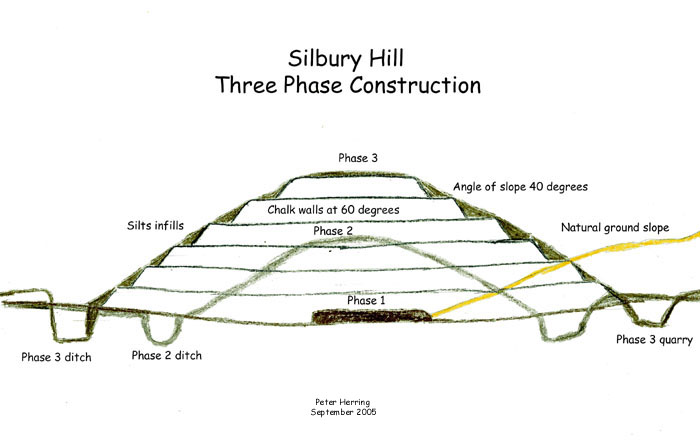
The one thing that we do know for certain is that it is not a natural hill, but man made. Caroline Malone who is a lecturer in archaeology at the University of Bristol and was a former Inspector of Ancient Monuments and Curator of the Alexander Keiller Museum at Avebury tells us that it was built in three phases as illustrated in this sectional drawing. Phase 1 was built around 2700BC and was a small mound built of muddy layers of gravel. It was covered in turf that was held in place with a fence of wooden stakes. We know that it was turfed in the summer because flying ants have been preserved in the freshly cut turf.
Phase 2 was started about 200 years later and consisted of a larger mound built over Phase 1. This involved the partial digging of a deep surrounding ditch and the excavated chalk rubble formed the mound. Before it was completed, plans were changed and work commenced on Phase 3. This meant filling in the first ditch and digging another further out enclosing an area of 2.5 acres. This ditch was 20 feet deep and contributed to the larger mound, but additional material was required and so extra quarries were dug. The working tools were of stone, bone, wood and antlers. This was a real feat of prehistoric engineering and not a simple mound at all. Six tiers of chalk walls were built up like a wedding cake. Each wall inclined inwards at an angle of 60 degrees to give maximum stability. This formed an internal skeleton or intricate web of reinforcement walls with the outer walls of each step built of larger blocks of chalk. The steps were then filled in with silt from the huge quarries. Only the top step was not filled in and this can clearly be seen today.
In my attempt at a reconstruction, I have shown the hill as it might have looked soon after Phase 3 was completed. It is recently grass grown and so the chalk shines through. Only the top deck is scoured clean of grass and soil so that it shines in the sunshine of a warm spring day in 2500 BC. The angle of the outer slope is that as shown in photos and is about 40 degrees. If it is true that all but the top terrace or tier were filled in with silt, then that would have produced a fertile, grass grown slope much like it is today. The exception would have been a shining chalk inward sloping wall at the top surmounted by a chalk platform. The whole thing would have looked like a gigantic green breast with a white nipple (groans - mother goddess stuff again!)
Very many questions remain unanswered, but two really intrigue:
1 Spiral path. Is there any evidence that there was a spiral path (other than the steeper one we see today which may be Roman) See this English Heritage drawing which shows a very pronounced spiral. The only pointer in its favour seems to be that today in this photo
the bottom of the top step seems to be lower on the right side than on the
left. That suggests an inclined plane.
2 Top step. If it is correct that the top step protruded from the green mound, then where did the soil that is there today come from? English Heritage's 3D model shown hereand naked eye observation does appear to show the top step much clearer than the lower ones as seen here.
We know that the later Roman road detoured around the hill and that the Romans used it as a survey point. Later still, the Saxons used it as a lookout post and stronghold. And what of the legend of King Sil who is supposed to be buried inside – no burial has yet been found. So what is Silbury Hill?


 We would like to know more about this location. Please feel free to add a brief description and any relevant information in your own language.
 Wir möchten mehr über diese Stätte erfahren. Bitte zögern Sie nicht, eine kurze Beschreibung und relevante Informationen in Deutsch hinzuzufügen.
 Nous aimerions en savoir encore un peu sur les lieux. S'il vous plaît n'hesitez pas à ajouter une courte description et tous les renseignements pertinents dans votre propre langue.
 Quisieramos informarnos un poco más de las lugares. No dude en añadir una breve descripción y otros datos relevantes en su propio idioma.