

Venus of Willendorf: 100th anniversary of her excavation
Submitted by coldrum on Friday, 26 September 2008 Page Views: 5820
Other Archaeology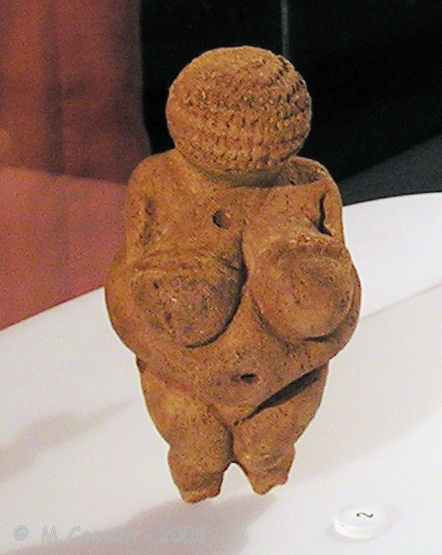
"This was the first statuette (from this period) that had such detailed features and it was also the first
statuette to be discovered at the time on an archeological site," says
Walpurga Antl-Weiser, head of the prehistory section at Vienna's
Natural History Museum.
On the 100th anniversary of her excavation, this Venus is being
honoured with a special exhibition at the museum, alongside other
artefacts from the same period. Carved from oolitic limestone, she is
a round woman, standing with her arms resting on her breasts and
belly, her bowed head hiding her face but showing off elaborate hair.
This Venus "resulted from perfect observation of the human body, but
she was also arranged to make her curves more harmonious," Antl-Weiser
adds.
The first and only statuette of her kind before the French Venus
of Lespugue and the Russian Venus of Kostienki joined her two decades
later, the lady from Willendorf can still attract crowds. But where
she came from and whether she represented a goddess or women's
elevated place in society remains a mystery. "We don't think she
represented prehistoric women," says Antl-Weiser. "She's a rather
older woman, one who has certainly already had children," she
explains. "Moreover, we can't prove that women played a predominant
role during this period and that these female statuettes honoured
them: there are many other statuettes (from that period) representing
animals, part-humans and part-animals or asexual human beings."
Rather than being a goddess, the Venus of Willendorf could have
been part of a ritual or a belief shared by several tribes over 20,000
years ago. Although excavated at opposite ends of the continent, the
French and Russian Venuses are similar in form to their Austrian
sister. "They could have been expressions of a single belief that
spread through Europe," says Antl-Weiser. But this does not explain
where the lady from Willendorf came from. While other artefacts and
statuettes were excavated near the same village in Lower Austria, no
traces remain of the rock out of which she was carved. Antl-Weiser
concludes: "From that point of view, either the Venus was brought
here, or the rock fragments disappeared when a railroad was built
there in the 19th century."
Source, with a photo of the Venus at AFP


 We would like to know more about this location. Please feel free to add a brief description and any relevant information in your own language.
 Wir möchten mehr über diese Stätte erfahren. Bitte zögern Sie nicht, eine kurze Beschreibung und relevante Informationen in Deutsch hinzuzufügen.
 Nous aimerions en savoir encore un peu sur les lieux. S'il vous plaît n'hesitez pas à ajouter une courte description et tous les renseignements pertinents dans votre propre langue.
 Quisieramos informarnos un poco más de las lugares. No dude en añadir una breve descripción y otros datos relevantes en su propio idioma.