
The Monumental Cemeteries of Prehistoric Europe – Magdalena S. Midgley
Submitted by mickm on Friday, 14 October 2005 Page Views: 13884
Neolithic and Bronze AgeType: Long BarrowInternal Links:

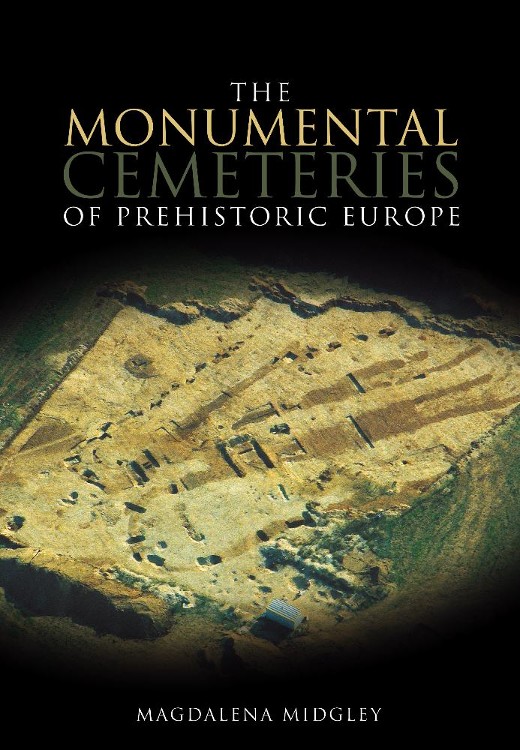
To begin the author takes us back to the later Mesolithic, describing the culture and society of the indigenous hunter gatherers, before introducing the early Danubian farmers of the linearbandkeramic (LBK) culture and discussing the interaction between the two groups. She then moves on to the period of the long barrows, a time when farming had spread over much of the continent, albeit supplemented by hunting, describing the regional groupings of both the Trichterbecherkultur (TRB) in the north and the Cerne culture in the west.
Having sketched out the geographical & cultural backdrop of the long barrow builders and their predecessors, she then begins to fill in the detail of first the earlier burial traditions, moving on to the construction of the barrows themselves and their placement within the landscape. Concentrating mainly upon the long barrow cemeteries (defined as being of 12 or more long barrows in a cluster), we are shown how they had a relationship with settlements, both past & contemporary, including in one instance 5 long barrows being directly imposed upon earlier houses. There is also discussion of how these burial traditions can be traced back to both the earlier farming & hunter gatherer practices.
The final flourishes are applied to the picture in the final chapter where Midgley unashamedly paints a personal vision of Europe at the time of the long barrows. Going beyond the concept of monumental houses for the dead, so popular amongst many prehistorians she states, “Thus the significance of the long barrow cemeteries does not lie in monumentalising the long house, but in monumentalising the entire ancestral village”.
Whilst the first half of this book draws upon the work of others, providing a synthesis of current knowledge of European culture during the 6th-5th millennia BC, the second half takes the reader into newer territory, providing insights based upon recent excavations including the author’s own involvement in work at the long barrow cemetery of Escolives-Sainte-Camille in Burgundy.
Magdalena Midgley is a Senior Lecturer in Archaeology at the University of Edinburgh. Ii is 20 years since the publication of her doctoral thesis, ‘The origin & function of the earthen long barrows of northern Europe’, during which time she has written but one further volume - on the TRB culture. This is a pity. Her writing style is clear, concise and easily understood, putting many a prehistorian to shame by not hiding her ideas behind obscure language and/or tedious prose. As a result this book will appeal to a much wider audience.
The volume is not above criticism however, academic arguments are often referred to but otherwise skimmed over for instance, although this could also be seen as a strength by the average reader in that the flow of the text is not unduly deflected. What does interfere with the flow is the continued practice by this publisher of separating colour plates into a single block, rather than integrating them into the text. It is to the credit of Tempus however that they regularly publish books, such as this, which fill gaps in the archaeological book market.
For the student of European prehistory and indeed anybody who has ever wondered what these monuments were about, this book will provide both good background reading for the period & an informative introduction to the long barrows & cemeteries themselves.
By Mick Miles.
Tempus £19.99. £16.99 direct from Tempus online

 We would like to know more about this location. Please feel free to add a brief description and any relevant information in your own language.
 Wir möchten mehr über diese Stätte erfahren. Bitte zögern Sie nicht, eine kurze Beschreibung und relevante Informationen in Deutsch hinzuzufügen.
 Nous aimerions en savoir encore un peu sur les lieux. S'il vous plaît n'hesitez pas à ajouter une courte description et tous les renseignements pertinents dans votre propre langue.
 Quisieramos informarnos un poco más de las lugares. No dude en añadir una breve descripción y otros datos relevantes en su propio idioma.