

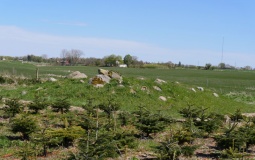

The Hunt for the missing Mississippi mounds
Submitted by coldrum on Friday, 01 August 2008 Page Views: 3009
Pre-ContactCountry: United States Type: Artificial MoundInternal Links:

Archaeologists are searching for clues to the past before the construction of a new Mississippi River bridge makes such exploration impossible. Whatever archaeologists find on land north of downtown St. Louis and along floodplains in the Metro East could enrich the area's understanding of people who lived along the Mississippi River thousands of years ago.
Archaeologists also are searching for links to working class immigrants who developed the riverfront in the 19th century.
The $640 million Mississippi River bridge and its interchanges and ramps will be built in an area where civilization dates back 10,000 years, archaeologists say. Bridge construction is expected to begin in 2010.
As engineers design the bridge and its components, archaeologists are visiting locations between Broadway and the river, digging with shovels and backhoes as they look for artifacts. In Illinois, they're digging up columns of soil along a stretch that parallels Route 3 around East St. Louis and Brooklyn.
"We're essentially writing pages and adding them to the history book of the region," said Brad Koldehoff, regional coordinator for the Illinois Transportation Archaeological Research Program. "For prehistory, everything has to be learned from the ground, the deposits and the artifacts."
The layers of dirt will give them information about floods, agriculture and traces of human activity through the centuries. From that soil, archaeologists will determine where to dig for such things as lost villages, plazas, or even old wells used by more recent settlers.
In the 1800s, mounds built by the Mississippian Indians were destroyed as farmers and builders developed St. Louis and East St. Louis. The earthen pyramids were built for ceremonial and burial purposes by a civilization that thrived a thousand years ago. In St. Louis, the largest mound north of downtown, called Big Mound, was destroyed in 1869 by the North Missouri Railroad. The railroad used the dirt for roadbed fill.
Archaeologists are excavating in the area where the Big Mound once stood.
The federal government requires an archaeological survey — in addition to historical and architectural surveys — before construction begins on any project that uses federal dollars. If archaeologists discover anything significant, they must preserve or excavate, depending on the condition of what they have found. They also must document the discovery.
"The real reason for doing this is to better understand human beings and understand what their lives were like," said Joe Harl, vice president of the Archaeological Research Center of St. Louis. "It also helps us understand ourselves today."
Transportation officials have notified the Osage and Peoria tribes of the survey. If anything important to the tribes' culture is found, they will be notified, said James Harcourt, senior historic preservation specialist with the Missouri Department of Transportation.
On the Missouri side, archaeologists expect to learn more about Irish and German immigrants. Harcourt and his staff of 20 have early maps of the area, showing where houses and businesses were.
"What we have a good chance of finding are privies and wells," Harcourt said. "They go quite deep. People tended to throw things in them they don't want people to know about."
On the Illinois side, archaeologists expect to unearth findings from prehistoric civilizations.
As for additional burial mounds, "We haven't identified any mounds or possible mounds in that alignment, Koldehoff said, "but that's one thing we're looking for and checking on."
Source: STL Today http://www.stltoday.com/stltoday/news/stories.nsf/stlouiscitycounty/story/D8E23A3274FE911C8625748E0012AACE?OpenDocument

 We would like to know more about this location. Please feel free to add a brief description and any relevant information in your own language.
 Wir möchten mehr über diese Stätte erfahren. Bitte zögern Sie nicht, eine kurze Beschreibung und relevante Informationen in Deutsch hinzuzufügen.
 Nous aimerions en savoir encore un peu sur les lieux. S'il vous plaît n'hesitez pas à ajouter une courte description et tous les renseignements pertinents dans votre propre langue.
 Quisieramos informarnos un poco más de las lugares. No dude en añadir una breve descripción y otros datos relevantes en su propio idioma.