

The Great Stone Circles – How they Work Part 4
Submitted by JACKME on Sunday, 19 June 2005 Page Views: 7886
Neolithic and Bronze AgeCountry: England Type: Stone CircleInternal Links:

The Summer Solstice at Stonehenge
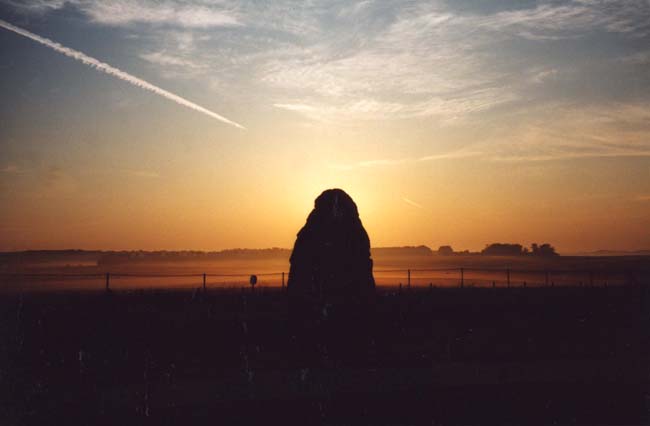
This article is written particularly for the benefit of those going to the Solstice party at Stonehenge. I am afraid I have got behind with the publication of this series, so I am having to jump forward to Stonehenge, in order not to miss this year’s Midsummer Solstice. However, it is impossible to comprehend the workings of this very complex site without seeing its component parts in their individual simple forms from different parts of the country and this evidence will be posted gradually over the next few months. There is still a tremendous amount to learn about Stonehenge and the investigations so far hint at much - see the last paragraph.The First Gleam at Stonehenge can be seen from several places through the stones, but the most important position is from the right hand side of the remaining leg of the Great Trilithon (Stone 56). Originally when the other leg of this was standing, the observation would have been through the central opening with the sun’s rays passing through the gap before striking the big round bun altar (Stone 15), in principle as seen in the Swinside photograph a couple of weeks ago.
It is very dangerous to look directly at the bright sun, so the Ancients devised a system whereby they erected tall stones to cast shadows to targets at about 5 minutes after First Gleam. The only exception being at the Summer Solstice when the times are shorter as the sun has 1° less to travel, then again after approximately 11 minutes, 22 minutes (which seems to be the most important timing) and finally after about 45 minutes. This system is also highly advantageous as on many days the sun has risen above the morning cloud and mist by the 22 minute mark. The same arrangement applies in the evenings as well, i.e. some time before Last Gleam.
Stonehenge was built for this purpose, to throw shafts of light and shadows both internally and externally. The height of the Trilithons was dictated by the requirement for the shadows to reach right down the slope (past the main road) into the surrounding valleys. Unfortunately when I observed this I was stuck in the Sunday evening traffic and unable to stop and check. This is identical to the Solstice setting sun shadow as seen at Castlerigg. I have seen this shadow pattern at both Solstices, but because of trees at Castlerigg I am unable to confirm that it acts as full sunset calendar but I expect that it does.
I am afraid that the proposed road works will ruin this part of the operation of Stonehenge in the future. We often complain that our forefathers destroyed things though ignorance and now we are about to do the same. It is more important than ever that observations with photographs are made whilst these marvels of ancient skill and technology are still there to be seen.
As the sun rises it moves to the right and after a few minutes it can be seen from the left hand side of Stone 56, past Bluestone 68, over the round bun altar (Stone 160b), past the edge of Stone 49, and the edge of Stone 30At this stage the sun will be seen at the Full Orb - that is when the bottom of the sun appears to be just clear of the earth. At the time of construction it would have been slightly higher. Now the light strikes Stone 160b, if you can see it for people!
Notice also at about this time (or the 22 minute mark), that the length of the shadow cast by the Great Trilithon will probably reach the area of the destroyed barrows or mounds. When I was watching this in 2001 I had not realised the significance of shadows, and unfortunately my photo is indefinite on this point. With so many people about at the Solstice, even if the sun shines, it will be difficult to locate this place, but it is still worth thinking about.
Once this is over, don’t waste time, move to the Heel Stone end of the circle where the shadows of the lintels of the outer ring will be cast onto the leg of the Great Trilithon, (Stone 56). It will be observed that the bottom of the shadow would have touched the top of the Bluestone number 68, had it still been standing vertical. Unfortunately this photo. was taken a little too late. At other sites the vertical line and a horizontal line cross on the target.
There are two factors likely to spoil the accuracy here:
1. Bluestone 68 has leaned from the vertical. Is this the result of deterioration over time or did they make it lean deliberately it to correct a fault in the layout?
2. The sun does not now rise as far North as it once did. It still passes the same azimuth as at the time of construction, but at a slightly lower elevation, meaning the shadow is a little higher than was originally planned.
This shadow striking the top of the Bluestone is by no means unique and has been observed at several times throughout the year. Or perhaps it would be fairer to say, seen to strike where their tops are assumed to have been, as some are now broken off.
If you stay around for a little longer, it is likely that another alignment will occur sometime between 40 and 45 minutes after sunrise. I have yet to witness this at Stonehenge at this time of the year, because on my visit in 2001 I was unaware that it was necessary to wait for a further alignment.
I do not claim to comprehend the entire workings of this magnificent site, indeed I feel I am only just beginning to understand it. Living in Cumbria I really need the help of someone living close to Stonehenge to carry on the research with the co-operation of English Heritage. This person must have the time available to undertake more observations for me throughout the year and be prepared to watch the sun and moonrises and settings at key times of the cycle, as and when we jointly decide and the weather allows. So far I have only managed to observe one sector of the moon movements out of the four.
If you are interested please contact through my private messages
Subject to a good weather forecast, I plan to be at Stonehenge myself for this year’s Solstice.
This is the fourth of a series of previously unpublished articles by retired farmer, Jack Morris-Eyton. Following 12 years of research visiting many of the circles in Britain and Ireland, Jack claims to have unravelled what no one else has done before - why, where and how the great stone circles worked. Jack does not profess to have the answers to all of the stone circle mysteries, indeed he admits himself there is still much to learn, but through the following series of articles he hopes to provide some possible answers to many intriguing questions.
Contents page for the whole series is here
Note: This is the fifth of a series of previously unpublished articles by retired farmer, Jack Morris-Eyton and the one we've all been waiting for - Stonehenge.


 We would like to know more about this location. Please feel free to add a brief description and any relevant information in your own language.
 Wir möchten mehr über diese Stätte erfahren. Bitte zögern Sie nicht, eine kurze Beschreibung und relevante Informationen in Deutsch hinzuzufügen.
 Nous aimerions en savoir encore un peu sur les lieux. S'il vous plaît n'hesitez pas à ajouter une courte description et tous les renseignements pertinents dans votre propre langue.
 Quisieramos informarnos un poco más de las lugares. No dude en añadir una breve descripción y otros datos relevantes en su propio idioma.