
The Great Stone Circles – How they Work Part 3a
Submitted by JACKME on Wednesday, 25 May 2005 Page Views: 5966
Neolithic and Bronze AgeCountry: England County: Cumbria Type: Stone CircleInternal Links:


The Calendar Systems - Swinside
All of the Great Stone Circles have an annual calendar built into them. I will begin by describing my observations at Swinside (SD172882), described by Aubrey Burl as ‘one of the finest stone circles in Western Europe.’ As previously mentioned, I consider Swinside to be the simplest and most complete of all the Great Stone Circles I have visited and I believe it holds the key to the understanding of all the others in this series of circles.The calendar at Swinside works by taking a line over a pair of stones in the eastern half ‘the Eastern Double’ to the First Gleam back to the Great Stone at the summer solstice. As the year progresses the sunrise moves along the skyline until the time of the winter solstice and then it returns.
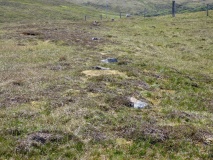
At the time of construction the alignment at Swinside would have come through the gap between Stones 55 & 56, being some 21 inches or 0.53 metres to the left of where it is seen in this picture.
This diagram shows the dates on which the first gleam has been observed at Swinside. Castlerigg works in a similar way, and at both sites, which are on fairly level ground, it is expected that the western doubles will act likewise as a sunset calendar, although I have yet to turn my attention to such observations.
The next two photos taken at the end of March and beginning of April show how fast the sunrise moves along the skyline at Swinside during the period of the Equinox. Both of these are seen over the Double 13/14.
In the next article I will take a look at other Calendar Systems.
This is the third of a series of previously unpublished articles by retired farmer, Jack Morris-Eyton. Following 12 years of research visiting many of the circles in Britain and Ireland, Jack claims to have unravelled what no one else has done before - why, where and how the great stone circles worked. Jack does not profess to have the answers to all of the stone circle mysteries, indeed he admits himself there is still much to learn, but through the following series of articles he hopes to provide some possible answers to many intriguing questions. Read the next article
Contents page for the whole series is here
Note: This is the third of a series of previously unpublished articles by retired farmer, Jack Morris-Eyton.


 We would like to know more about this location. Please feel free to add a brief description and any relevant information in your own language.
 Wir möchten mehr über diese Stätte erfahren. Bitte zögern Sie nicht, eine kurze Beschreibung und relevante Informationen in Deutsch hinzuzufügen.
 Nous aimerions en savoir encore un peu sur les lieux. S'il vous plaît n'hesitez pas à ajouter une courte description et tous les renseignements pertinents dans votre propre langue.
 Quisieramos informarnos un poco más de las lugares. No dude en añadir una breve descripción y otros datos relevantes en su propio idioma.