

The mystery of the Dacre Bears - were they part of a pagan shrine?
Submitted by nicoladidsbury on Tuesday, 24 May 2005 Page Views: 14283
MysteriesCountry: England County: CumbriaInternal Links:

The first recorded reference to Dacre occurs in the Venerable Bede's Ecclesiastical History of AD731 where he describes a miracle attributed to St Cuthbert. Bede places one of these miracles in "the monastery which, being built near the river Dacore, took its name from it". The most precious relic in the monastry was a lock of St Cuthbert's hair. A young monk had a painful tumor on his eye which appeared to be incurable. When he had an opportunity to handle the relic, he placed it to his eye and within hours the tumour was gone. This monastery no longer exists. Dacre is now just a quite, pretty village quite close to Ullswater - a lovely place. Archaeological evidence from excavations in 1929, 1982 and 1984 support the view that the church is built on the site of the monastery mentioned by Bede.
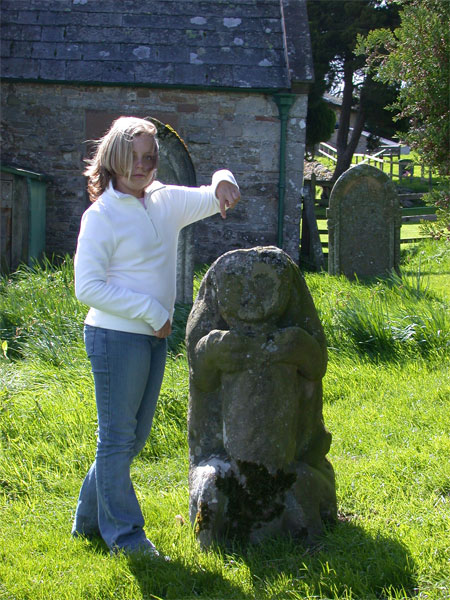
Bishop Nicolson, writing in 1704, linked the bears to the chained bear and ragged staff on the arms of the Earls of Warwick. But these two emblems were not actually linked until the medieval age and the church and bears are much older.
In 1890 Chancellor Ferguson studied the bears closely and though he had solved the mystery. He surmised that they were a humorous rendering of a bear legend and told the following story.
1. North West Corner - The bear is asleep with his head resting on top of a pillar. Click here
2. South West Corner - A small cat like animal has jumped on the bear's back. The bear's head is turned to the right, trying to see what has happened. Click here
3. South East Corner - The bear fights with and attempts to dislodge the animal. Click here
4. North East Corner - The bear is alone, with a wide smile on its face, it appears to have eaten the animal and looks extremely satisfied. Click here
The trouble with this theory is that figure No. 4 in the best state of preservation, sports a mane and a long tail. These are not the usual characteristics of a bear, so the statue appears to be that of a lion. Indeed, some modern experts have suggested that the "bears" are really lions.
A recently expressed archeological opinion is that they are pre-Saxon in origin, and may have marked boundaries of some pagan sacred site.
The Ancient Cross Shafts
The Cross Shafts in the chancel are fragments of two cross shafts from the 9th and 10th centuries. The smaller, which is believed to date from the 9th century, was found in 1900 close to the church and deep in clay. It is considerably damaged but some detail of the carving is still quite sharp. The least damaged face of the shaft, where the top has been broken off, shows two pairs of human feet. Beneath is a lion-like winged creature with a large face and sorrowful eyes and with the head and part of the body of a serpent. The face of this lion like creature is very like that of the North Eastern bear, could there be a link. The cross shaft is thought to be Anglo-Saxon in style.
The larger stone was discovered amongst the rubble of the east wall during restoration work in 1875. It is believed to date from the 10th/11th century and is believed to be part of a Norse cross. At the top of the shaft are two human figures whose hands are joined over a rectangular object with pellet-like legs. It is possible that the scene represents Abraham and Isaac. The strange looking four legged creature over their heads may depict the ram sacrificed instead of Isaac. Immediately below is an antlered stag with a dog-like animal on its back. The "hart and hound" motif was often used, particularly by commentators of the bible such as the Venerable Bede, to symbolise the soul pursued by the forces of evil. The scene at the bottom of the shaft is thought to portray Adam and Eve in the Garden of Eden. Eve is reaching up to pick from the tree. She is wearing a skirt whilst Adam appears to be unclothed.
Note: Medieval icons or Pagan totem animals? What do you think?


 We would like to know more about this location. Please feel free to add a brief description and any relevant information in your own language.
 Wir möchten mehr über diese Stätte erfahren. Bitte zögern Sie nicht, eine kurze Beschreibung und relevante Informationen in Deutsch hinzuzufügen.
 Nous aimerions en savoir encore un peu sur les lieux. S'il vous plaît n'hesitez pas à ajouter une courte description et tous les renseignements pertinents dans votre propre langue.
 Quisieramos informarnos un poco más de las lugares. No dude en añadir una breve descripción y otros datos relevantes en su propio idioma.