
Featured: Exploring Avebury: The Essential Guide - New Expanded Edition!

Exploring Avebury: The Essential Guide - New Expanded Edition!

The Quest for the Shaman: Shape-shifters, Sorcerers and Spirit-healers of Ancient Europe

The Quest for the Shaman: Shape-shifters, Sorcerers and Spirit-healers of Ancient Europe

Login

Register here - as a registered user you get more features and fewer ads.

Who's Online

There are currently, 415 guests and 8 members online.

Sponsors

Terence Meaden: How Pytheas the Greek Discovered Iron-Age Britain and Stonehenge

Submitted by Andy B on Tuesday, 08 July 2025  Page Views: 3035

Discoveries

<< Books/Products >>

Terence Meaden: How Pytheas the Greek Discovered Iron-Age Britain and Stonehenge
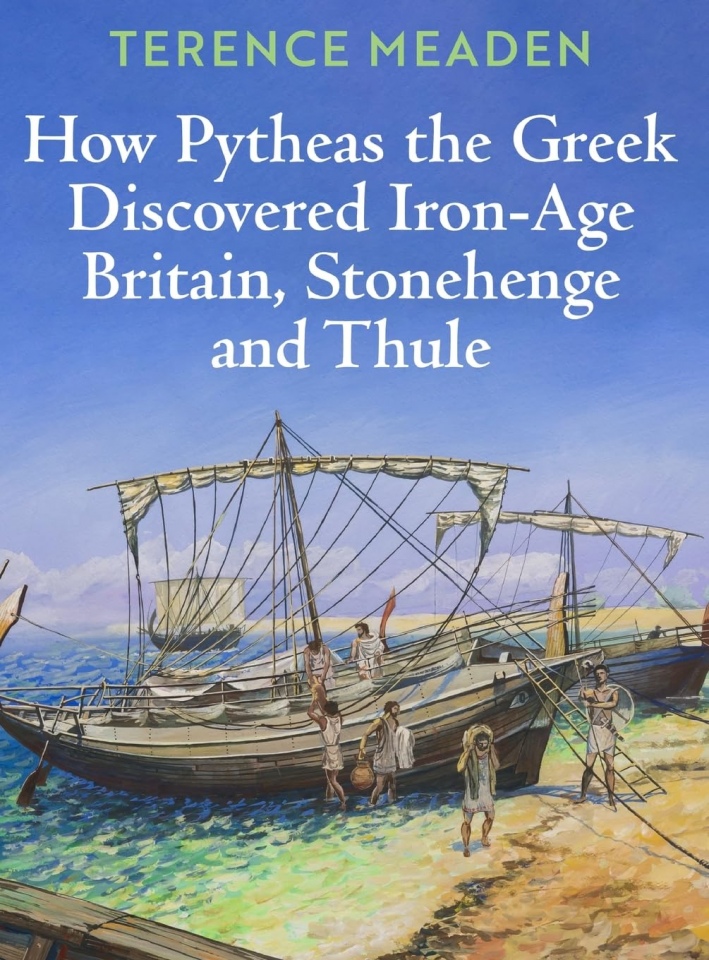
Terence Meaden: How Pytheas the Greek Discovered Iron-Age Britain and Stonehenge submitted by Andy B : Terence Meaden writes: Pytheas of Massalia, a Greek scientific adventurer of the fourth century BC was the first literate explorer to meet British countryfolk and write of their customs, crafts, food and farming practices. He explored parts of Britain including Kent, Stonehenge (*) and the Cornish tin mines, then sailed to Scotland, Shetland, Iceland and the amber coasts of Denmark. Read more... (Vote or comment on this photo)
...and Thule. Terence Meaden writes: Pytheas of Massalia, a Greek scientific adventurer of the fourth century BC was the first literate explorer to meet British countryfolk and write of their customs, crafts, food and farming practices. He explored parts of Britain including Kent, Stonehenge (*) and the Cornish tin mines, then sailed to Scotland, Shetland, Iceland and the amber coasts of Denmark.

His was a truly ambitious voyage, extremely risky for mariners in the boats of the time, especially in stormy conditions and near-Arctic drift ice. Consequences arising from Pytheas' inspection of Stonehenge are far-reaching because as a learned Greek he understood its purpose and, in the assessment of the present author, validly identified it as a Temple to the Sun.

Temples implicitly accommodate and safeguard in their inner sanctum one or more icons to the divine. Befittingly, the present author had previously noted a significant, hitherto-unrecognized, carefully-carved phallic icon (a fallen bluestone) in the middle of the monument, and in this volume makes it public knowledge.

Moreover, Pytheas describes the Stonehenge priesthood in enough detail as to indicate that the monument was still in use when he was there. Purposeful, exciting, audacious, this was a sensational exploit on sea and land. The 58 illustrations help to express the points under study, and allow readers to appreciate the mood of ocean and countryside that Pytheas encountered.

(*) Other writers, including Aubrey Burl have asserted that Pytheas must have visited and described Calanais stone circle in the Outer Hebrides, however I find Terence's hypothesis, including his description of Pytheas' land journey across southern England entirely plausible - MegP Ed.

Terence adds:
1. We learnt at school that recorded British history began with the writings of the literate Romans. This is no longer true. The intellectual Pytheas wrote about facts of life in Iron Age Britain in 325 BC.

2. Pytheas came from a land of 'temples of the sun-god Apollo’. He recognised Stonehenge for what it is and said so. This ends the 500 years of uncertainty among those academics who say that Stonehenge was built as a place for the dead [MPP, 2025, for latest comment] or definitely not a place of worship to the sun but instead only built with solar alignments [C Ruggles and A Chapman 2024].

3. Being a temple, there would be icons to the divinity. This is why I chose to announce at this time my discovery of a phallic centrepiece which everyone had missed spotting. Reminder pictures are added below.

4. Pytheas spoke with priests who were obviously bilingual. Their religious language was ancestral, because the priesthood was passed down through heritage, from the time when the monument was built.

5. Stonehenge was clearly still in use.

Items 2 and 3 are of the highest interest to all scholars who study stone circles. You do not need to know any Greek to appreciate this. It is now proven beyond all doubt that Stonehenge is a temple to the sun.

How Pytheas the Greek Discovered Iron-Age Britain, Stonehenge and Thule by Terence Meaden is an excellent read for anyone interested in stone circles and their connection to the wider ancient world. It is published by ‎ New Generation, available at Amazon.co.uk and Amazon.com.

Please add your thoughts on this site

Prehistoric houses at Sumburgh in Shetland

Prehistoric houses at Sumburgh in Shetland

Sponsors

More Books/Products

See all Books/Products →

"Terence Meaden: How Pytheas the Greek Discovered Iron-Age Britain and Stonehenge" | Login/Create an Account | 4 News and Comments
  
Go back to top of page    Comments are owned by the poster. We aren't responsible for their content.
Re: Terence Meaden: A Reappraisal Of The Written Sources Of Pytheas' Voyage To Britai by drolaf on Wednesday, 22 October 2025
(User Info | Send a Message)
Pytheas says he visited all of Britain (does not say by land) so there is no evidence he went on land much, apart from to visit a temple near a town or port (polis) and see local houses and storage. As a merchant geographer, Pytheas’ mission was to measure sun positions as far north as he could, so was unlikely to get distracted by a slow long land journey. As he was primarily interested in the far north, Pytheas would probably have visited sites there. He may have been surprised and impressed to find wheelhouses and brochs in the far north, with busy trading communities. Scatness was on the tin route from Cornwall, as it imported tin to make bronze with local copper, and exported it to Britain and further.

The description of two crops a year does not mean that he visited a temple in the south. Cereal crops can be grown in two seasons in the north (long summer days)-spring barley and oats, and winter wheat, one crop for human food the other for beer and animal fodder. Barley was found at Scatness.

Pytheas describes a temple to Apollo. Apollo was a god of healing, music and (sun) light. He was possibly a luni-solar god like Thoth, so also represented reflected sunlight from the moon. Pytheas' moon god (un-named) comes every 19 years. There are several Later Iron Age shrines found in southern England with an external an outer nemeton, temenos, or sacred space, and with a (roofed, domed) inner circular enclosure, naos, for the votive pit. With contact to the eastern Mediterranean from at least 1200 BC, this suggests there were earlier ones. The temple Pytheas saw was described as spherical, so perhaps had a domed roof, or was a large mound.

A possibility is Maes Howe, as Pytheas names Orcas. Another possibility is that he identified a shrine at Scatness or Jarlshof.

He may have visited an Iron age shrine when he first landed in England. If he took the tin route, he may have landed at the ports of Hengistbury or Poole. A likely location for the polis is Maiden Castle, a large complex carrying on trade with mainland Europe, and just 5 miles inland from Weymouth.

Bearing in mind that there are only second and third hand quotes of the original text, we should be wary of adding information from later Roman writers, and even more wary of inserting speculation as fact. There is far more evidence of Iron Age activity in Shetland than on Salisbury plain.
[ Reply to This ]

Re: Terence Meaden: A Reappraisal Of The Written Sources Of Pytheas' Voyage To Britai by Hilary on Sunday, 13 July 2025
(User Info | Send a Message)
Unable to locate this book anywhere. Can you provide more details?
[ Reply to This ]

Crucial new light on Stonehenge and ‘solar temple’ ritual by Andy B on Tuesday, 08 July 2025
(User Info | Send a Message)
Crucial new light on Stonehenge and ‘solar temple’ ritual by Geoff Ward

About 2,300 years ago, the scientific adventurer Pytheas of Massalia was on an ambitious and perilous exploration of the European north-west when, on a hike across southern England, he came across Stonehenge and realised it was a ‘Temple to the Sun’.

According to a fascinating new book which shows the adventures of the Ancient Greek explorer, geographer and astronomer in an invaluable new perspective, the consequences of Pytheas’ arrival at Stonehenge in about 325BC are far-reaching because, as a learned Greek and the first person to write about the monument, he understood its purpose.

And in How Pytheas the Greek Discovered Iron-Age Britain, Stonehenge and Thule (New Generation Publishing, May, 2024), Dr Terence Meaden, an academic physicist and archaeologist, announces a remarkable discovery he has made which is key to the role of Stonehenge as a solar temple built for prehistoric fertility rituals.

archive.is/yG2BL#selection-521.0-533.243
[ Reply to This ]

Terence Meaden: A Reappraisal Of The Written Sources Of Pytheas' Voyage To Britain by Andy B on Tuesday, 08 July 2025
(User Info | Send a Message)
Pytheas: A Reappraisal Of The Written Sources Of Pytheas' Voyage To Britain And His Visit To Stonehenge, C. 325 Bc, Which He Recognised As A Temple Of The Sun-god Apollo
2023, Expression: The International Journal of Conceptual Anthropology

This case study uses archaeological and anthropological knowledge to check details dating from the time of the visit to southern England of Pytheas of Massalia who sailed to Britain in the fourth-century BC, as recorded in his travelogue Peri tou Okeanou. All copies of his book are lost, but some 40 fragments survive in the writings of 17 classical historians. Hecataeus of Abdera had read Pytheas' volume and written about it, including a description of what Pytheas had called a Temple of Apollo with a 'magnificent temenos'. Fortunately, before that book got lost too, Diodorus Siculus (of the first century BC) read Hecataeus' account. Greeklanguage reanalysis of Diodorus' summary justifies the argument that Stonehenge was the monument in question, and that it was still in use. Some commentators preferred to overlook Stonehenge possibilities or deny them because of treating the text as if it meant there were two fine temples in proximity which is unlikely. The problem arose from confusing the meanings of temenos and naos which in the context of this case-study respectively refer to the precinct-with-temple and the presence of an inner sanctuary or naos that holds and safeguards the cult images. In fact, Stonehenge does have a splendid carved-stone phallus that stood 2.5 m high in the central zone, hitherto unrecognised because it has been knocked over and is awkward to view, but has been recently identified and photographed by the author.
Free download, registration required:
www.academia.edu/128116543/
[ Reply to This ]

Your Name: Anonymous [ Register Now ]
Subject:


Add your comment or contribution to this page. Spam or offensive posts are deleted immediately, don't even bother

<<< What is five plus one as a number? (Please type the answer to this question in the little box on the left)
You can also embed videos and other things. For Youtube please copy and paste the 'embed code'.
For Google Street View please include Street View in the text.
Create a web link like this: <a href="https://www.megalithic.co.uk">This is a link</a>  

Allowed HTML is:
<p> <b> <i> <a> <img> <em> <br> <strong> <blockquote> <tt> <li> <ol> <ul> <object> <param> <embed> <iframe>

We would like to know more about this location. Please feel free to add a brief description and any relevant information in your own language.
Wir möchten mehr über diese Stätte erfahren. Bitte zögern Sie nicht, eine kurze Beschreibung und relevante Informationen in Deutsch hinzuzufügen.
Nous aimerions en savoir encore un peu sur les lieux. S'il vous plaît n'hesitez pas à ajouter une courte description et tous les renseignements pertinents dans votre propre langue.
Quisieramos informarnos un poco más de las lugares. No dude en añadir una breve descripción y otros datos relevantes en su propio idioma.