

Featured: Exploring Avebury: The Essential Guide - New Expanded Edition!

Exploring Avebury: The Essential Guide - New Expanded Edition!

Random Image

Temples of Stone: Exploring the Megalithic Tombs of Ireland

Temples of Stone: Exploring the Megalithic Tombs of Ireland

Login

Register here - as a registered user you get more features and fewer ads.

Who's Online

There are currently, 481 guests and 8 members online.

Sponsors

Team Unearths Ancient Circle Stone Circle Shetland

Submitted by coldrum on Monday, 02 July 2007  Page Views: 3074

Neolithic and Bronze Age

<< News >>

Country: Scotland County: Shetland Type: Stone Circle

Internal Links:

A Team of archaeologists from Bath has helped uncover an ancient stone circle in one of Britain's most remote locations.

Members of the Bath and Camerton Archaeological Society (Bacas) have taken part in a two-week excavation on Foula, part of the Shetland Islands.

The team was previously involved in an extensive geophysical survey on the island in May last year.

They were invited back to investigate the possibility that an early Bronze Age ceremonial enclosure, aligned to the midwinter sunrise, had been discovered.

Jayne Lawes, the Bacas director of excavations, said: "This year's excavation has proved conclusively that the stone enclosure is manmade.

"It is similar in construction to others of the late Neolithic or early Bronze Age.

"The actual date of the construction has yet to be established, though one shard of pottery has been found buried under 60cm of peat on the floor of the enclosure.

"That should help to provide evidence of a date when the site was in use."

The team has also taken samples of the peat for further analysis in the hope that pollen samples may give further clues to the date of the site.

Bacas member John Holbourn, who lived for most of his life on Foula before moving to Wiltshire, said: "The alignment of the stone ring to the midwinter sunrise is of real significance.

"While in the summer the island is bathed in light throughout most of the day and night, in the winter daylight lasts for only a few hours.

"The knowledge that the days will lengthen and get warmer is very cheering."

From August 6 to September 14, Bacas members will be continuing to excavate the Iron Age and Roman site at Upper Row Farm near Norton St Philip.

The site has previously featured on Channel 4's Time Team and anyone wishing to participate in this year's excavation is welcome and a training programme is available.

There will also be an open day at the Upper Row Farm site on Saturday, July 21, from 10am to 4pm.

For more information about the Foula excavation, or for details of the local summer excavation or open day, contact Bridget Hetzel on 0117 932 9939 or visit the Bacas website, www.bacas.org.uk .

thisisbath.

Please add your thoughts on this site

Prehistoric houses at Sumburgh in Shetland

Prehistoric houses at Sumburgh in Shetland

Sponsors

More News

See all News →

"Team Unearths Ancient Circle" | Login/Create an Account | 4 News and Comments
  
Go back to top of page    Comments are owned by the poster. We aren't responsible for their content.
Re: Foula still uses Ancient calendar system, Yule is 6th January. by AngieLake on Friday, 06 January 2017
(User Info | Send a Message)
Thought this article was interesting:
http://www.dailymail.co.uk/news/article-4090662/The-island-ll-Christmas-TOMORROW-Remote-Shetland-isle-uses-2-000-year-old-calendar-New-Year-won-t-ring-January-13.html
It also reminds me of the upside-down 'V' feature on Stone 16 at Stonehenge that is highlighted on 6th Dec and 6th January at sunrise, which might be more significant given the ancient way of calculating the years... (ok, that was erected or carved way before this calendar, but still....)
[ Reply to This ]

Re: Archaeologists rise to solstice circle discovery by Andy B on Wednesday, 11 July 2007
(User Info | Send a Message)
We show the location of this site and more information on our site page here:
http://www.megalithic.co.uk/article.php?sid=17040
[ Reply to This ]

Archaeologists rise to solstice circle discovery by coldrum on Tuesday, 10 July 2007
(User Info | Send a Message)
Archaeologists rise to solstice circle discovery

ARCHAEOLOGISTS working on a remote Scottish island have discovered an ancient stone ceremonial enclosure that is perfectly aligned to the winter and summer solstices.

The find was made by members of the Bath and Camerton Archaeological Society (Bacas) working on the island of Foula.

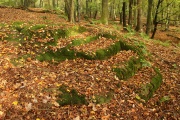
The stones were found on the last day of an extensive geophysical survey at an area called Da Heights. The group found stones rising from the ground in a curve which did not look like they were placed naturally.

Extensive research has shown the stones were part of an early Bronze Age ceremonial enclosure. The structure would have been built some time between 3500 and 2000BC.

Jayne Lawes, the director of excavations, said: "This excavation has proved conclusively that the stone enclosure is man made and similar in construction to others of the late Neolithic or early Bronze Age.

"The actual date of the construction has yet to be proved, though one shard of pottery has been found buried under 60cm of peat on the floor of the enclosure and should help to provide evidence of a date when the site was in use."

John Holbourn, a Bacas member from Wiltshire, said: "The alignment of the stone ring to the midwinter sunrise is of real significance.

"While in the summer the island is bathed in light throughout most of the day and night, in the winter daylight lasts for only a few hours.

"The knowledge that the days will lengthen and get warmer is very cheering."

Isobel Holbourn, who owns the land in Foula where the discovery was made, said: "We knew there was something there, and the archaeologists found an egg-shaped circle of stones.

"It turns out that the winter sunrise goes right up the middle, while the summer solstice rises at right angles to it.

"The circle is egg shaped, and in the centre they dug a trench and found a paved area and a bit of black pottery in between the stones.

"This has been sent away to be dated. The team watched the summer solstice sunrise on 21 June. From the middle spot the sun rolls and rises up the side of Ronas Hill - the highest hill on the Shetland mainland."

This article: http://news.scotsman.com/scotland.cfm?id=1046352007
[ Reply to This ]

Your Name: Anonymous [ Register Now ]
Subject:


Add your comment or contribution to this page. Spam or offensive posts are deleted immediately, don't even bother

<<< What is five plus one as a number? (Please type the answer to this question in the little box on the left)
You can also embed videos and other things. For Youtube please copy and paste the 'embed code'.
For Google Street View please include Street View in the text.
Create a web link like this: <a href="https://www.megalithic.co.uk">This is a link</a>  

Allowed HTML is:
<p> <b> <i> <a> <img> <em> <br> <strong> <blockquote> <tt> <li> <ol> <ul> <object> <param> <embed> <iframe>

We would like to know more about this location. Please feel free to add a brief description and any relevant information in your own language.
Wir möchten mehr über diese Stätte erfahren. Bitte zögern Sie nicht, eine kurze Beschreibung und relevante Informationen in Deutsch hinzuzufügen.
Nous aimerions en savoir encore un peu sur les lieux. S'il vous plaît n'hesitez pas à ajouter une courte description et tous les renseignements pertinents dans votre propre langue.
Quisieramos informarnos un poco más de las lugares. No dude en añadir una breve descripción y otros datos relevantes en su propio idioma.