


Talk Review: Robin Heath's 'Proto Stonehenge' in Wales
Submitted by cerrig on Wednesday, 09 July 2014 Page Views: 6297
Alternative ArchaeologyCountry: Wales County: Carmarthenshire (Sir Caerfyrddin)Internal Links:


The room was soon full of interested people, and more chairs were needed to accommodate the crowd. We got going with a short talk about a wide variety of sites, from Nazca in Peru to Stonehenge, and how an aerial view is important in understanding the sites. Robin then told us that his new discovery was a second link between Preseli and Stonehenge that pre-dated the monument itself.
He moved on to talk about the atmosphere that researchers operate in when investigating Stonehenge and similar monuments, with characters such as Jaquetta Hawkes, John Michell, Magnus Magnusson, Alexander Thom and Clive Ruggles to name a few . The widely differing views of these individuals and their “muckers” has coloured the debate about Neolithic man for a long time, and it's still going on now.
Robin stressed the role that Astronomy, Geometry and Metrology has played in the design of Stonehenge, and the Archaeological establishments refusal to consider these in the study of ancient man, and now we have Mike Parker Pearson and the ongoing Bluestone transport debate. This melting pot is the backdrop to the situation today , and it's into this that Robin's discovery will be dropped.
The cornerstone of Robin's work is measurement and this is where Alexander Thom's excellent plan of Stonehenge comes in, along with the implications that are contained within the long lost meanings behind these measures. By marrying Astronomy, Geometry and Metrology Robin, along with those that came before, has found some answers that explain the earlier phases at Stonehenge, and now it's proto counterpart in Wales.
We then moved onto a brief history of Stonehenge, through it's earlier phases . It soon became apparent that there was a lot more to it than the simple monument that was seen at the time.
He took us through the car park post holes, onto the Heel stone, and how the name actually means “appearance of the sun”, found through Astronomy, folklore and the Welsh language, a taste of things to come. Then we had a short description of the Aubrey holes and their geometry, and how the 56 holes are curiously unevenly spaced around an accurate circle.
We were then taken briefly through the remaining phases of Stonehenge, with the appearance of the Bluestones, onto the first complex linear geometry at the site in the Station stones, and finally onto the structure we see today, and the re-use of the Bluestones.
This brought us to the main reason for Thom's accurate plan of the monument - without some confidence in the plan any understanding of Stonehenge was always going to be incomplete. Once the plan was completed, at the request of Richard Atkinson , a much more detailed analysis of the monument was possible.
This made it possible for Robin to give us a proper explanation of the Aubrey holes, and their possible use as a calender device that was calibrated by the sun/moon cycles, and an eclipse predictor. All made possible by the use of the number 56.
We then came to the Station stone rectangle, and how, with the aid of Thom's plan it is possible to see that the original surveyors of Stonehenge knew their stuff. The accuracy of this rectangle is impressive, and telling. What it shows is geometrical concepts that were supposed to have been invented far into the future and thousands of miles away, not in Neolithic Britain.
Stonehenge's designers were using Geometry, accurate Astronomy and some form of Metrology. All of which are Anathema to the Stonehenge establishment. The rectangle turns out to be either the centre of an Octagon or two Pythagorean 5:12:13 triangles.
Research from the 70's, this time involving the Heel stone, confirmed that the ratio 12:13 was already evident in the monument's design. A picture was emerging of an ancient people that were familiar with geometry, and they had a means of passing this knowledge on.
This is where Robin introduced the contentious Megalithic yard, and how it is the most likely unit of length used as the basis of Stonehenge's Metrology. We were then given a grounding in the Astronomy of Stonehenge, and the uniqueness of its latitude, which again showed a long standing knowledge of the heavens by our ancestors.
After what had been a whistle stop tour of the main background to Robins discovery, and quite a lot of information to take in, we came to the real basis of his talk, the Station stones, and their hidden gem, Robin's “Lunation triangle”.
Robin explained that the Station stone rectangle has the proportions of 5:12, and the diagonal is another whole number of 13, which makes it two Pythagorean right angled triangles. The 5:12 and 13 are in unit lengths of 8 megalithic yards/unit. In Neolithic Britain this should never be, according to established wisdom . But it's there anyway. Even without the stones in the middle the monument was proving to be impressive, but for scientific and not sightseeing reasons.
We were treated to a look into the problems of calender making, and how day counting alone is not enough as the solar year is 365 and just under a quarter day long, so an accumulating error builds up, which is why we now have leap days. It needs both the sun and moon and their different cycles to calibrate each other in order to keep track of the year.
Robin took us through the Lunation triangle, and it's unique property as a calender device that marries the Moon to the Sun. It does this by treating the units in the side length's as Lunar months, which makes the 12 and 13 sides just under and just over the length of a solar year. By splitting the 5 side into 3:2, and joining this point to the pointy end, you have a new length of 12.369 lunar months, which is also precisely the length of the solar year. This length, 12.369 , of units of 8 MY, contains 99 megalithic yards, and there are 99 lunar months in 8 solar years, fancy that, what a coincidence.
Robin showed us how a knotted rope with 30 equal divisions could be turned quickly and easily into a lunation triangle by pegging the 5 point and the 17 point, and joining the two ends together. This automatically forms a right angled triangle, and by bringing the 13 side down the 3:2 point on the 5 side the length of the solar year is automatically defined.
Phases of the moon can be predicted with this device, as can eclipses, without needing to watch the horizon. A very simple and clever device, and accurate to 1 day in 46 years.
Robin summed up the picture so far:
* The station stones are set up accurately on the same perimeter as the Aubrey holes .
* They are aligned to the solstices and the moon's standstills.
* They contain the Lunation triangle, which also uses the Sun and Moon.
* They are set out using the megalithic yard as a time measure converted to a linear measure.
* All this done at a latitude that is unique in it's property of matching the Sun and Moon rise and set positions into a right angle.
This was the work of extremely clever people, who must have had a long history of observing the skies behind them, and some way of recording that information for future generations. If the Lunation triangle is real it should exist outside Stonehenge, and Robin showed us other examples, again set out with significant alignments and the megalithic yard.
We then moved onto the new discovery, and the reason for all the excitement.
Robin's latest find is appropriately in the land of the Bluestones, and it's significance is probably that it's linked to Stonehenge by science, and not by stone. This one is quite difficult to quantify really, because the link is a cultural and scientific one, and not a geological one, but it's there, large as life.
We were introduced to the Lunation triangle, and then other Lunation triangles from further afield, and also Robin's Preseli/Stonehenge rectangle. We were now introduced to the new discovery, and something that has been staring Robin in the face for a long time. Right on his doorstep, contained within monuments he has studied for a long time, is what he has dubbed "the Carningli triangle ".
So there it was, bigger and less obvious than the English one, but Welsh versions do tend to be like that.
Robin explained the different sites that make up the triangle - all megalithic - and the assessment process he went through in order to clarify just what he had found. It has turned out that, in the home of the Bluestones, is possibly the home of the Lunation triangle - which turns the Bluestone at Stonehenge question on its head, as there is now a scientific link as well as a geological one.
[I think should at this point outline the sites that are at the corners of this proposed triangle - which are: the summit of Carningli, which is rich in prehistoric features, Llech Y Dribedd Chambered Tomb and three cairns at Crugiau Cemaes, all of which are on hills of 347m, 192 and 197 metres respectively - MegP Ed]
Robin took us through the evaluation process, and the accuracy is impressive, as is the scale, with sides of 9647 feet, 23,136 feet and 25,070 feet.
It's a big one, and the reason for such a scale is not easy to comprehend, but it's there, and it takes some explaining away. A Lunation triangle, on a grand scale, in the home of the Bluestones. You couldn't make it up, but it's there.
Robin has thrown another bomb into the debate about the Bluestones, and our scientific heritage . Could he be right about this? He has certainly found the possibility of something very special.
Cerrig
July 2014
We now have Robin's heath's new book Proto Stonehenge in Wales, which gives all the details, in stock.
For more on the construction of Stonehenge, see Feanor's excellent diagrams, including this one.
The summit of Carningli
Viewed from Pentre Ifan
Llech Y Dribedd Chambered Tomb
With Robin Heath and Meg P stalwart Sem, who have both met Cerrig!
The three barrows at Crugiau Cemaes
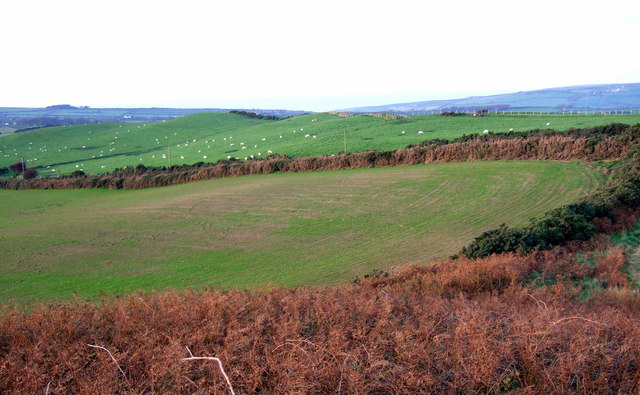


 We would like to know more about this location. Please feel free to add a brief description and any relevant information in your own language.
 Wir möchten mehr über diese Stätte erfahren. Bitte zögern Sie nicht, eine kurze Beschreibung und relevante Informationen in Deutsch hinzuzufügen.
 Nous aimerions en savoir encore un peu sur les lieux. S'il vous plaît n'hesitez pas à ajouter une courte description et tous les renseignements pertinents dans votre propre langue.
 Quisieramos informarnos un poco más de las lugares. No dude en añadir una breve descripción y otros datos relevantes en su propio idioma.